Wellness Loyalty Programs: How to Reward Healthy Habits
Wellness loyalty programs reward customers for healthy behaviors, not just purchases. Members earn points, perks or status for actions like reaching step goals, buying more fruit and vegetables, or maintaining a weekly routine. The goal is to make the program part of a customer's daily life, so engagement lasts long after the sign-up bonus is spent.
That matters because most loyalty programs have an engagement problem more than an enrollment problem. Signing members up is easy, but keeping them active in month three, when the welcome offer is gone and the emails get ignored, is hard.
According to Euromonitor, 63% of the top 100 global loyalty brands underperform on engagement.
White Label Loyalty's analysis of 3.5 million members across 23 programs points the same way: what members do in their first 90 days strongly predicts whether they're still active in months four to six.
Wellness gives members a reason to come back that a discount can't: progress on something they already care about. Here's how the leading programs work, what the evidence says, and how to build one.
What is a wellness rewards program?
A wellness rewards program is a loyalty program that ties earning and rewards to health-related behaviors as well as spending. A traditional loyalty program asks, "How much did you buy?", while a wellness loyalty program also asks, "What did you do?"
These are the main differences:
- What earns rewards: verified activity, healthy purchases, completed challenges, check-ins and streaks, alongside transactions.
- What members get: experiences, coaching, partner perks and progress milestones, not only discounts.
- How often members engage: daily or weekly, because habits happen daily, instead of only when they shop.
This is a form of behavioral loyalty: the program rewards the actions that build a relationship, not just the revenue that results from it. Despite the name, it isn't only for health brands. Retailers, hotels, banks and insurers can all reward healthy habits that fit their customers' lives. For care providers specifically, see our guide to loyalty programs in healthcare.
Why are wellness loyalty programs growing now?
Wellness has become one of the largest and most resilient categories of consumer spending. The Global Wellness Institute valued the global wellness economy at $6.8 trillion in 2024 and projects $9.8 trillion by 2029, growing 7.6% a year.
Consumer priorities point the same way. In McKinsey's Future of Wellness survey of more than 10,000 people in the US, UK, Germany and China, two in three US consumers said they prioritize wellness more than they did a year ago.
Wellness spending also holds up when money is tight: only 21% of US adults would cut it if their finances worsened, per an ICSC report cited by eMarketer.
For loyalty teams, that combination is rare. Wellness is something customers want help with, and it creates natural reasons to engage between purchases.
6 models of wellness loyalty programs
Most wellness loyalty programs follow one of six models. They can be combined, and none requires a brand to become a health company.
Model | How members earn | Example | Best fit |
| Behavioral incentives | Verified activity from wearables or gym visits | Vitality Active Rewards | Insurers, financial services |
| Healthy-basket challenges | Personalized targets on healthy purchases | Sainsbury's Nectar Great Fruit & Veg Challenge | Grocery, convenience, QSR |
| Activity-to-points partnerships | Recorded hikes, runs or rides via a partner app | Marriott Bonvoy × Outside | Travel, hospitality, retail |
| Data-led personalization | Health dashboards linking receipts and wearables | FamilyMart | Convenience, pharmacy |
| Coaching and paid tiers | Access to experts as a member benefit | Kroger OptUP | Grocery, subscription brands |
| Gamified quests | Walking challenges, quizzes, badges and XP levels | Biscuit | Apps, pet care, consumer brands |
Behavioral incentives. Vitality rewards insurance members with weekly perks, like a coffee or cinema ticket, for hitting activity goals. Its Apple Watch benefit adds loss aversion: members pay a small upfront fee, then earn their monthly payments down to zero by staying active.
Healthy-basket challenges. Sainsbury's sets each Nectar member a fruit and vegetable target based on their own typical shop, with bonus points for hitting it. In one year, participants bought more than three times as much fruit and veg as non-participants. Tesco runs a similar Clubcard scheme.
Activity-to-points partnerships. In May 2026, Marriott Bonvoy and Outside launched a program that lets members who link their accounts earn 50 points for each hike, run or ride they record during stays at participating outdoor hotels in the US and Canada, up to 5,000 points a year.
Data-led personalization. FamilyMart built a health dashboard that links e-receipts with wearable data. Euromonitor reports its monthly active users grew from 656,900 in Q1 2025 to 997,400 in Q4 2025.
Coaching and paid tiers. Kroger includes free virtual nutrition coaching for its Plus members through OptUP. The reward is expertise, which is hard for competitors to match on price.
Gamified quests. Biscuit, a UK pet well-being app powered by White Label Loyalty, rewards dog owners for meeting breed-specific exercise goals. Members join walking challenges, take quizzes and collect badges to earn XP; reaching 100 XP in a skill unlocks new levels and rewards. In its first nine months, Biscuit passed 50,000 registered users, who walked more than 950,000 miles and completed over 350,000 daily activity goals and 60,000 weekly challenges.

Do wellness rewards programs work?
Well-designed wellness rewards programs change behavior, while generic ones mostly don't. The research is clear on both sides.
The case for. A RAND Europe study tracked 422,643 Vitality members in the UK, US and South Africa from 2015 to 2018. Members on the loss-framed Apple Watch benefit logged 34% more activity days per month, about 4.8 extra days.
A separate peer-reviewed UK study of nearly 12,000 Vitality members, written by Vitality researchers, found weekly short-term rewards raised activity sharply and sustained it for two years, with the biggest gains among the least active.
Retailers also benefit: a study of more than 268,000 loyalty-card customers at a Croatian supermarket chain found a fruit and vegetable reward program increased fruit and vegetable spending. Among members who redeemed a reward, spending on other food categories rose too, and the lift persisted after the program ended.
What our own data shows: in White Label Loyalty's study of 3.5 million members across 23 loyalty programs, a first reward members earned through their own activity lifted their odds of staying active by 31 percentage points. A first reward funded by a sign-up bonus lifted them by just 6.
Members who returned on four or more days in their first month had a 24-point retention edge over one-day visitors. The findings are correlational, but they point the same way as the trials: rewarding repeated actions beats handing out freebies.
The case against. Workplace wellness incentive programs show what fails. In a randomized trial at BJ's Wholesale Club, employees were offered wellness classes with small gift-card rewards. After 18 months, two of 29 self-reported behaviors improved, with no measurable effect on clinical health, healthcare spending or absenteeism. A University of Illinois trial found similar results.
The lesson: occasional, one-size-fits-all rewards for attending a class don't build habits. Personalized targets, frequent rewards and smart framing do.
How to build a wellness loyalty program
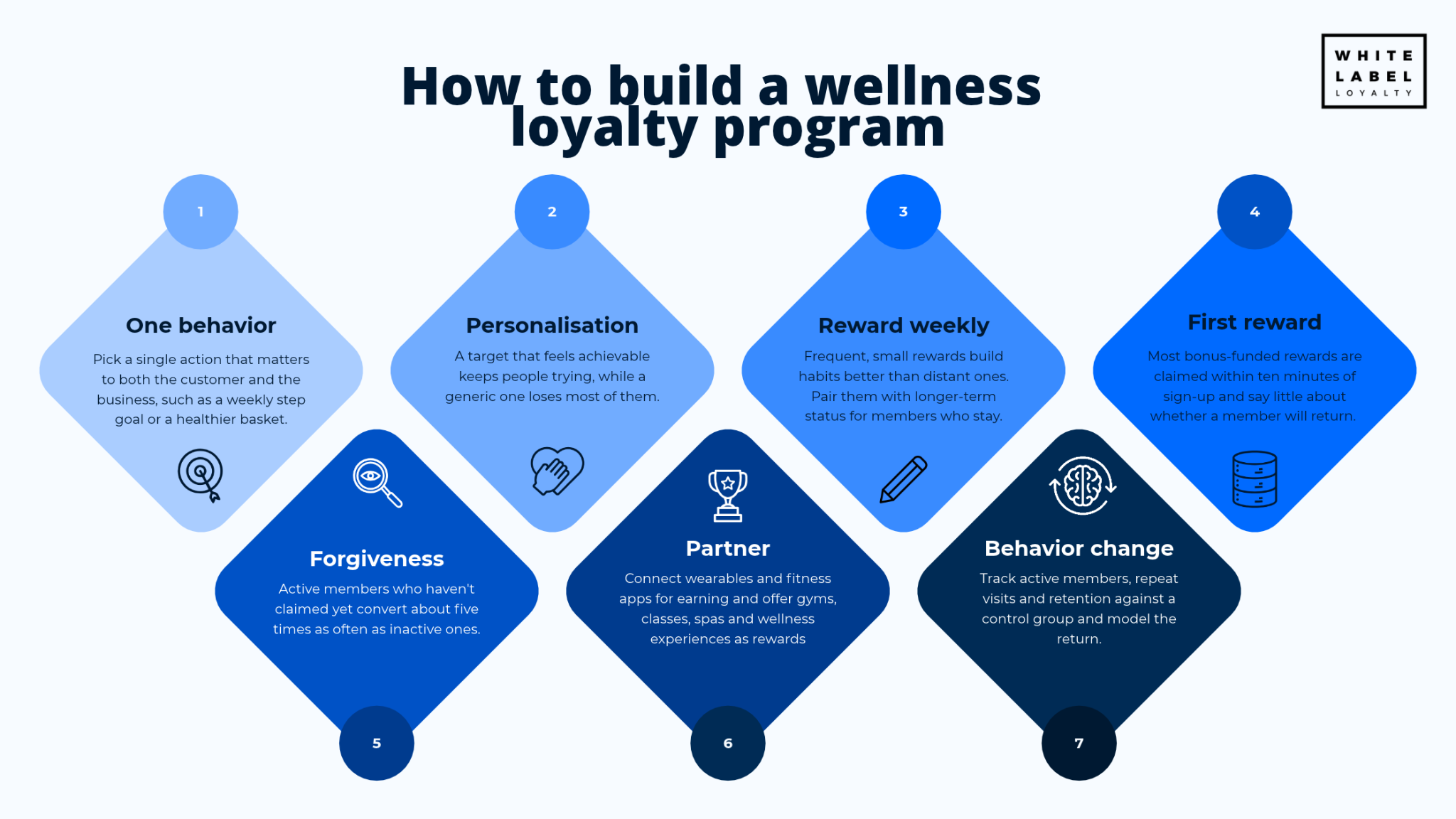
The programs that work share seven design choices: the idea is to use these as a sort of checklist if your aim is a successful wellness loyalty program.
- Start with one behavior. Pick a single action that matters to both the customer and the business, such as a weekly step goal or a healthier basket. Prove it works before adding more.
- Personalize the target. Set goals against each member's own baseline, as Sainsbury's does. A target that feels achievable keeps people trying, while a generic one loses most of them.
- Reward weekly. Frequent, small rewards build habits better than distant ones. In White Label Loyalty's research, each extra return day in a member's first month added about 5 percentage points to retention, up to around six days. Pair them with longer-term status, levels or gamified features for members who stay. Biscuit pairs weekly walking challenges with XP levels in exactly this way.
- Make the first reward earned. Skip the big welcome bonus: most bonus-funded rewards are claimed within ten minutes of sign-up and say little about whether a member will return. Set a first reward members can reach through a week or two of healthy activity instead.
- Build in forgiveness. Vitality South Africa offers a "Rest Week" after 25 consecutive active weeks, so members can pause without losing their streak. One bad week shouldn't end the relationship. Late starters count too: only 43% of first rewards are claimed within 90 days, and active members who haven't claimed yet convert about five times as often as inactive ones.
- Partner instead of building. You don't need to become a fitness brand. Connect wearables and fitness apps for earning through integrations or a loyalty API, and offer gyms, classes, spas and wellness experiences as rewards through a rewards marketplace.
- Measure behavior change. Track active members, repeat visits and retention against a control group with loyalty analytics, and model the return with an ROI calculator. A high redemption rate can mean strong engagement, or rewards that are simply too generous.
Health data, privacy and consent in wellness loyalty programs
Wellness programs collect sensitive signals, so privacy has to be designed in from day one. The rules differ by market:
- UK and EU: GDPR Article 9 treats health data as "special category" data, which requires explicit, separate consent. Context matters. A step count alone may not count as health data, but step counts linked to a weight-loss plan or a health condition usually do. The safe default is to treat wearable health metrics as special category data and run a Data Protection Impact Assessment before launch.
- US: state consumer health data laws, such as Washington's My Health My Data Act, and California's CCPA rules on financial incentives can apply. HIPAA may apply depending on who runs the program and how data flows.
In every market, collect only what the program needs, explain the value exchange in plain language, and make it easy to opt out. Trust is the product: a privacy misstep will undo the goodwill the program was built to create.
Turning wellness into lasting loyalty
The strongest wellness loyalty programs work because they add a reason to engage on the days customers aren't buying. With flexible earning rules, wearable and app integrations, and a rewards marketplace of wellness experiences, any brand can start with one behavior and grow from there.
See how Biscuit reached 50,000+ users in nine months, explore our gamification solutions, or talk to White Label Loyalty about designing yours.
Frequently Asked Questions (FAQs)
Recommended Posts
If you enjoyed this article, check out these relevant posts below.
Twelve Loyalty Campaigns You Can Build in an Afternoon
Loyalty Program Architecture: 5 Decisions for Enterprise Scale
2027 Marketing Calendar: Key Dates for Loyalty Campaigns
Share this Article

Sara Rabolini
Senior Content Marketing Executive
Sara is our Senior Content Marketing Executive. She shares engaging and informative content, helping businesses stay up-to-date with the latest trends and best practices in loyalty.
Post Tags