How to Modernise Bank Rewards in 2026
Banks have spent decades building loyalty programs but most customers still don't feel particularly loyal. Deloitte's research shows that only 19% of banking customers count as "truly loyal," despite institutions spending roughly £150 per customer on rewards in the first year alone.
That gap can be mostly attributed to infrastructure: most bank rewards programs sit on top of a core banking system that was never designed to support real-time, personalised decisions. This limitation is becoming harder to hide as customers get used to Amazon, Spotify and fintech apps responding to their behaviour in real time.
The problem comes down to four recurring issues, and modernising rewards means addressing each of them.
Why banks struggle with loyalty personalisation
The short version: the technology sitting underneath most bank rewards programs wasn't built to run personalisation in real time, so even banks with genuinely good rewards ideas can’t reach the customer they're designed for when they're most relevant.
A few specific issues keep showing up.
1. Customer data is scattered across systems that don't talk to each other
Transaction history sits in one system, product holdings sit in another, app and branch activity sit somewhere else again. Without a single customer view, "personalisation" turns into a best guess rather than something the bank can actually act on.
2. Legacy cores run on batch, not real time
Even when a bank does have the data, a lot of personalisation logic still runs on overnight batch jobs sitting on top of a legacy mainframe. That's a real constraint: as Tredence's research on banking personalisation points out, this kind of architecture generally can't support the sub-100 millisecond decision making that a genuinely real-time offer needs.
So by the time the offer reaches the customer, the moment it was relevant to has already gone.
3. Compliance gets treated as a blocker instead of a design requirement
Banks have to be able to explain why one customer got a different offer to another: that's a fair lending requirement, not red tape for its own sake.
But when a rewards program is built without that explainability from the start, it tends to get stuck in legal review rather than reaching production, and teams start avoiding personalisation altogether to sidestep the conversation.
4. Rewards get filed under "cost" rather than "growth"
Finance teams often see loyalty spend as pure cost because attribution is genuinely hard. It's difficult to prove a customer stayed because of the rewards program rather than simple inertia.
That uncertainty makes it harder to build the case for investing in something better, so banks end up patching the same ageing system year after year instead of replacing it.
The result is an industry where only 29% of banks say personalisation is genuinely part of how they operate, even though most customers now expect to be rewarded for their loyalty in a way that feels relevant to them specifically, not just handed a generic points catalogue.
How to modernise a legacy bank rewards program
For banks, modernising rewards in 2026 starts with the infrastructure behind the program.
Move from single-product rewards to rewarding the whole relationship
Most rewards programs are still built around one product, usually the credit card, when the real opportunity is rewarding the full relationship and recognising that different customers want different things from it.
Wesleyan, one of the UK's longest-standing financial services providers, ran into exactly this problem. Its members are mostly doctors, teachers and other professionals, and a single generic rewards catalogue wasn't going to cut it.
We built two things instead: Wesleyan Wallet, a card-linked cashback app for everyday spending at retailers like John Lewis and Marks & Spencer, and Wesleyan Rewards, a separate program reserved for their highest-value members with one exclusive reward a year.
Same institution, two rewards experiences, each matched to what that segment of the relationship actually wanted. The result was a 68% redemption rate and 96% of customers saying they were happy with the reward choices on offer.

Put an engagement layer on top of the core, don't try to rebuild it
Replacing a core banking system simply to modernise loyalty isn't realistic for most institutions. An API-first engagement layer can provide the same flexibility without requiring the core itself to be replaced.
This is exactly the gap our loyalty engine is built to close: it plugs into a bank's existing systems and runs rewards logic on live events (a card swipe, an app login, a referral) instead of waiting for a batch job to catch up.
Build the audit trail in from day one
If a regulator asks why customer A got a better offer than customer B, "the algorithm decided" isn't an answer anyone can use. Rules-based logic with a clear, exportable audit trail needs to be part of the rewards engine itself, not something bolted on after compliance flags it.
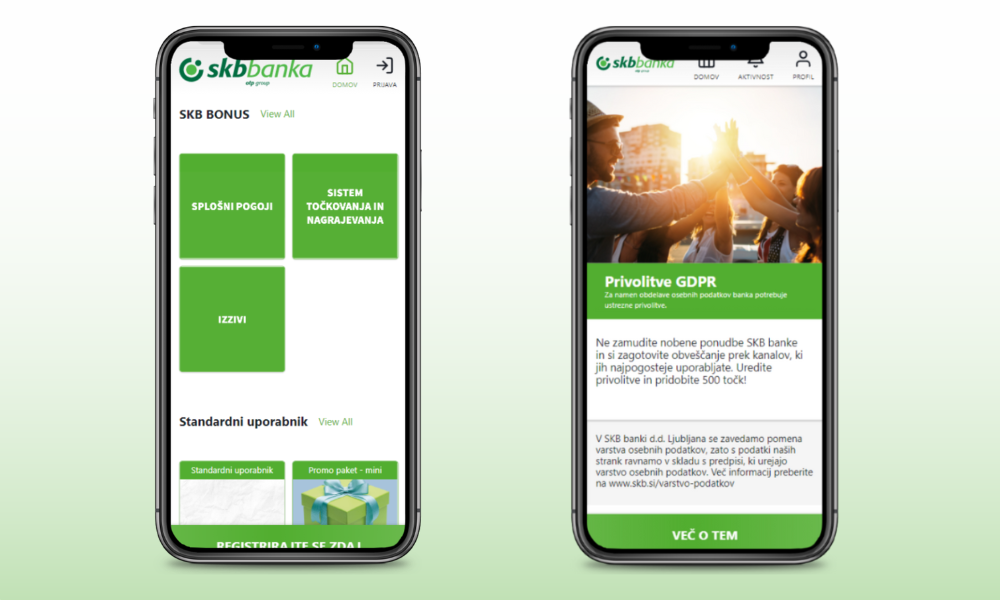
It's one of the reasons banks like SKB Bank chose an event-based loyalty engine over building their own: the logic behind every reward is visible and traceable from day one.
Prove the ROI instead of assuming it
Treat rewards investment like any other growth experiment: give one segment a personalised offer, hold a matched group back, and measure the actual difference in spend and retention.
When SKB Bank, part of the OTP Group, piloted a gamified rewards program with White Label Loyalty, the results were measurable within months: a 188% increase in Flik payment transactions, a 17% jump in app activations, and over 30% of participants updating their GDPR consent along the way.
Evidence like this makes it much easier to position rewards as a measurable growth channel rather than a discretionary cost.

Launch on a platform built for this, not a five-year IT roadmap
Building real-time personalisation from scratch would require significant changes to the legacy core: an expensive and time-consuming process for most banks.
A white-label, API-first loyalty platform sidesteps that: tiers, partner rewards, referral mechanics and redemption catalogues can go live in weeks rather than years, because the integration work of connecting to the core, the card processor and the mobile banking app is handled once, not rebuilt every time the institution wants to launch something new.
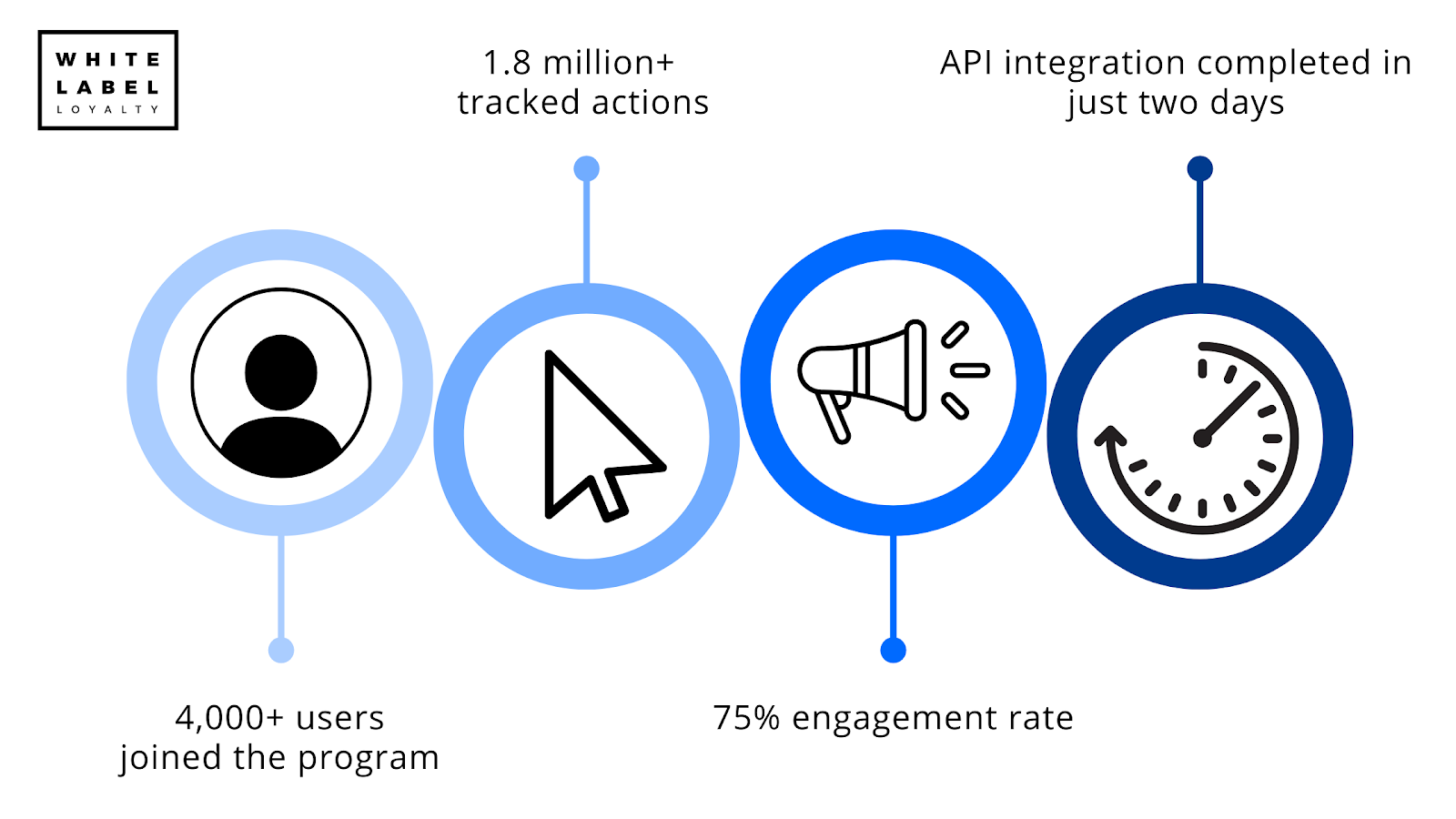
One US fintech serving over 18 million users proved just how fast this can move. Rather than build a rewards system in-house, its team plugged our Loyalty API directly into their financial product comparison tools, an integration that took two days.
From there, the program tracked real user behaviour (on-time payments, new product approvals, financial literacy modules) and issued points automatically against rules they set themselves.
The whole thing went from kickoff to live program in three months, reached over 4,000 users, and logged more than 1.8 million tracked actions at a 75% engagement rate. The result is a much shorter path from integration to launch, without committing the bank to a multi-year IT program.
Let AI act on the data, not just report on it
Leading banks are moving beyond automated point calculations and using AI to identify churn risks and engagement opportunities earlier.
Our Lifecycle Intelligence module, for instance, is built to spot early churn signals in a customer's behaviour and trigger a retention offer automatically, before that customer starts shopping around. That shifts loyalty from simply rewarding past behaviour to influencing what a customer does next.
The bottom line
Modernising bank rewards in 2026 starts with the infrastructure behind them: banks need unified data, real-time decisioning and an audit trail that can stand up to compliance scrutiny before they can deliver meaningful personalisation at scale.
Banks that solve the infrastructure problem are moving toward relationship-wide, AI-driven loyalty. The ones that don't are still patching single-product programs on batch processing, and losing engagement to competitors who got there first.
If you're weighing up whether to rebuild in-house or launch on a platform that already does this for banks and financial institutions like Wesleyan and SKB Bank, book a demo and we'll show you what it looks like on your own data.
For a broader look at the fundamentals, see our guide to building customer loyalty in the banking industry, or how fintechs approach loyalty if you're building for a digital-first audience.
Frequently Asked Questions (FAQs)
Recommended Posts
If you enjoyed this article, check out these relevant posts below.
Share this Article

Sara Rabolini
Senior Content Marketing Executive
Sara is our Senior Content Marketing Executive. She shares engaging and informative content, helping businesses stay up-to-date with the latest trends and best practices in loyalty.