2027 Marketing Calendar: Key Dates for Loyalty Campaigns
Do you ever feel like planning marketing and loyalty campaigns for next year is mostly copy-paste? Take this year’s calendar, shift it along, fight about budget, done.
That works, until it doesn’t: dates move, weekends land badly (and you’re bound to forget about that bank holiday on the day of your newest campaign launch), two events that sat comfortably apart end up stacked.
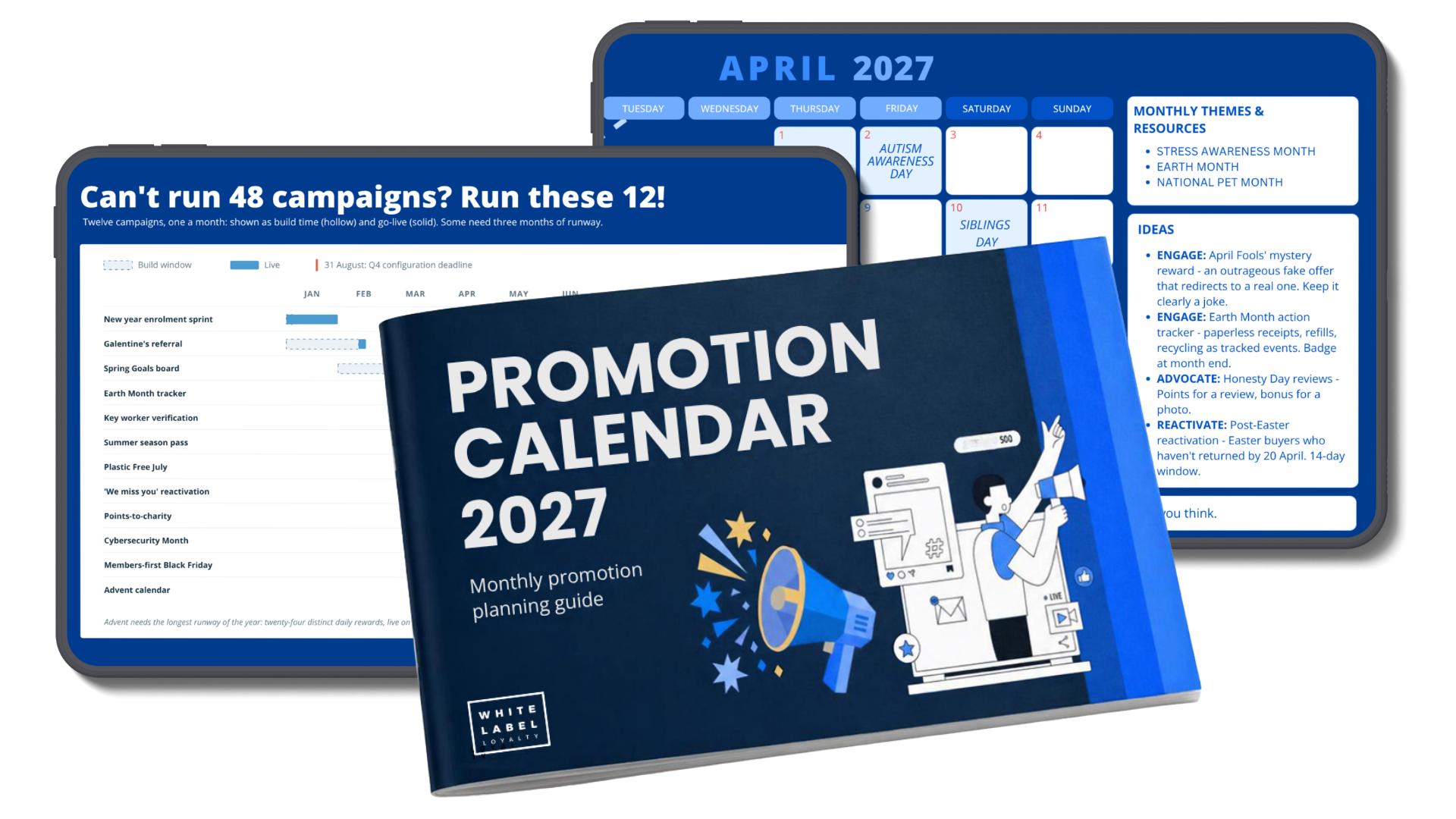
We’ve done the work for you. Our free 2027 Loyalty Promotion Calendar has 126 key dates and 48 campaigns you can actually run - four for every month, each with a lead time telling you when to start building.

Six dates to keep in mind for 2027
None of these are complicated or new, but they’re very much cheaper to know in October than to find out in March when it’s already too late.
1. March is the busiest month of the year
Easter Sunday falls on 28 March 2027, which is a little over a week earlier than this year and more than three weeks earlier than 2025.
On its own that’s a minor scheduling note, but it collides with UK Mothering Sunday on 7 March to give you two significant gifting peaks exactly three weeks apart inside a single month. Add International Women’s Day on the 8th and Eid al-Fitr falling around the 9th, and March 2027 is busier than any other month in the year by a comfortable margin.
The practical consequence is that if your spring campaigns normally get built in March, you’ve already missed both peaks before you start.
- Mothering Sunday needs to be in build by late January.
- Easter by the middle of February.
- Anything with a mechanic sitting behind it needs longer still, because it has to be configured and tested before a customer ever sees it.
April thins out, because everything that would ordinarily sit in the first fortnight has been dragged forward into March, which leaves you short of momentum at exactly the point you want to be building into Q2.
2. Black Friday gives you more room.
Thanksgiving is on 25 November 2027, making Black Friday the 26th and Cyber Monday the 29th. That leaves 29 days to Christmas Day, which is the most breathing room you’ll have had since 2023.
The risk is what a longer window tempts you into: given room, most brands stretch the discount period to fill it, and a four-week Black Friday does real damage to the margin you were relying on to carry full-price gifting through December.
The better use of the extra days is to keep the sale short and spend the recovered time on the gifting window instead, where you’re selling at full price to people with high intent.
If you run a loyalty program, this is also the year to lean on members-only early access: opening 24 hours ahead of the public sale lets you start the peak a day early without extending the discount period at all, and it brings in sign-ups and not simply handing over margin.
3. Christmas Day is a Saturday
Christmas falls on Saturday 25 December with Boxing Day on the Sunday, which makes the last true shopping weekend the 18th and 19th and leaves Christmas Eve on a Friday. The run-in is softer than usual as a result.
Most brands simply go quiet through that stretch, which seems like a strange decision when your members have time on their hands and almost nothing competing for their attention.
Gift card redemption, points top-ups, pre-orders for January, or a simple year-in-review summary: plenty of ideas you can use to channel the holiday season (and you’ll find plenty more in our free calendar!)
4. Valentine’s Day and Halloween both fall on Sundays
Valentine’s Day is Sunday 14 February, which pushes spending towards experiences rather than objects: think meals out, days out, things done together rather than panic-bought on the commute home.
It also shifts weight onto the Friday and Saturday before rather than the day itself: bundled rewards tend to work better than straight discounts here, because the purchase is already emotional rather than price-led.
Galentine’s Day on the 13th is a Saturday this year: a referral campaign built around friendship, running a full day ahead of everyone else’s Valentine’s messaging, on a day when people are already out with their friends, is a considerably easier slot to win than competing head-on for attention on the 14th.
Halloween lands on Sunday 31 October, which skews it towards families and in-store, daytime rather than evening, with the whole weekend available instead of the single weekday you’d get in other years.
5. Ramadan runs across Chinese New Year
Ramadan runs from roughly 8 February to 9 March 2027, with Eid al-Fitr falling around the 9th, though the exact dates depend on moon sighting and vary by region, so it’s worth holding those loosely until closer to the time.
That window covers Chinese New Year on the 6th, the Super Bowl on the 7th and Valentine’s Day on the 14th, which gives you four culturally distinct moments stacked inside about five weeks.
If a meaningful share of your customer base is Muslim, treating February as a single undifferentiated promotional period is going to land badly, particularly where food and drink messaging goes out during fasting hours.
The solution is unglamorous but effective: segment properly, and start early, because segmented campaigns take noticeably longer to build than general ones.
6. Chinese New Year is on a Saturday
Chinese New Year is Saturday 6 February 2027, beginning the Year of the Fire Goat, with the Lantern Festival following on the 20th. Saturday placement helps, since it gives you the full weekend rather than a weekday most of your customers will spend at work.
A campaign that opens on the 6th and resolves at the Lantern Festival has time to build, which suits anything cumulative: a collect-and-unlock mechanic or a reward that gets better the longer someone stays with it.
Most brands treat Chinese New Year as one day of themed messaging and miss the structure that’s already there.
Want the rest?
Those are just six of them, the other 120 are in our free 2027 Loyalty Promotion Calendar, along with 48 campaigns you can actually run: four for every month, each tagged by what it moves, each with a lead time telling you when to start building.
Free, no strings attached - download it now!
Recommended Posts
If you enjoyed this article, check out these relevant posts below.
Share this Article

Sara Rabolini
Senior Content Marketing Executive
Sara is our Senior Content Marketing Executive. She shares engaging and informative content, helping businesses stay up-to-date with the latest trends and best practices in loyalty.