Loyalty Platform Buyer's Guide 2026: 10 Must-Have Features
Short version: if you're wondering what to look for in a loyalty platform, pick one that collects first- and zero-party data, keeps one profile per member, lets your team change rewards without a developer having to do more work, works in real time at the till and online, and can show you what the program actually adds to revenue.
The 10 sections below go through each of these, and there's a scoring table at the end you can use in an RFP.
Why the platform choice matters more in 2026
Most loyalty platforms can issue points, but fewer can tell you who your members are, what the program adds to revenue, or how quickly you could launch a new tier without any more work. This article is built around those questions.
The 2026 Bond Loyalty Report found the average American belongs to more than 20 programs and uses about 10 of them (Bond).
Feeling valued has been the top reason people stay loyal for four years running, but fewer than a third of members say their programs manage it. When members feel valued, Bond measured 2.9 times the spend and 2.4 times the retention.
We've grouped the 10 capabilities by what they do for you: capturing data (1 to 3), keeping customers (4, 5, and 9) and running the program across channels at scale (6 to 8 and 10).
In this guide:
- Zero- and first-party data capture
- A unified member profile and CDP sync
- Consent, privacy and AI governance
- A flexible rules and rewards engine
- Personalisation and AI with human control
- Real-time omnichannel delivery
- API-first, composable architecture
- Proven scale and multi-market support
- Emotional loyalty, community and partners
- Time to value and total cost of ownership
1. Zero- and first-party data capture designed into the program
Ask members for information and reward them when they give it.
- Zero-party data is what people tell you directly, like their size, their dog's name or when they plan to buy.
- First-party data is what you see them do: purchases, visits, redemptions. You need both, on the same profile.
Plenty of programs have years of transaction history and very little else, so the offers stay generic.
A longer sign-up form it’s not necessarily the right fix: it works better to ask one or two questions at a moment when the member can see why you're asking, and then change what they see straight away (The Wise Marketer).
When you assess a platform, check that:
- you can reward actions that aren't purchases, such as completing a profile, answering a poll, writing a review, referring a friend or uploading a receipt
- it can ask for the next missing piece of profile data at the next touchpoint, without repeating questions
- members have a preference centre they can find and edit, and their changes land on their profile
- a shopper who starts anonymously (guest checkout, a QR code at the till) can be linked to a member later with their history intact
- your team can add custom fields and use them in rules and segments without raising a ticket
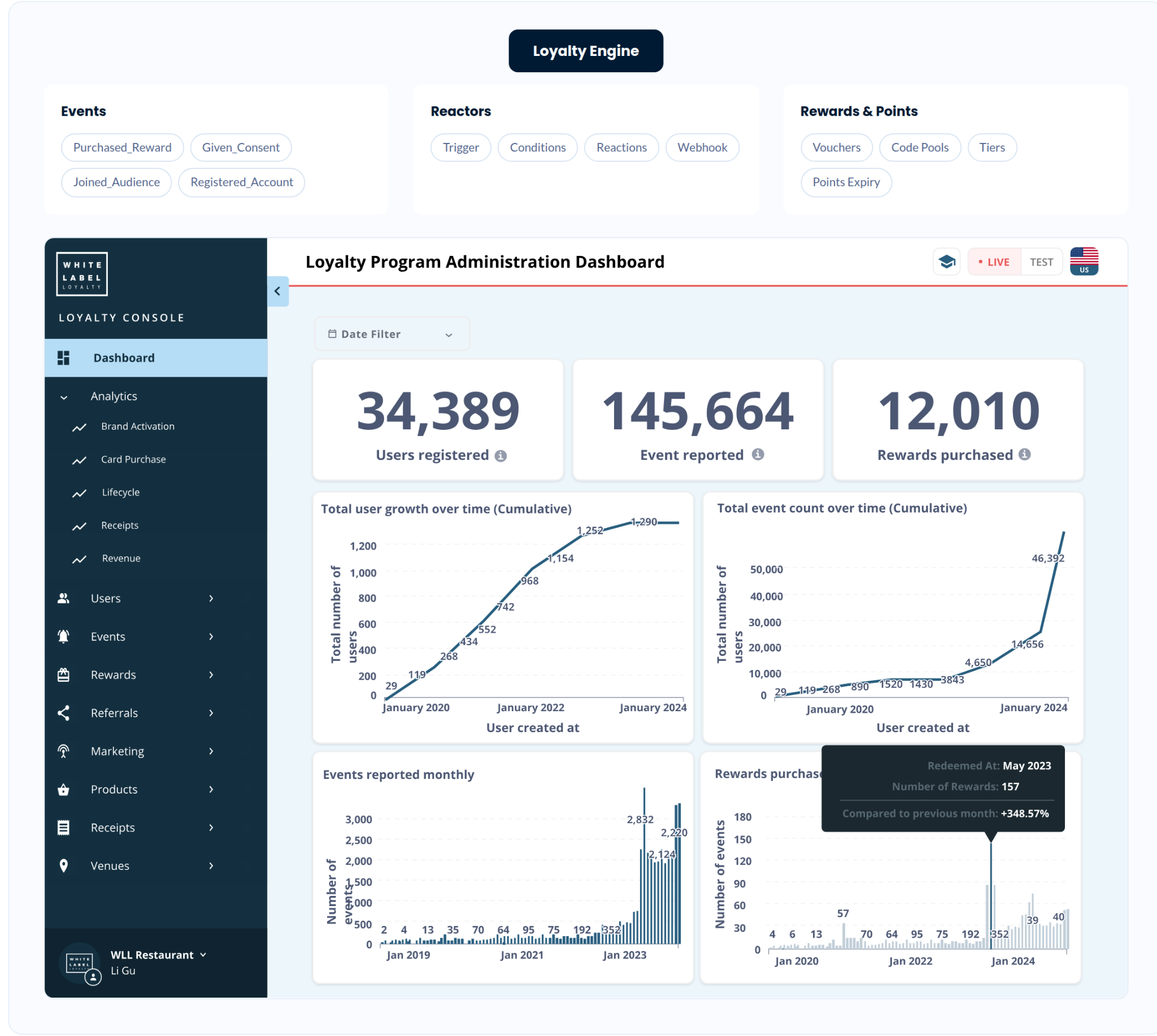
White Label Loyalty’s engine can reward purchases, referrals, feedback, geofence entries, social media engagement or any custom event you define.
2. A unified member profile that plays well with your CDP
Data only helps if every purchase and click ends up on the same member record, and that record is shared with the rest of your stack. Decide early which system owns identity, whether the loyalty platform, or a CDP that the platform syncs with.
If records aren't joined up, someone who buys in store, earns points and browses online shows up as three different people, and the loyalty platform never sees the online basket (Lexer).
Things to check:
- the member ID can be used as a matching key alongside email and phone number
- merging two profiles keeps the full points history
- events stream out in real time (webhooks or an event bus) to your CDP, email platform and data warehouse, and updates can flow back in
- there are ready-made connectors for the CRM and CDP you already use
- your service team can see the whole member timeline, including earns, redemptions, tier changes and consents
White Label Loyalty connects to CRM, ERP, ePOS and ecommerce systems with real-time sync, including integration with Salesforce, HubSpot, Microsoft Dynamics, SAP S/4HANA, Klaviyo, Shopify and many more.
3. Consent, privacy and AI governance
You can only use customer data you were allowed to collect, and you need to be able to prove it: the platform should store consent by purpose and by channel, and be ready for the new rules on AI.
Regulators see loyalty programs as a trade of benefits for data: under California's CCPA rules, for example, a program like this needs a notice of financial incentive, and GDPR requires a lawful basis for any profiling.
The EU AI Act added transparency duties under Article 50 from 2 August 2026: people must be told when they're talking to an AI system such as a chatbot, certain AI-generated content has to be labelled, and fines go up to €15 million or 3% of global turnover (Cooley).
On the checklist:
- timestamped consent records for marketing, profiling and data sharing, which rules and exports respect automatically
- export, correction and deletion requests handled in the platform, points and transaction history included, with an audit trail
- a choice of hosting region (EU, US, UK) and a published list of sub-processors
- SOC 2 Type II or ISO 27001 reports, PCI DSS scope if card data is involved, and single sign-on with role-based access for staff
- AI features that tell members they're automated and keep a log of what they did
- fraud controls such as velocity limits, duplicate-account checks and rules on transferring points
4. A flexible rules & rewards engine that goes beyond points
Your program will change several times over the life of the contract, and the engine needs to let you launch a new mechanic without moving platforms.
Points per pound spent is the minimum now: if you take a look at the best loyalty programs of this year, it’s clear that people stay for tiers, access, experiences and rewards they can use straight away.
Loyalty360's 2026 State of Customer Loyalty report found 63% brands had updated rewards in the past year and 64% planned to add new options, with travel, events and exclusive access at the top of the list (360 Magazine).
More brands are also adding a paid tier on top of a free program. Baesman's view is that this works when the paid tier offers access and service, and less well when it just offers bigger discounts (Baesman).
What to look for:
- earn rules on any event: product, category, channel, basket size, location, time of day or something custom
- several models running side by side, for example points, stamps, cashback, credits, tiers and a paid membership
- rewards other than discounts, like free products, early access, experiences, partner rewards and charity donations
- challenges, streaks, badges, progress bars and referral mechanics
- earning and spending in real time, including paying partly with points at checkout
- scheduling, versioning and a sandbox, so a campaign can go live on Friday and be rolled back on Monday
In our Loyalty Console, marketers write their own rules and campaign logic, segment members, build tiers, badges and achievements, and choose from thousands of rewards.
5. Personalisation and AI that act on loyalty data, with a human in control
Every vendor talks about AI now, so judge it on results: does it pick a better offer for each member, and can your team see why it chose that offer and change it?
Forrester's Q3 2025 report on loyalty platforms named AI the biggest disruptor in the category, pointing to real-time personalisation, predictive analytics and automated journeys (Forrester).
Still, it’s clear that there’s plenty of room to improve: the 2026 Bond Loyalty Report found only 20 to 30% of members ever get the personalised offers, surprises or recognition that make them feel valued (Bond).
Loyalty data is also a sensible place to start with AI, because it's consented and tied to things you can measure, such as repeat purchases and redemptions.
Look for:
- scores on every member for churn risk, likely next purchase, predicted lifetime value and likely tier movement
- next-best-offer logic that can choose between points, access and discounts for each member, within margin limits you set
- segment and campaign building in plain language, with the resulting rule shown to you before it runs
- an explanation of why each member got an offer, and a human approval step before automated actions go out
- holdout groups built in, so you can measure the uplift (more on this in section 9)
- a straight answer on which models are used, where data is processed and whether your data trains anyone else's model
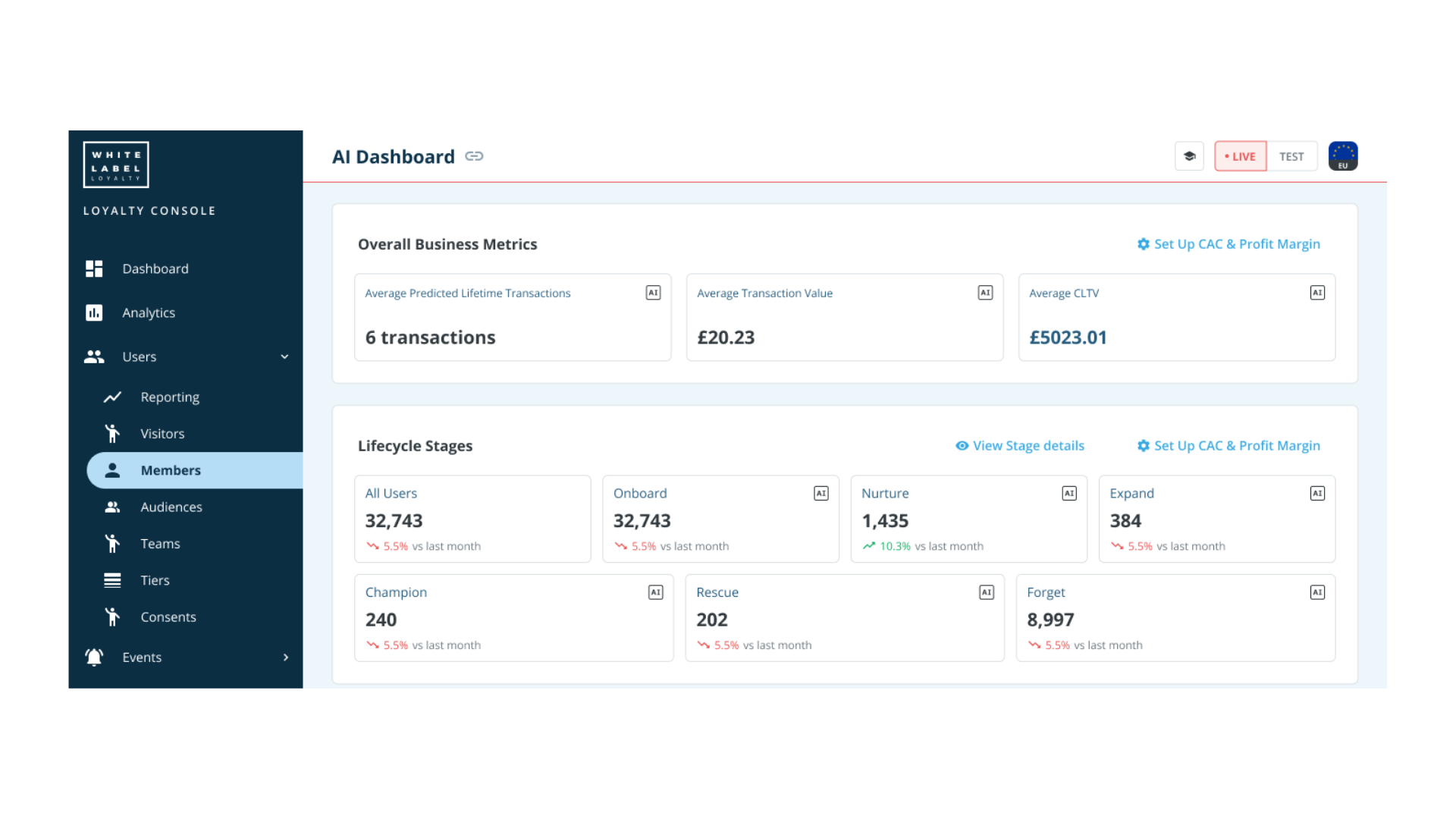
Our Lifecycle Intelligence (AI) module scores each member's churn probability and predicted lifetime value every day and places them in one of six journey stages: Activate, Engage, Grow, Champion, Rescue or Lapsed. Teams can then tailor offers to each stage without needing a data science team.
6. Real-time omnichannel delivery
Members judge a program at the till and at checkout: the platform has to recognise them, let them earn and redeem in real time on every channel, and show the same balance wherever they look.
Redemption is where most of the friction is: in the Canadian data from the 2026 Bond Loyalty Report, the share of members rating easy claiming of rewards as important rose from 69% to 73% in a year (The Wise Marketer).
Wallet passes help, because Apple Wallet and Google Wallet are already on the phone and nobody has to download an app.
Check for:
- integrations with the POS systems you actually run, covering member lookup, earning, redeeming and showing offers at the till, plus a fallback for when a store goes offline
- ecommerce plug-ins or SDKs, and a headless option for custom storefronts
- Apple and Google Wallet passes that update balances and tiers as they change
- mobile SDKs or widgets, so your app team isn't rebuilding loyalty screens from scratch
- receipt scanning or card linking for sales through channels you don't control, such as retailers, marketplaces and delivery apps
- earn and redeem APIs that respond in under a second, with a stated latency figure at peak
At White Label Loyalty, members are recognised through ePOS and ecommerce integrations, receipt scanning, QR codes and card linking. Brands can launch a branded React Native app for iOS and Android, with push notifications and geolocation or a loyalty microsite.
If you sell through retailers, our guide to building loyalty without a direct customer relationship explains how that works.
7. API-first, composable architecture with a real integration ecosystem
The loyalty engine should run as its own service, with every channel and system talking to it through documented APIs and events. That's what lets you add a channel, change your CRM or start a partner program without replacing the platform.
In this set-up, channels call the engine in real time and the engine sends every member event back out, so no other system keeps its own copy of points or tiers.
Points calculation, redemption and everything else is available through an API, and the engine runs separately from your commerce platform, CMS and CRM, so you can change one without breaking the others.
A purely headless engine has no front end, so someone has to build the member experience: for most brands the practical answer is an API-first engine that also comes with white-label front ends you can configure.
What to check:
- public, versioned API documentation you can read before signing, with a sandbox and SDKs
- webhooks or an event stream for every member event: earns, redemptions, tier changes, consent changes
- working connectors for your POS, ecommerce, CDP, email, CRM, data warehouse and payments, with clients using them in production
- an optional white-label web app or widgets, so you can launch quickly and go fully headless later
- outside certification, such as MACH Alliance membership, if your architecture team cares about it
- a full export of members, ledgers and history in a standard format if you ever leave
White Label Loyalty is API-first, with 3,000+ ready-made integrations and a developer portal with a sandbox. More than that, product teams can build on Dynamo, our headless loyalty API, by accessing our loyalty API for 14 days at no cost.
8. Proven scale, uptime and multi-brand, multi-market support
A program that works for 50,000 members in one country can fall over at 5 million across ten. Buy for where you expect to be in three to five years, and ask the vendor to prove it.
Ask about:
- the SLA (99.9% or better), service credits, a public status page and the incident history
- load-test results at your expected peak, in transactions per second and p95 latency for earning and redeeming
- auto-scaling and failover across regions
- running several brands, banners or franchises under one account, each with its own rules and branding, with shared or separate member pools
- currencies, languages and time zones, plus local tax and expiry rules
- permissions that let a market team run local campaigns without touching global settings
Our platform serves over 5.7 million end-users in more than 20 countries and 25 industries, and has processed over 130 million loyalty events.
Ravensburger shows what this looks like in practice: the toy and puzzle maker relaunched its loyalty program on our platform across 11 markets in six months, with a microsite, translated content and reward catalogue for each country, and points earned in local currency.
Members earn and redeem both in store and online, and can pay partly or fully with points at checkout. In its first year the program reached a 58% engagement rate and a 20% repeat purchase rate, and Ravensburger plans to roll it out to 20 more countries in 2027.

9. Emotional loyalty: community, partners, gamification and recognition
Discounts bring people back for a sale, but recognition, belonging and access are what keep them when a competitor runs a better one, so look for features that let members do more than spend.
Worth checking:
- partner and coalition support: earning and spending with other businesses, partner reward catalogues and settlement between partners
- referrals, reviews, user-generated content, member events and family or group accounts
- automatic rewards for birthdays, anniversaries and milestones, so nobody has to set up a campaign each time
- options to donate points to charity or earn for sustainable choices
- member status that staff at the till and in customer service can see, so VIPs actually get treated as VIPs
With White Label Loyalty, referrals, feedback and social media engagement can all earn rewards, and tiers, badges and achievements give members something to work towards. Multi-tenant set-ups also support coalition programs across several businesses.
10. Time to value & marketer self-service
A platform with every feature still fails if each change needs a developer, or if the cost grows faster than the program, so keep in mind you also need to judge vendors on how fast you can launch and how much your own team can change without help.
You'll be testing new earn rules, rewards and tiers every quarter. If each of those becomes a change request, the program goes stale, and the business case weakens.
Ask about:
- no-code admin for rules, rewards, tiers, segments and content, with approval steps and an audit history
- a realistic launch plan, with phases, typical weeks to a first version and what you'll need to supply
- tools to migrate members, balances and history from your current program, so nobody's points get reset
- help with program strategy and design as well as technical onboarding, and a named success manager
- clear pricing, including what pushes the cost up (members, transactions, API calls, markets, modules), modelled over three to five years
As an example of launch speed, AkzoNobel went live end to end in 10 days: there's more on this in our guide to launching a loyalty program quickly.
Buyer's checklist: score vendors in one table
Use this table in your RFP and score each vendor from 1 to 5 on each row, based on what you saw in a live demo rather than on slides.
Weight the rows to suit your goals: a program built mainly around data might count rows 1 to 3 and row 9 double. Our article on writing a loyalty RFP covers the rest of the process.
# | Capability | Outcome it drives | Proof to demand | Vendor A (1–5) | Vendor B (1–5) |
| 1 | Zero- and first-party data capture | Data | Marketer adds a rewarded profile question live | ||
| 2 | Unified profile and CDP sync | Data | Merge demo; tier change reaches ESP in seconds | ||
| 3 | Consent, privacy, security, AI governance | Data | Consent history, deletion, SOC 2 | ||
| 4 | Flexible rules and rewards | Retention | New campaign built and tested in sandbox | ||
| 5 | AI personalisation with control | Retention | Offer rationale plus holdout uplift from a live client | ||
| 6 | Real-time omnichannel delivery | Omnichannel | POS, web and wallet journey with timings | ||
| 7 | API-first architecture and integrations | Omnichannel | Public API docs, sandbox, production integration list | ||
| 8 | Scale, uptime, multi-brand and market | Omnichannel | SLA, load-test results, reference at your scale | ||
| 9 | Emotional loyalty and partners | Retention | Partner earn-and-burn and settlement report | ||
| 10 | Time to value | All | Phased plan and three-year cost model |
Frequently Asked Questions (FAQs)
Recommended Posts
If you enjoyed this article, check out these relevant posts below.
Share this Article

Sara Rabolini
Senior Content Marketing Executive
Sara is our Senior Content Marketing Executive. She shares engaging and informative content, helping businesses stay up-to-date with the latest trends and best practices in loyalty.
Post Tags