Mastering Customer Retention: The Role of Loyalty Incentives
Loyalty incentives increase revenue through three leversthey raise purchase frequency, raise spend per customer, and reduce churn. The third is what makes the other two compound: a customer you keep costs nothing to reacquire, so every point of retention you add changes your revenue base for every year that follows.
That's the mechanism. The rest of this article covers what each incentive type actually drives, what it costs you, and how to tell whether yours is working.
What are loyalty incentives?
A loyalty incentive is a reward given in exchange for a customer behaviour you want more of. Points for a purchase, a bonus for a referral, early access for a returning customer, cash back for scanning a receipt.
The important distinction is between an incentive and a discount. A discount lowers your price to win a transaction you might have lost. An incentive gives something in return for a behaviour, which means it can be aimed at things a discount can't touch: reviews, referrals, consent, app installs, showing up between purchases.
How do loyalty programs increase customer retention and revenue?
Lever 1: purchase frequency
Members buy more often, because a points balance gives them a reason to come back to you rather than a competitor. This is the fastest-moving of the three levers and the easiest to measure.
ARDEX/BAL saw 3x purchase frequency within six months of launching GivBax Rewards, a B2B program rewarding tradespeople for buying ARDEX and BAL products from any UK distributor, using receipt scanning to capture purchases the manufacturer otherwise couldn't see.

Lever 2: spend per customer
Tiers, thresholds and multipliers give customers a reason to consolidate spend with you instead of splitting it. The same ARDEX/BAL program delivered a 10%+ increase in total spend per user over the same six months, alongside a 73% engagement rate and 17% of the total customer base signing up and actively using it. Read the case study →
Lever 3: reduced churn
The quietest lever and the most valuable. Retained customers don't need reacquiring, and they don't need the discount you'd have used to win them back.
Wesleyan, a UK financial services provider, built Member Rewards around cashback, digital gift cards and exclusive annual rewards for a professional customer base in healthcare and education — sectors where engagement is genuinely hard. The programme reached a 68% redemption rate, a 4.6/5 customer journey score, and 96% of customers satisfied with the reward options. Redemption rate matters more than enrolment here: a customer who redeems has experienced the value, and that's the point at which behaviour changes.
The arithmetic, worked through
Numbers in the abstract don't help you build a business case, so here's the shape of one. The inputs below are illustrative, substitute your own. The uplift percentages applied are the real ARDEX/BAL results.
| Before | After | Change | |
|---|---|---|---|
| Active customers | 10,000 | 10,000 | — |
| Enrolled in programme | — | 1,700 (17%) | ARDEX/BAL enrolment rate |
| Purchases per member per year | 4 | 12 | 3x frequency |
| Average order value | £50 | £55 | +10% spend per user |
| Annual revenue from that cohort | £340,000 | £1,122,000 | +£782,000 |
Then subtract what it costs: reward value redeemed, platform licence, and the marketing to promote it. The number that matters is incremental revenue, the lift against a comparable non-member baseline, not total member revenue, which includes people who would have bought anyway.
Two things this simplified model deliberately ignores, because your finance team won't: enrolled members are usually your better customers to begin with, so some of that lift is selection rather than causation; and points issued but not yet redeemed are a liability sitting on your balance sheet, not free engagement.
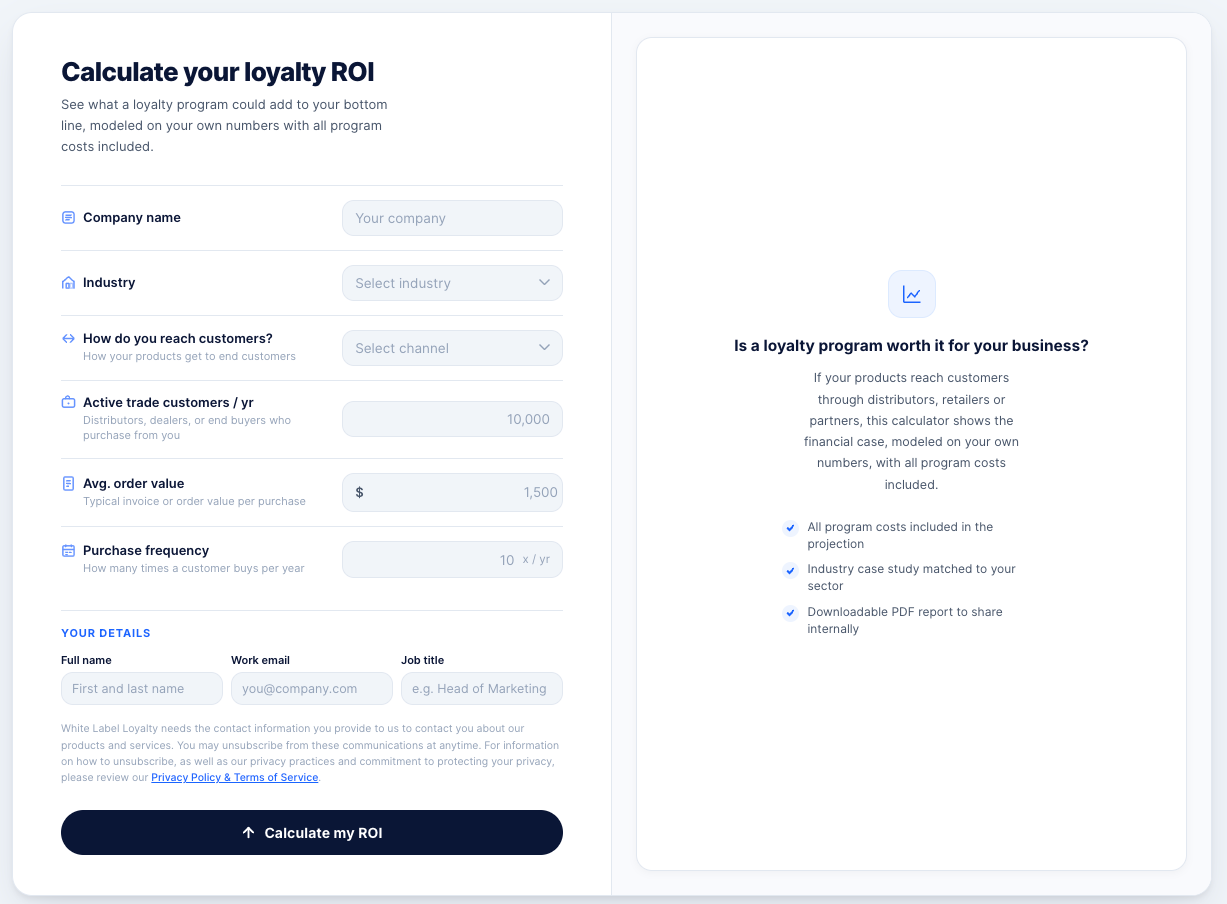
Want a version with your own numbers in it? Our ROI calculator gives you a personalised estimate from your own business inputs, no sales call required.
Which incentive drives which behaviour — and what each one costs you
Five incentive types, what each is good at, and what each will cost you if you get it wrong.
| Incentive | Behaviour it drives | Margin impact | Setup effort | Works without a purchase? | Main risk |
|---|---|---|---|---|---|
| Loyalty programme (points, tiers) | Repeat purchase, consolidated spend, data capture | Deferred, you pay on redemption, not on earn | Medium to high | Yes, if event-based | Points liability builds up unmanaged; low redemption means low behaviour change |
| Referral bonus | New customer acquisition via existing customers | Low, you pay only on a converted referral | Low to medium | Yes | Gaming and self-referral without fraud controls |
| Early access | Repeat purchase, tier progression, exclusivity | None directly | Low | Yes | Needs genuine inventory depth or it reads as a gimmick |
| Returning-customer pricing | Repeat purchase, volume thresholds | Direct and immediate | Low | No | Trains customers to wait for the offer; erodes full-price sales |
| Contests & gamification | Engagement, social sharing, data capture | Low and capped, one prize, many entrants | Medium | Yes | Attracts prize-hunters rather than customers; engagement spikes then drops |
The pattern worth noticing: the incentives with the lowest margin cost are the ones that reward non-purchase behaviour. Returning-customer discounting is the only one on this list that takes money off your top line every single time it fires.
Notes on three of them
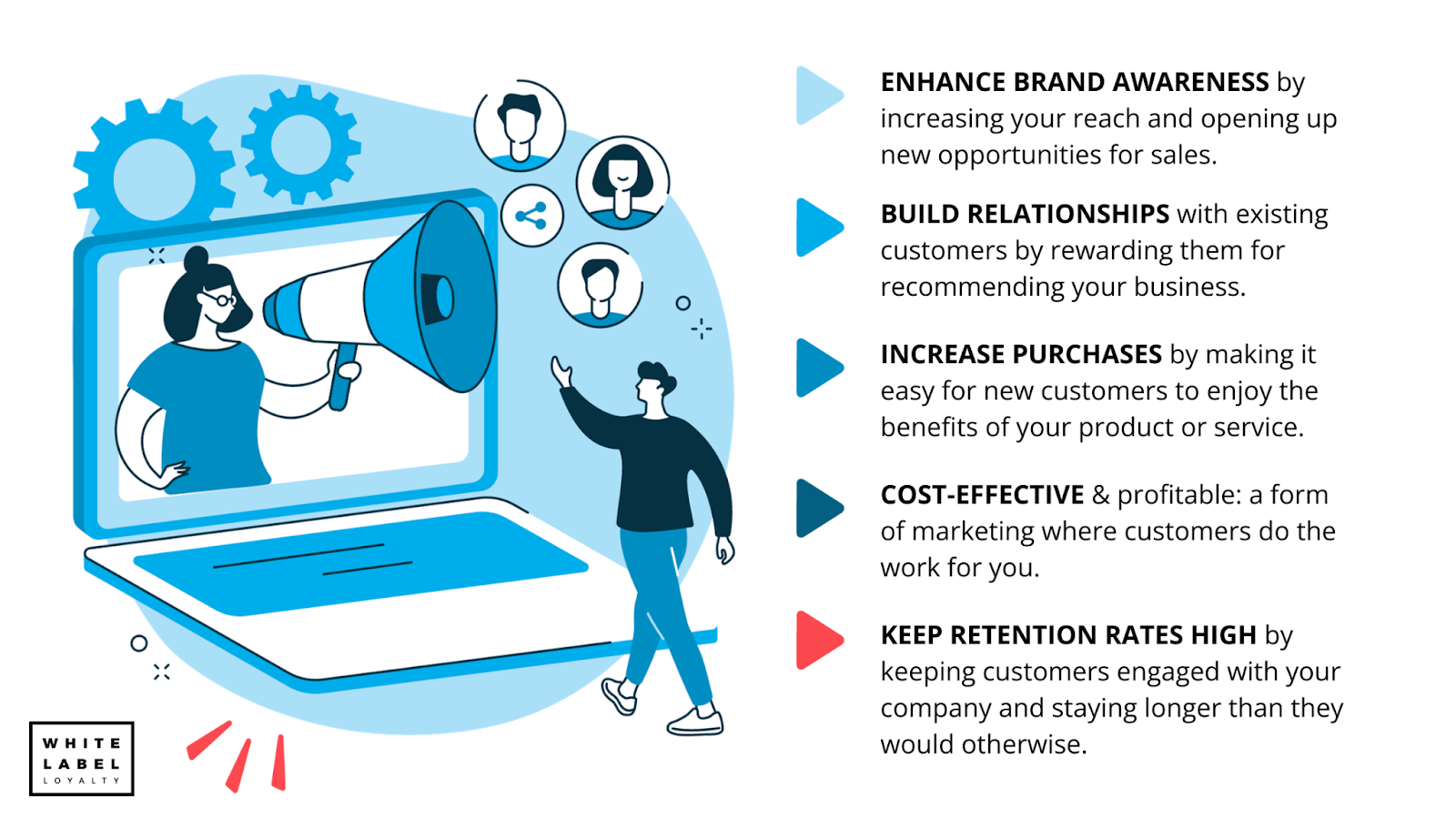
Referrals are the best-evidenced of the five. SKB Bank, one of Slovenia's leading banks and part of the OTP Group, built a gamified tiered programme where new users completed three tasks to move from Basic to Bronze. Over a three-month pilot, 3.5% of users referred a friend, converting to 1.48% new-to-bank clients, plus 188.2% growth in Flik instant payment transactions and a 17% increase in Flik app activations. Read the case study →
The same programme also produced the number that best shows what incentives can reach: 30.9% of all GDPR consent updates made to the bank came from programme users. Consent has no transaction value and is invisible to a discount. It was moveable because it was incentivised.
Contests and gamification work best when the entry mechanism is itself something you want (a referral, a review, a social share) rather than a purchase. Points, levels, badges, leaderboards and goals all do this job.
Loyalty programmes are the broadest of the five because the earn rules are yours to define. With an event-based system, any customer action becomes rewardable, which means the programme can target whichever of the three revenue levers is weakest in your business.

How to tell whether your incentives are actually working
Track five things:
- Retention rate: the share of customers still active over a defined period
- Repeat purchase rate: the share making a second and third purchase
- Purchase frequency: average purchases per member per period
- Average order value: among members versus non-members
- Customer lifetime value: members versus non-members
Then the methodological point that separates a real business case from a flattering one: measure against a matched control group or a pre-launch baseline, not against total member revenue. Members are self-selecting (they're often your best customers already) so total member revenue always looks impressive and tells you almost nothing. Only incremental revenue tells you what the programme caused.
If you can, A/B a single earn rule or reward on a subset of members before rolling it out. Compare against a similar cohort who didn't get it. Seasonality will otherwise take credit for your programme, or blame for it.
Read next
- Complete guide to loyalty programs: types, build steps and what to consider before you launch
- Why only 1 in 4 loyalty programs succeed: our research on the root causes behind loyalty programme failure
- Points-based vs event-driven loyalty programs: choosing the architecture behind your incentives
- Complete guide to referral marketing: the highest-margin incentive on the list above
Conclusion
When it comes to incentivising customers, the main thing to keep in mind is always the same: value. Offer your customers things that they really value and you’ll be able to foster not just initial transactions but sustained loyalty.
If you’re ready to harness the power of customer incentives, you can get in touch with one of our experts!
Frequently Asked Questions (FAQs)
Recommended Posts
If you enjoyed this article, check out these relevant posts below.
Share this Article

Sara Rabolini
Senior Content Marketing Executive
Sara is our Senior Content Marketing Executive. She shares engaging and informative content, helping businesses stay up-to-date with the latest trends and best practices in loyalty.