Destination Loyalty Programs for Mixed-Use Developments
A destination loyalty program for mixed-use developments is a unified rewards scheme that lets visitors earn and spend points across every venue in a development (hotels, restaurants, retail, entertainment, and leisure) under a single program owned by the developer or asset manager.
Unlike single-brand loyalty programs, destination programs are designed to increase cross-venue spend, consolidate visitor data at the asset level, and turn occasional visitors into loyal regulars across the whole development, not just one tenant.
This article covers how destination loyalty programs work, why the Middle East leads the world in this model, and a five-step framework for building one that moves the commercial needle.
The problem with single-venue loyalty in mixed-use destinations
A visitor who dines at your restaurant and leaves without visiting your retail, spa, or hotel is a missed revenue opportunity.
Yet most mixed-use developments leave that opportunity on the table, because their loyalty infrastructure is fragmented across individual tenants, each running their own separate program.
This fragmentation creates three compounding problems:
- It reinforces siloed behaviour. When visitors have no financial incentive to explore the wider development, many don't. A loyalty program that covers only one venue rewards staying put, not discovering more.
- It gives visitor data to the wrong people. Every transaction processed through a tenant-run loyalty program sends data to that tenant, not to the asset owner. Over time, individual tenants build increasingly detailed visitor profiles while the developer remains data-blind about the people spending money across their entire asset.
- It weakens the destination brand. A coherent destination with a single, unified loyalty identity is more memorable and distinctive than a collection of businesses with separate reward schemes. The loyalty program is, in effect, the most touchpoint-rich expression of your destination brand, and most developers are letting tenants define it by default.
The defining question for any mixed-use developer is not "should each of our tenants have a loyalty program?" It is "who owns the relationship with our visitors?"
Why destination loyalty programs work: the commercial case
Destination loyalty programs (also called coalition loyalty programs or multi-venue rewards schemes) unite all venues within a development under a single rewards infrastructure. Visitors earn points at any venue and can redeem them at any other. The program is owned at the destination level.
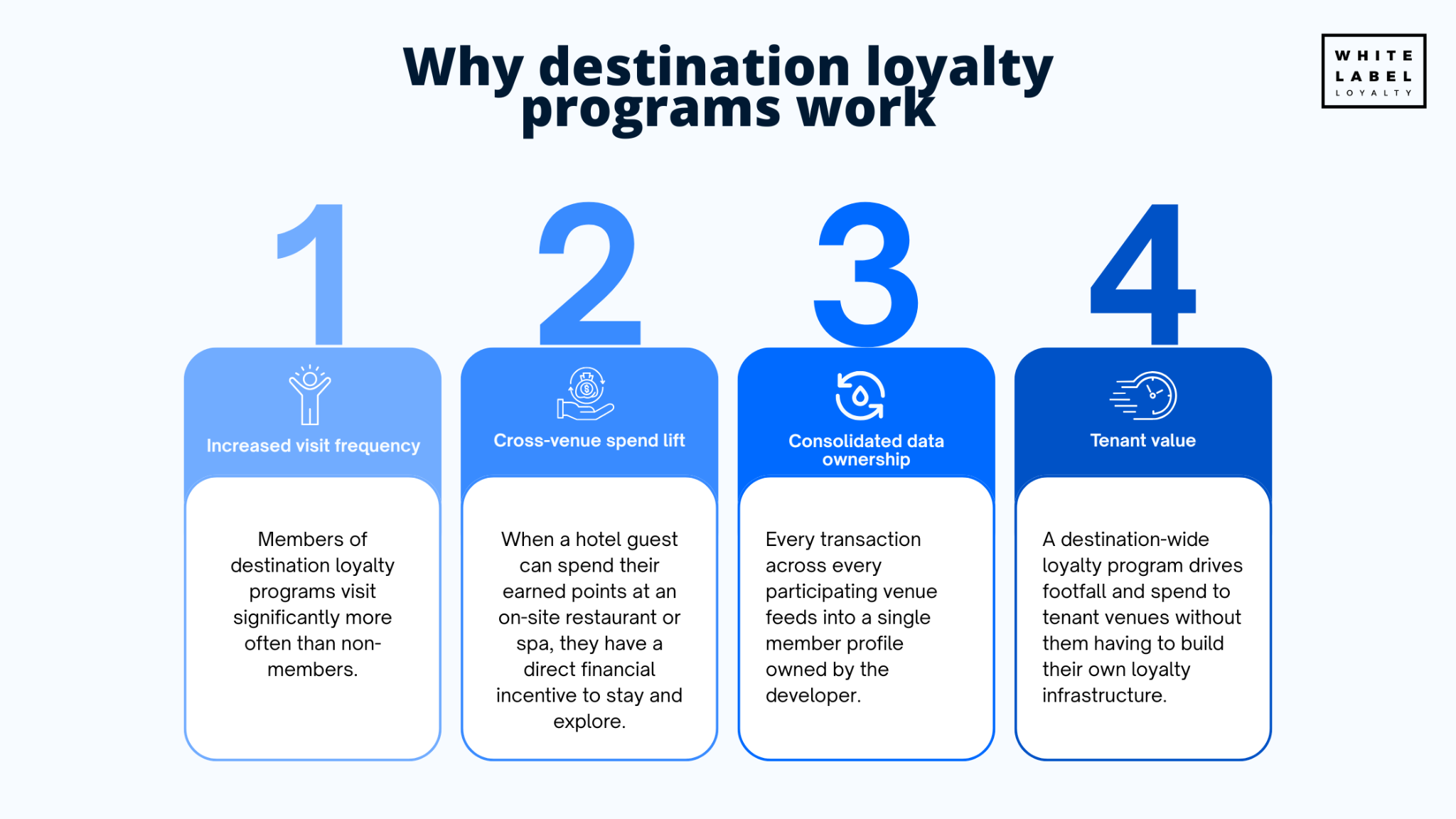
The commercial impact operates across four dimensions:
- Increased visit frequency. Members of destination loyalty programs visit significantly more often than non-members. The earn mechanic creates a concrete, financial reason to return, and the redemption mechanic drives destination preference when visitors are deciding where to spend their evening or weekend.
- Cross-venue spend lift. When a hotel guest can spend their earned points at an on-site restaurant or spa, they have a direct financial incentive to stay and explore rather than leave the development. This is one of the most significant drivers of incremental revenue in mixed-use destinations: deeper engagement from visitors already on-site.
A 2024 McKinsey & Company hospitality study found that leveraging loyalty data to personalise experiences results in a 20% increase in guest satisfaction and a 23% increase in spending. - Consolidated data ownership. Every transaction across every participating venue feeds into a single member profile owned by the developer. Over time, this creates a proprietary understanding of visitor behaviour (which combinations of venues the highest-value guests use, what times drive peak engagement, which offers drive return visits) that cannot be replicated by any individual tenant program.
- Tenant value. A destination-wide loyalty program drives footfall and spend to tenant venues without them having to build their own loyalty infrastructure. That is a genuine, quantifiable value-add that strengthens tenant relationships, supports lease negotiations, and differentiates the development when competing for quality tenants.
According to CXFoundation, 80% of companies that measure loyalty program ROI report a positive return, with an average of 4.9 times more revenue generated than costs. At a destination level, this effect is compounded by the cross-venue dynamic.
The leading examples: what Dubai got right
The Middle East, and Dubai specifically, is the most advanced market in the world for destination loyalty programs. Two programs are the clearest benchmarks.
Tickit by Dubai Holding
What it is: A card-linked destination rewards program spanning Dubai Holding's portfolio of retail, hospitality, leisure, and entertainment venues across the UAE.
How it works: Members link their UAE-issued Visa or Mastercard to the Tickit app. Points are earned automatically on every transaction at participating venues, no app to open, no receipt to scan, no barcode to present. Points are redeemed via a virtual card in the app, providing a seamless digital-first experience across more than 3,500 participating locations.
Tickit was built on the White Label Loyalty platform, the same infrastructure available to destination developers today.
Why it matters: Tickit's card-linking technology removes the single biggest barrier to loyalty program participation: behavioural friction. Most programs fail not because the rewards are unappealing, but because earning requires an action the customer forgets to take. By making earning automatic, Tickit dramatically increases participation rates across its destination portfolio.
The lesson for developers: Frictionless earning is not a nice-to-have feature. It is the most important design decision in a destination loyalty program. Every step between a transaction and an earned point is a drop-off point.

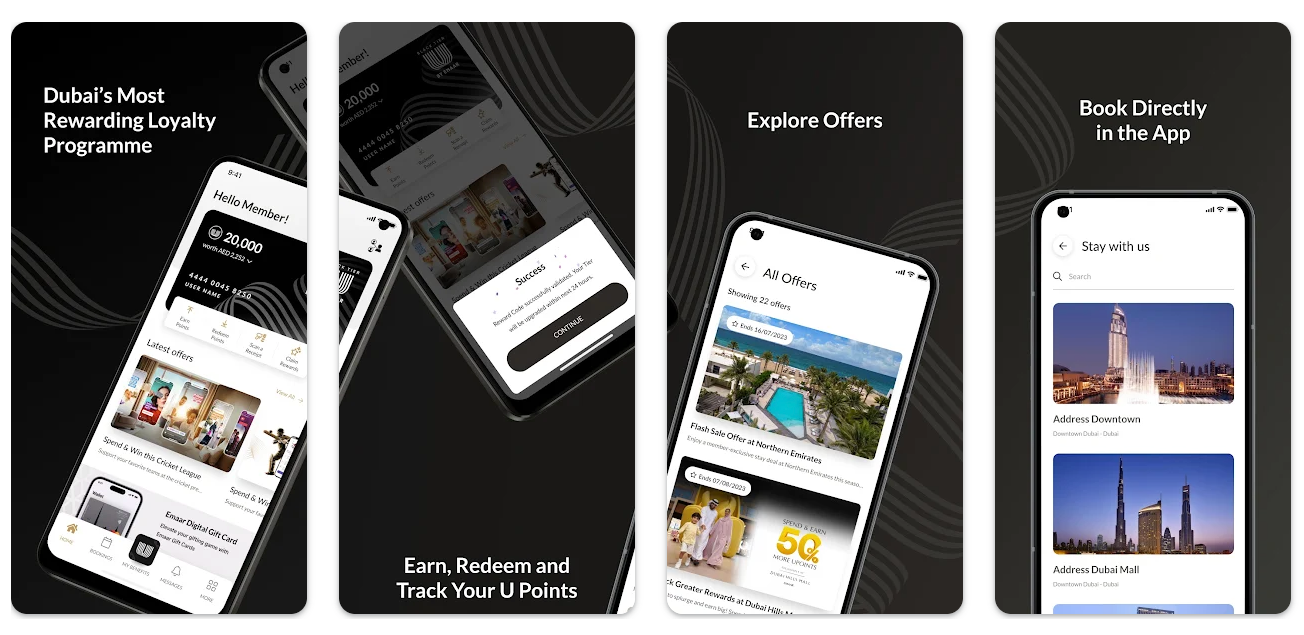
U by Emaar
What it is: Emaar's destination loyalty program spanning hotels, dining, retail, fitness, and entertainment across the Emaar portfolio.
How it works: Members earn Upoints on every transaction across participating Emaar venues and redeem them for hotel stays, fine dining, spa experiences, fitness access, and entertainment, across fundamentally different categories from where they were earned.
Why it matters: The breadth of redemption options is the program's most important design feature. A reward that feels irrelevant to a specific member has zero loyalty value, regardless of its nominal worth. By making points spendable across accommodation, food, wellness, and leisure, U by Emaar ensures that virtually every member profile can find a redemption that is genuinely motivating.
The VENUE framework: five steps to building your destination loyalty program
A structured framework for mixed-use developers designing a destination loyalty program from first principles.
V: Visitor segmentation
Before designing any program mechanic, understand who your most commercially valuable visitor segments are and what loyalty looks like for each.
A marina development might serve resident berth holders, local dining regulars, hotel guests, and day-trip visitors, each with different frequency patterns, spend levels, and motivations.
A luxury mixed-use district might have weekly local regulars, monthly occasion visitors, and infrequent tourist visitors. Each segment requires a different approach to earning, rewards, and communication.
Key questions:
- Who are your top 20% of visitors by spend, and what does their cross-venue behaviour look like today?
- Which segments have the highest frequency potential, and which have the highest spend-per-visit potential?
- What does loyalty already mean to each segment, with or without a formal program?
E: Experience mapping
Map the ideal cross-venue visitor journey, then design the earn and bonus mechanics to pull visitors along it.
If a hotel guest who also dines and uses the spa is worth three times a guest who only sleeps, the program should actively incentivise that multi-venue journey. If a retail visitor who also has lunch generates 40% more revenue than one who doesn't, there should be a cross-category earn bonus that rewards the combination.
Practical mechanics to consider:
- Bonus points for visiting three or more venues in a single day
- New venue discovery bonuses for a member's first visit to a recently opened outlet
- Off-peak incentives that reward visits during quieter periods to flatten demand curves
- Category crossing rewards that specifically incentivise movement between venue types (hotel to F&B, retail to leisure)
N: Network design (tenant participation)
The quality of a destination loyalty program is entirely dependent on the participation of the venues within it. A program that covers 60% of a development's venues sends a confusing message and misses significant spend.
Two commercial structures for tenant participation:
Structure | How it works | Best for |
| Developer-funded | Developer absorbs all points costs; program is offered to tenants as a free service | Launch phase; maximising participation; building the data asset quickly |
| Shared-cost model | Tenants contribute proportional to points earned at their venues | Mature programs with demonstrated ROI; larger tenant ecosystems |
Most destination programs launch on a developer-funded basis and introduce a cost-sharing model once the program has demonstrated clear commercial value to tenants. Starting with full developer funding removes the biggest barrier to tenant participation and allows you to build visitor data quickly.
On anchor tenants with existing loyalty programs: Hotel brands with their own established programs (Marriott Bonvoy, Hilton Honors, etc.) present a specific challenge.
Position the destination program as complementary rather than competitive: members can earn in both systems, but the destination program offers cross-venue rewards and destination-wide status that the hotel brand program cannot. In practice, most visitors participate in multiple programs when each offers distinct value.
U: Underlying tech
The program requires a platform capable of real-time points issuance across multiple venues, member profile management, rewards fulfilment, and ideally card-linking integration with major payment networks.
Technology decision framework:
Requirement | App-based earn | Card-linked earn |
| Implementation complexity | Low-medium | High |
| Time to launch | 3-6 months | 6-12 months |
| Participation rate | Moderate | High |
| Friction for member | Moderate (must remember to scan/present) | None (automatic) |
| Best for | Smaller developments; early-stage programs | Large-scale developments; high-frequency visitors |
Building a destination loyalty program from scratch is a significant undertaking: card-linking integrations with Visa and Mastercard alone can take years to develop, and the multi-venue data architecture requires enterprise-grade infrastructure that most development teams have never built before.
The developers who get to market fastest, and with the most robust programs, do it by working with a platform purpose-built for exactly this use case.
White Label Loyalty's enterprise loyalty platform is the infrastructure behind some of the most advanced destination programs in the world, including Tickit, Dubai Holding's card-linked rewards program that now operates across 3,500 locations in the UAE.
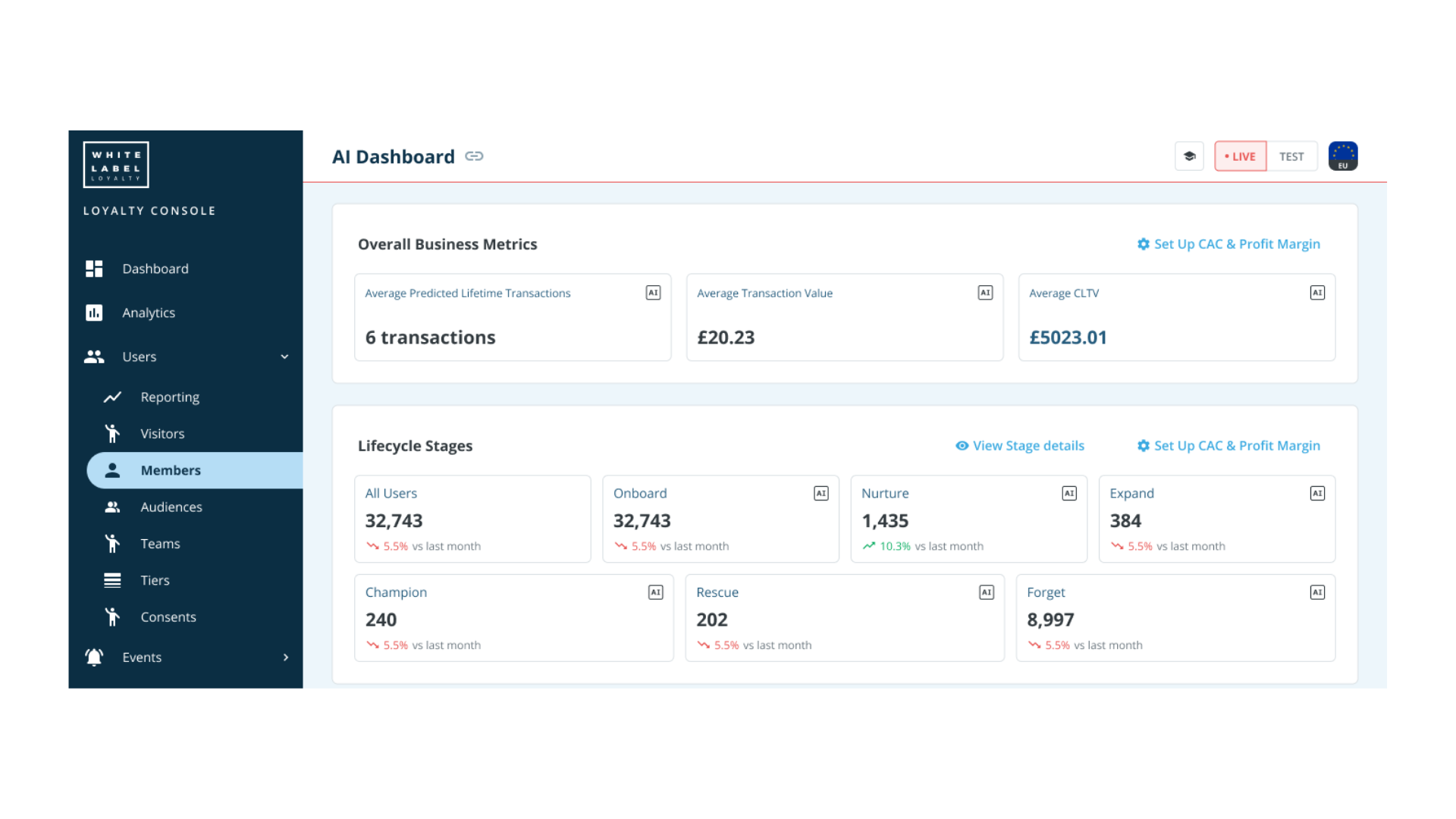
The platform handles real-time points issuance across unlimited venue types, card-linking with major payment networks, member profile management, and AI-powered lifecycle intelligence that predicts visitor behaviour and identifies churn risk before it happens, all live in weeks, not years.
For mixed-use developers evaluating their options, the choice is rarely between building and buying. It's between building everything yourself over 18-24 months, or launching a production-grade destination loyalty program in a fraction of the time on infrastructure that's already been proven at scale.
E: Execution & promotion
The most common loyalty program failure mode is a quiet launch followed by gradual neglect. A program that members don't know about is worthless.
At launch:
- Personally brief every department head and front-line team member across all participating venues, they are the primary channel through which members learn the program exists
- Invest in visible physical presence across the destination: signage, tent cards, POS materials, lobby displays
- Run a launch campaign across owned digital channels with a compelling sign-up incentive (bonus points on first transaction, elevated tier entry for early members)
- Issue a press release targeting regional lifestyle and business media, destination loyalty programs are genuinely newsworthy in the Gulf market
Ongoing:
- Review loyalty metrics quarterly: track earn rates, redemption rates, and cross-venue visit frequency by member segment
- Run seasonal campaigns tied to destination programming: Ramadan offers, summer activations, holiday events
- Use member data to personalise communications: a message about a new restaurant opening is dramatically more effective when it's sent specifically to members who have dined on-site before
- Refresh the reward catalogue at least annually to maintain relevance
Common pitfalls in destination loyalty programs
Launching with insufficient venue coverage. Aim for at least 70–80% of key venues live at launch. A program that excludes major anchors feels incomplete and trains members to think of the program as partial.
Making redemption difficult. Points that are hard to spend become points no-one values. Redemption should be at least as frictionless as earning: ideally instant, via a virtual card or automatic discount at point of sale. If a member has to call someone or fill out a form to redeem, the program has already failed the experience test.
Underinvesting in data infrastructure. The member transaction data the program generates is one of its most commercially valuable outputs, more valuable in the long term than the direct revenue lift. Invest in analytics capability from day one. Segment members, track cross-venue behaviour, and use the insights to inform tenant mix decisions, programming calendars, and capital allocation.
Treating it as a marketing campaign. A loyalty program is not a campaign. It is a product, and it requires ongoing management, rewards refreshes, seasonal activations, and tenant engagement. Programs that are launched and then left to run without attention consistently underperform.
Ignoring the employee experience. Front-line staff across every participating venue are the primary touchpoint through which members interact with the program day-to-day. If staff cannot explain how the program works, cannot answer basic member questions, or don't understand why the program matters, member experience degrades regardless of how good the technology is.
Ready to build your destination loyalty program?
White Label Loyalty is the enterprise platform behind some of the world's most advanced destination programs, including Tickit, Dubai Holding's card-linked rewards program operating across 3,500 locations in the UAE.
We work with mixed-use developers, destination operators, and hospitality groups to design and launch loyalty programs tailored to their specific development, tenant mix, and visitor base, live in weeks, not years.
Frequently Asked Questions (FAQs)
Recommended Posts
If you enjoyed this article, check out these relevant posts below.
Share this Article

Sara Rabolini
Senior Content Marketing Executive
Sara is our Senior Content Marketing Executive. She shares engaging and informative content, helping businesses stay up-to-date with the latest trends and best practices in loyalty.