Is it better to buy or build loyalty technology?
When creating a loyalty program, there are 2 options:
- Buy loyalty software
or
- Build it yourself
But which one is better?
For most businesses, the answer is buy: or more precisely, buy an API-first platform that gives you the configurability of a build without the cost, time, and risk of building from scratch.
Building in-house is viable only if you have a dedicated engineering team of five or more, a genuinely unique loyalty mechanic that no existing platform can support, and an 18-24 month runway before you need the program live. If all three of those aren't true, buying is the lower-risk path to a proven outcome.
83% of companies that measure loyalty ROI report a positive return, with top-performing programs generating up to 5.2x more revenue than cost. The infrastructure to deliver that outcome already exists: the question is whether it makes sense to build it again from scratch.
This guide covers the honest pros and cons of each path, the real costs involved, when each option makes sense, and a decision framework to help you choose. Before diving in, it helps to be clear on which type of loyalty program you need - the mechanics you choose will influence whether an off-the-shelf platform can support them.
Build vs. buy loyalty platform: side-by-side comparison
| Build in-house | Buy existing software | |
|---|---|---|
| Year-one cost | £300k–£600k+ (engineering team, infrastructure, loyalty strategy) | $200–$800/month mid-market; custom for enterprise |
| Time to launch | 12–24 months for first member-facing features | 6–16 weeks for enterprise API-first platforms; days for plug-and-play |
| Ongoing maintenance | £100k–£200k/year (team, updates, security, infrastructure) | Included in platform fees; handled by provider |
| Loyalty expertise | Must hire or develop in-house | Built into the platform and support team |
| Integration flexibility | Full control, but requires significant engineering to achieve | API-first platforms integrate with your existing CRM, POS, and ecommerce stack |
| Scalability | Scales only as fast as your engineering team can build | Enterprise platforms built to scale across markets, channels, and member volumes |
| Customisation | Fully bespoke: you own the roadmap | API-first platforms support full white-labelling and custom mechanics |
| Risk profile | High: no precedent, no safety net, trial and error | Low to medium: tested infrastructure with dedicated support |
Cost ranges based on publicly available industry benchmarks and WLL deployment data.
Building a loyalty program in-house
Businesses that build in-house want complete ownership of the platform: the roadmap, the data architecture, the feature set. If you build it, you own it. There are no vendor dependencies, no product roadmap negotiations, and no ceiling on what you can build.
That level of control comes at a price. Time is the first major cost: loyalty technology is genuinely complex to build well. Connecting earn mechanics to a live POS system, managing real-time points balances at scale, handling fraud prevention, and building redemption flows that work across channels is not a six-week sprint. Mid-market brands that build in-house typically reach their first member-facing feature after 12–24 months of development, not weeks.
The second cost is the team. You will need engineers who understand distributed systems, data analysts, UX designers, and people who understand loyalty mechanics. Building technically functional loyalty software is one challenge; building loyalty software that actually changes customer behaviour is another. Without loyalty expertise, the program logic is likely to be simpler than what a specialist platform offers out of the box.
A loyalty program is also deeply connected to your existing marketing stack: CRM, ecommerce platform, POS, CDP. Building the integration architecture in a way that works long-term, without creating technical debt that limits future development, requires experience most in-house teams don't have on day one.
When building in-house makes sense
Build is a viable option only when all three of the following are true:
- You have a full team ready. A minimum of 3–5 engineers with relevant experience, plus loyalty strategy expertise, either hired or contracted.
- You have a genuinely unique mechanic. Your loyalty logic is proprietary in a way that existing platforms genuinely cannot support, not just a preference for control.
- You have the runway. 18–24 months before launch and the budget to sustain the team through development, testing, and iteration.
If any one of these isn't in place, the risk-adjusted answer is buy.
Building a loyalty program in-house
Pros
Complete control.
Cons
Expensive.
Time-consuming.
Complicated.
Buying existing loyalty software
There's a saying that goes "If you want something done right, do it yourself." But when it comes to loyalty programs, many businesses have decided that external providers are a better choice.
Most businesses buy loyalty software because it lets them focus on running their loyalty program rather than building the infrastructure behind it. The platform has already been built, tested, and iterated by a team whose entire focus is loyalty technology. You get the benefit of that expertise on day one.
The practical advantages are significant. A proven platform has already solved the hard problem: fraud prevention, real-time points processing, reward fulfilment, data security, uptime. These are not trivial engineering challenges, and they tend to be the things that derail in-house builds. When you buy, you inherit solutions to problems you haven't encountered yet.
Speed is the most tangible advantage. An enterprise API-first platform can go from contract to live program in 6–16 weeks. A simple e-commerce plug-in can be live in days. That compresses time-to-value dramatically compared to any in-house build timeline.
The one genuine trade-off is product roadmap dependency. The loyalty provider controls what gets built and when. For most businesses this is acceptable: the provider's roadmap reflects the needs of many clients, which means the platform evolves in useful directions. For businesses with truly proprietary requirements, it can become a constraint.
When buying from a loyalty software provider makes sense
- You want to be live within six months. No in-house build can match the deployment speed of a mature platform.
- You want loyalty expertise without hiring for it. Platforms come with account managers, implementation specialists, and support teams who have seen your problem before.
- You want reliability from day one. Existing platforms have been stress-tested at scale: fraud prevention, uptime, data security, and compliance are already handled.
- You want to collect customer data without building the infrastructure. Data capture solutions: receipt scanning, card linking, event tracking — are built in, not bolted on.
- You want access to a rewards ecosystem. Reward fulfilment partnerships, gift card networks, and pre-integrated reward catalogues take years to build independently. Platforms bring them ready-made.
To compare the leading platforms side by side, see our best loyalty program software guide for 2026.
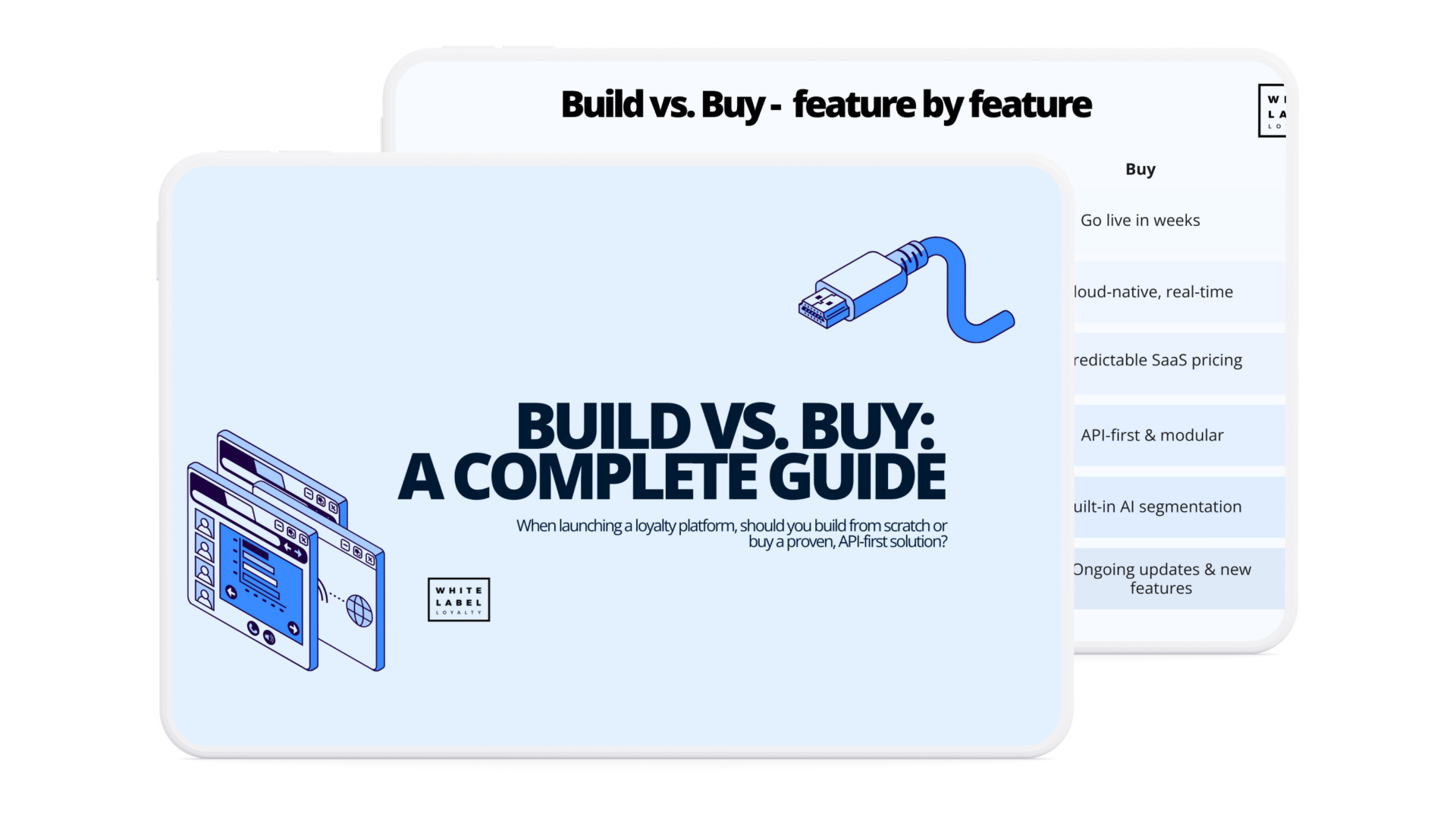
Buying loyalty technology
Pros
Fewer resources required.
Lower startup costs.
Tech expertise not required.
Quicker to launch.
More certainty, reliability & security.
Cons
Less control over software development.
Still unsure? Take a look at these resources below
The composable middle ground: API-first platforms
The buy vs. build framing is increasingly outdated. For most enterprise buyers in 2026, the real answer is an API-first, headless loyalty platform that gives you the control and configurability you would want from a build, at the speed and cost of a buy.
This is the composable model. You buy the platform infrastructure: the points engine, the rewards marketplace, the data capture tools, the analytics layer. You configure, extend, and integrate it as if you built it: custom mechanics, white-label branding, bespoke integrations with your existing CRM, POS, and ecommerce stack. You own the customer-facing program entirely. You don't own the infrastructure underneath it.
The cloud-based, API-first segment of the loyalty market is growing at 16.4% annually (Mordor Intelligence, January 2026), driven precisely by this demand: enterprise teams that want the flexibility of a build without the risk, cost, and timeline.
API-first platforms make sense when:
- Your existing tech stack is complex and integration depth matters.
- You need white-label branding: the program should look entirely like yours.
- Your loyalty mechanics are sophisticated but not genuinely proprietary.
- You need to scale across markets, channels, or brands without re-platforming.
- You want to go live in weeks, not years, without sacrificing long-term flexibility.
This is the model White Label Loyalty was built around. Talk to our team to understand what a composable deployment would look like for your business.
Which path is right for you? A decision framework
Answer these four questions honestly before committing to either path:
1. Do you have a dedicated team of 5+ engineers available for 18–24 months? If no → buy or composable.
2. Is your loyalty mechanic genuinely unique in a way no existing platform can support? If no → buy or composable.
3. Do you need to be live within 12 months? If yes → buy or composable.
4. Is building and maintaining software a core competency of your business? If no → buy or composable.
If you answered yes to questions 1 and 2 and no to questions 3 and 4, a build may be viable: provided you have the budget and risk tolerance. In every other combination, buying or an API-first composable platform is the lower-risk path to a better outcome.
The decision isn't really about control: modern API-first platforms give you more control than most in-house builds achieve in year one. It is about whether building the infrastructure is the best use of your time, money, and team.
Key takeaways
- For most businesses, buying loyalty software is faster, lower-risk, and delivers better outcomes than building in-house.
- Building in-house costs £300k–£600k+ in year one and typically takes 12–24 months to reach a live program.
- Buying a mid-market platform costs $200–$800/month; enterprise platforms are custom-quoted.
- API-first, composable platforms are the best of both: buy the infrastructure, configure it like a build.
- 83% of companies that measure loyalty ROI report a positive return (Antavo, 2025). The infrastructure to deliver that exists. Build only if you have a genuinely unique reason to.
- Use the four-question framework above to make the decision objectively.
Conclusion
People often ask whether it's better to buy or build loyalty software. The answer depends on a lot of factors, but generally speaking, it's best to buy third-party loyalty technology if you want to scale quickly.
Opting to develop in-house might be the right way to go if you have the time and resources, but it does take a lot of hard work!
By contrast, buying loyalty software solution means that someone has already done all the hard work for you! You'll be able to focus on other aspects of your business while being looked after by experts.
No matter what path you choose, the final product should be easy to use. But most importantly, it should create a loyal customer base. That’s why you’re doing it, after all.
If you want to understand how you can create loyalty in your business, get in touch with one of our experts.
Frequently Asked Questions (FAQs)
Recommended Posts
If you enjoyed this article, check out these relevant posts below.
Share this Article

Sara Rabolini
Senior Content Marketing Executive
Sara is our Senior Content Marketing Executive. She shares engaging and informative content, helping businesses stay up-to-date with the latest trends and best practices in loyalty.