Build a Loyalty Program Fast with a Headless API
Developers no longer need to build loyalty engines from scratch to create a successful loyalty program. With a headless loyalty API, you can build a loyalty program fast, shipping points, rewards, tiers, referrals, and gamification in days or weeks, not months.
Modern digital brands want customer loyalty programs that feel natural inside their product experience, not bolted on, and not dependent on rigid templates.
This article explains how headless loyalty works, how the right loyalty system can increase customer retention, and how these solutions help companies build customer loyalty with speed, flexibility, and seamless integrations.
Why loyalty is moving to headless APIs of the future
Traditional loyalty platforms are slow to integrate, rigid, and tied to prebuilt UIs. They often force brands into generic workflows and prevent teams from creating the kind of customer engagement that drives repeat visits, repeat purchases, and long-term customer lifetime value.
Today’s businesses, especially digital-first products, need complete control over the UX, real-time engagement logic that keeps loyal customers coming back, flexible reward structures (including cashback rewards, store credit, digital vouchers, and exclusive discounts), fast deployment cycles, and easy integration with mobile apps, wallets, and ecommerce flows
This is why the future is seeing a massive shift toward headless loyalty. You own the UI, while the engine handles the complexity.
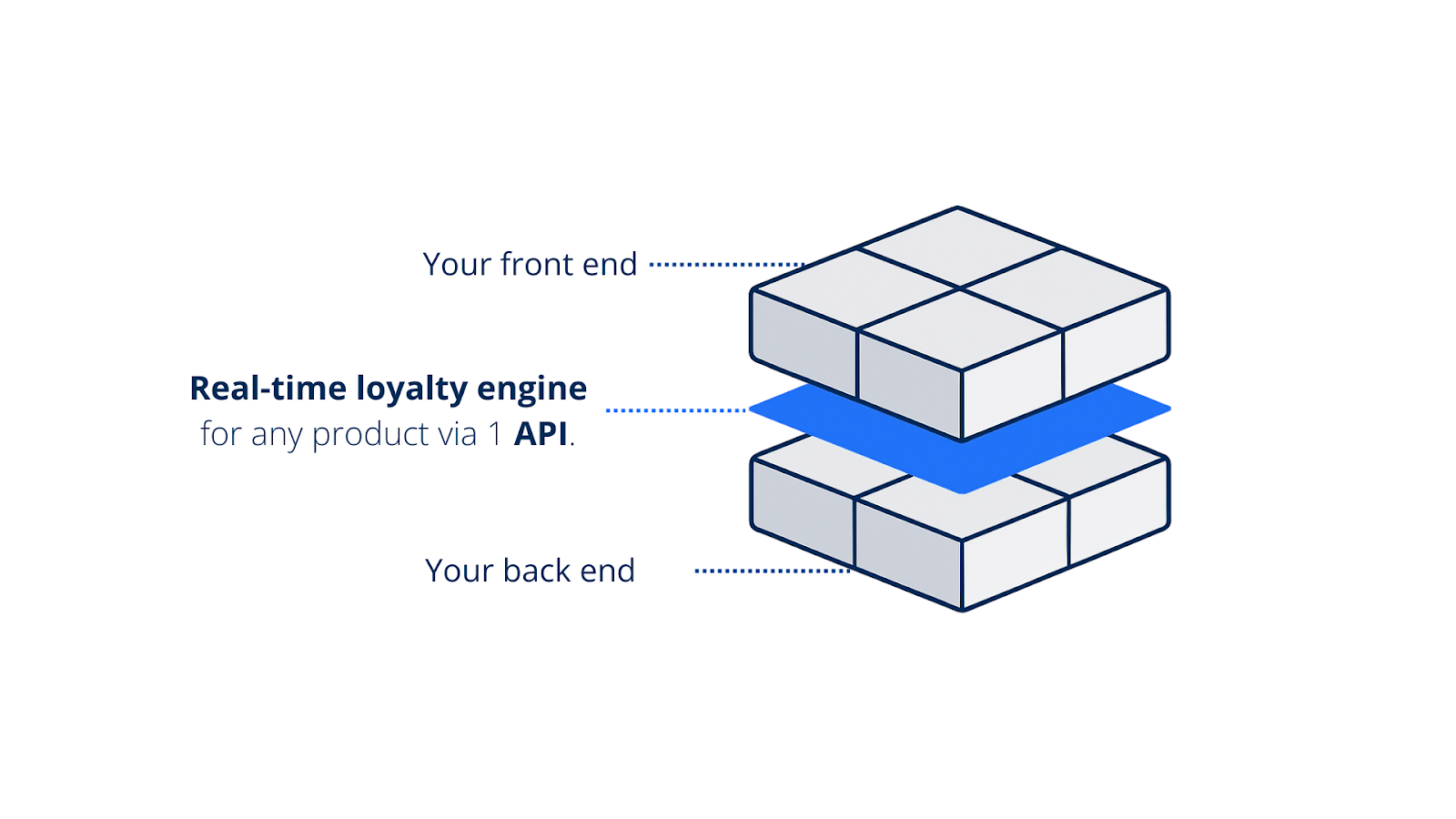
A headless loyalty API decouples the frontend from the logic layer, giving developers clean, composable endpoints to build any loyalty experience:
✔ apps
✔ wallets
✔ digital banking interfaces
✔ marketplaces
✔ ecommerce flows
✔ membership apps
If you want to go deeper before starting your build, check out our companion article Best Loyalty APIs for Developers in 2026: a full comparison of the top loyalty platforms and headless engines on the market.
What is a headless loyalty API? (And why do developers love it?)
A headless loyalty API is the modern way of building loyalty programs: instead of forcing your product into someone else’s templates or predefined user journeys, it gives you direct access to the loyalty logic itself: the “engine room” where points, tiers, rewards, and engagement mechanics are defined.
In a traditional loyalty platform, you’re usually stuck with whatever UI components, workflows, and campaign structures the vendor provides. Changing anything often requires workarounds, custom requests, or entire redesigns. A headless API flips this dynamic. You own the experience. The platform just provides the logic and infrastructure underneath.
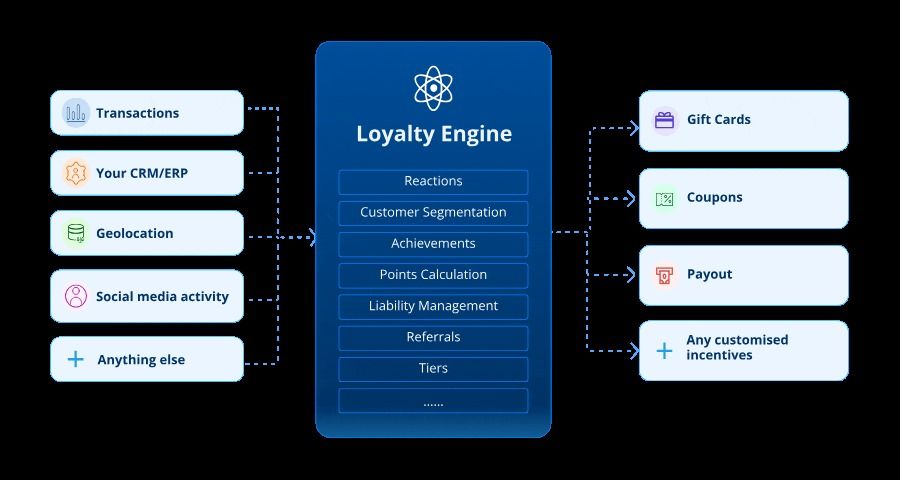
At its core, the model is very simple: your app emits events → the loyalty engine evaluates them → you retrieve outcomes via API.
Your app processes events like:
- a purchase passes a spending threshold
- a user reaches a milestone
- customers earn points for referrals
- repeat or frequent visits
- a friend referral succeeds
- customers sign up through your social media channels
These actions become event triggers. The engine evaluates them based on your program rules and outputs updated loyalty data: balances, tiers, offers, vouchers, or new exclusive perks. Your UI then displays everything to loyalty program members in a fully custom interface.
From a developer’s perspective, this model feels almost invisible. There’s no heavy interface to wrestle with and no rigid template forcing a particular customer journey. You integrate it exactly where it makes sense: mobile app, digital wallet, banking dashboard, ecommerce checkout, internal CRM, or a completely custom front-end experience.
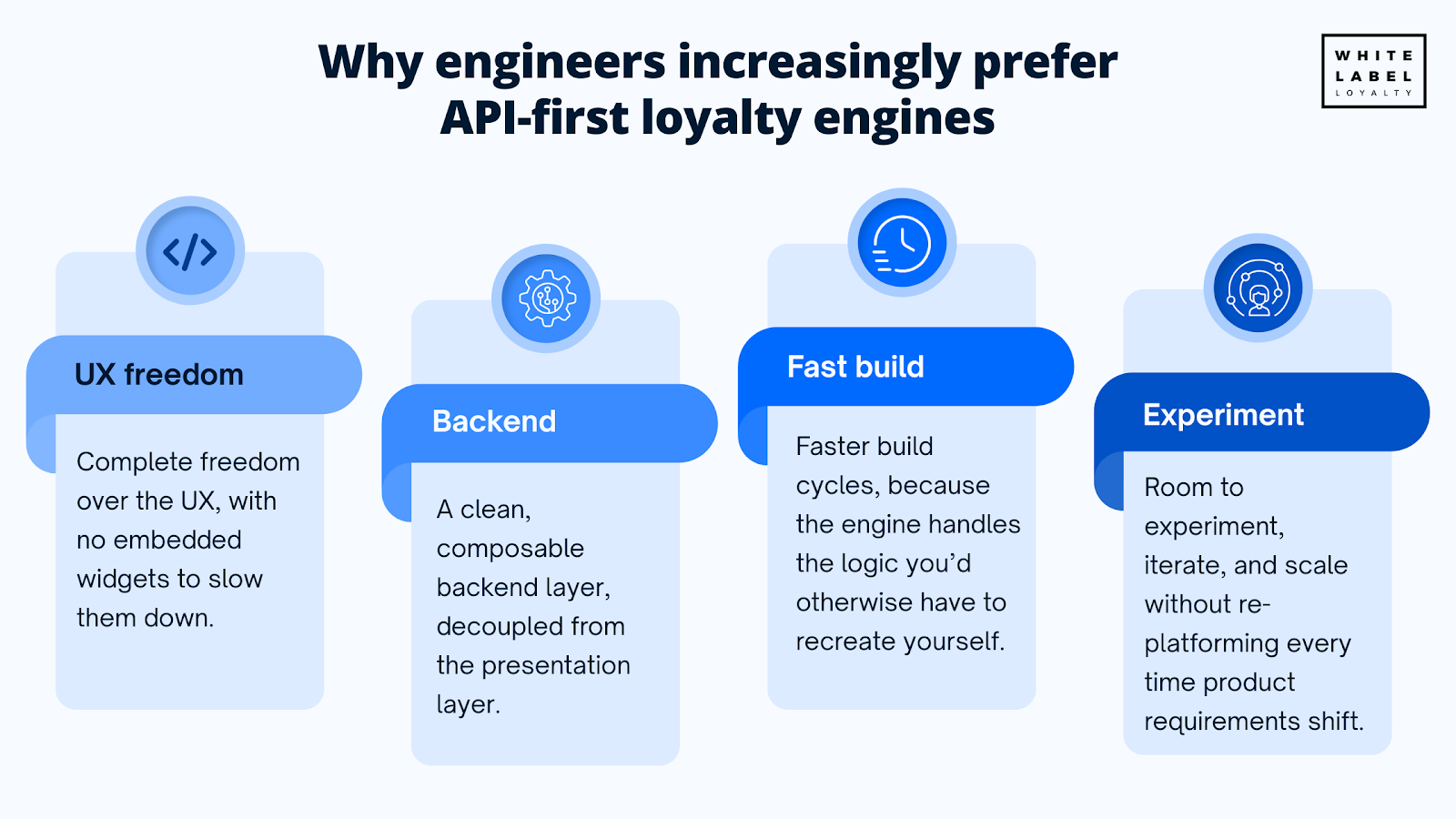
This is why engineers increasingly prefer API-first loyalty engines over monolithic platforms. They get:
- Complete freedom over the UX, with no embedded widgets to slow them down.
- A clean, composable backend layer, decoupled from the presentation layer.
- Faster build cycles, because the engine handles the logic you’d otherwise have to recreate yourself.
- Room to experiment, iterate, and scale without re-platforming every time product requirements shift.
For modern digital products, especially fintech, SaaS, marketplaces, and mobile apps, a headless loyalty API feels less like “implementing a loyalty tool” and more like adding a flexible, on-demand capability to your stack. It’s a natural extension of how teams already think about modular architecture.
Why build your loyalty program with a headless API instead of from scratch
Building from scratch is slow: a custom loyalty engine requires months of engineering time, and most teams underestimate the complexity by 5–10x.
- Transaction tracking
- Event processing
- Rules engine
- Rewarding logic
- Tiers & status
- Security & audits
- Reporting
- Fraud checks
- Scaling
- Maintenance forever
A headless API lets you launch in days, and your engineers only build the experience layer, the thing your users actually see. You get:
- Prebuilt event ingestion
- Scalable rules engine
- Reward issuance
- Tier management
- Profiles & wallet endpoints
- Secure, compliant infrastructure
- Reliable audit trails
- Pre-tested logic
- Sandboxes for rapid prototyping
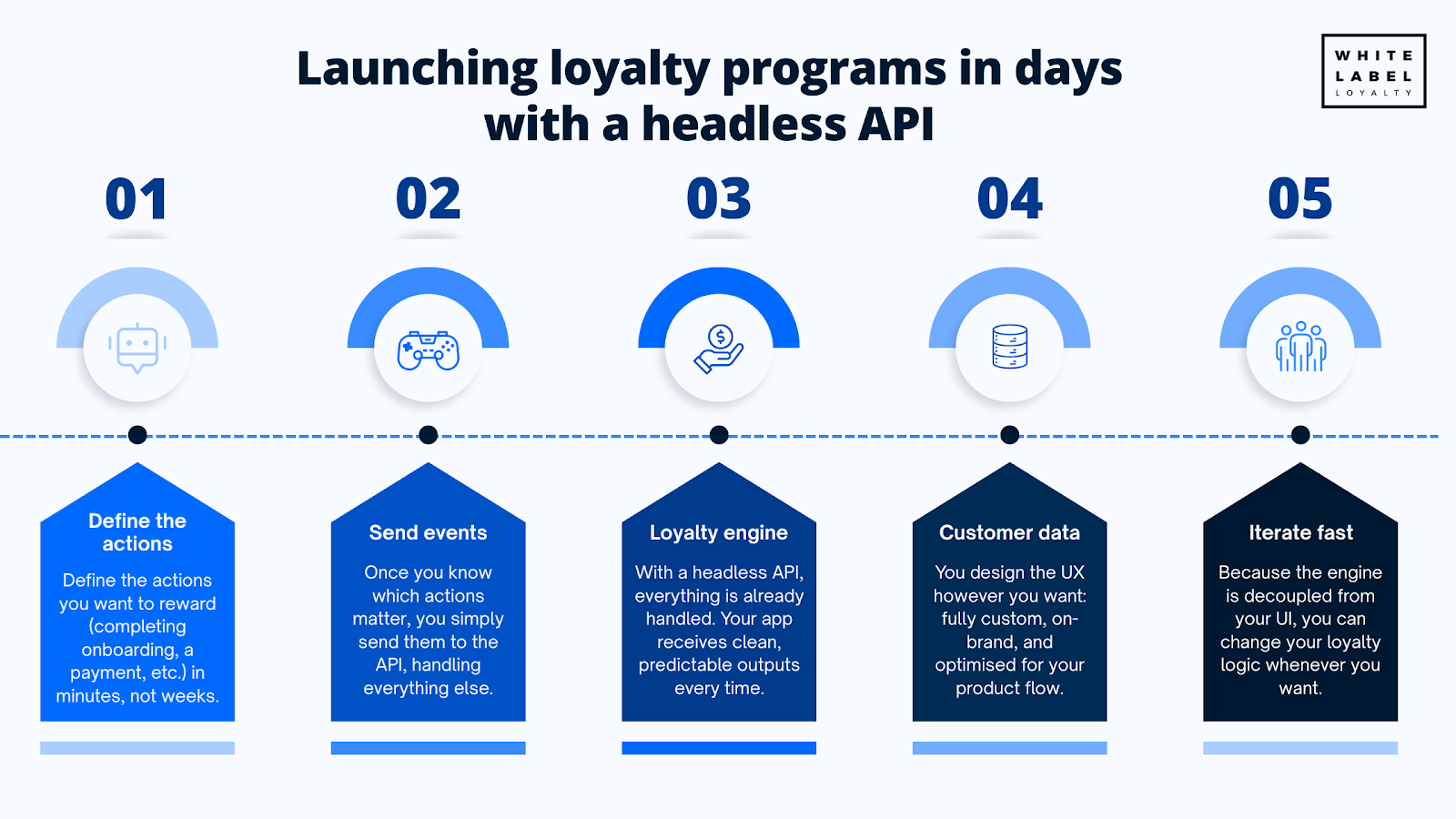
Launching loyalty programs in days with a headless API
Most teams assume that launching a loyalty program is a months-long project, something that requires heavy architecture, a custom rules engine, and an entire sprint dedicated to tracking points, rewards, tiers, and edge-case behaviour.
That used to be true. But headless APIs have completely changed the build process.
A headless loyalty API works like any modern service: you plug it into your stack, send the events you care about, and instantly unlock the underlying logic without writing it yourself. Instead of building a full system from the ground up, your team only focuses on the parts that matter: the product experience and your unique rules.
Here’s how teams are now shipping loyalty features in days instead of months.
1. Define the actions you want to reward (this takes minutes, not weeks)
In traditional builds, the first step is mapping triggers to backend logic, and then implementing that logic. With a headless loyalty engine, the backend already exists.
All you do is decide which actions matter:
- a fintech user completing a payment
- a SaaS user hitting a usage threshold
- a customer completing onboarding
- a referral event or referring friends
- a purchase above a dollar spent target
- first visit, frequent visits, or major milestones
These become events your product already emits: no new architecture, no custom tables, no orchestration layer.
2. Send events to the loyalty API (your app already tracks them)
Once you know which actions matter, you simply send them to the API.
Headless engines handle everything after the event is received: calculating points, updating balances, handling tiers, triggering rewards, and keeping a clean ledger.
This is where Dynamo shines: it’s an API-first loyalty engine designed so developers can start sending events instantly. There’s no waiting for a sales call, no gated access, no configuration backlog. You open the sandbox and start building.
3. The engine processes digital rewards automatically
The loyalty engine acts as the brain of your system. It evaluates your rules, processes the event, and updates the user’s loyalty state in real time.
With a traditional build, this would require:
- designing a rules engine
- validating edge cases
- setting up background jobs
- creating a ledger
- ensuring accurate balances
- supporting audits and rollbacks
With a headless API, all of this is already handled. Your app receives clean, predictable outputs every time.
4. Fetch the customer data for your UI
You design the UX however you want: fully custom, on-brand, and optimised for your product flow. Unlike template-based loyalty software, a headless API never dictates how your loyalty experience should look.
Your UI can display:
- current points
- progress towards a reward
- tier status
- badges or achievements
- available vouchers or perks
- customer benefits tailored to your audience
Dynamo supports this flexibility with SDKs (e.g., React, React Native) and multiple integration paths. You can build your own wallet UI, create a progress dashboard, or even deploy a lightweight microsite, whatever fits your product best.
5. Iterate fast without rewriting backend logic
Because the engine is decoupled from your UI, you can change your loyalty logic whenever you want:
- adjust reward values
- introduce new badges or tiers
- add bonus actions
- update expiry rules
- test new incentives
All without rewriting backend code. Faster experimentation leads to higher sign-up rates, stronger engagement, and higher customer lifetime performance.
This is why building with a headless API compresses timelines dramatically. The slow parts, infrastructure, logic, and data integrity, are pre-built. Your team only handles the experience.
How Dynamo fits into this customer loyalty workflow
Dynamo is built specifically for this kind of rapid loyalty development. Everything about it supports fast prototyping and fast shipping:
- Instant sandbox access (no sales gatekeeping)
- API-first architecture designed for developers
- Real-time, event-driven processing
- Flexible reward types including points, vouchers, gift cards, badges, tiers, and referrals
- SDKs for modern stacks like React and React Native
- Scalable infrastructure suited to fintech and SaaS
Instead of forcing you into predefined flows, Dynamo becomes part of your product: a modular piece of infrastructure your team can extend, shape, and integrate however they want.
Because Dynamo lets customers join quickly and stay active, brands can grow their customer base while giving loyalty members a smoother, more intuitive experience.
The result: customer loyalty programs in days, not months
With a headless API, building loyalty stops being a major engineering project and becomes a straightforward integration:
- Your product emits events
- Dynamo processes them
- Your UI displays the results
The architecture stays clean, the logic stays centralised, and your team keeps full creative control.
If your goal is to add loyalty to your product without derailing your roadmap, a headless API is the fastest (and safest) path, and Dynamo delivers that experience out of the box.
Frequently Asked Questions (FAQs)
Ready to build your loyalty program in days, not months?
Start prototyping with Dynamo today and see how fast you can ship your first loyalty feature.
👉 Get instant access to the Dynamo sandbox
👉 Try your first event in under 5 minutes
👉 Build a fully custom loyalty experience without touching backend logic
Start building, the fast way.
Recommended Posts
If you enjoyed this article, check out these relevant posts below.
Share this Article

Sara Rabolini
Content Marketing Executive
Sara is our Content Marketing Executive. She shares engaging and informative content, helping businesses stay up-to-date with the latest trends and best practices in loyalty...