Product-Led Loyalty: A Guide for Product Managers
For most of the last twenty years, loyalty lived in marketing. It meant a points program run out of a CRM, an email cadence promoting double-points weekends, and a separate rewards portal that customers visited maybe twice a year. Engineering built the integration once, then tried to never touch it again.
That model is not working anymore. The companies winning on retention today (Duolingo, Strava, Notion, Robinhood) build loyalty into the product itself with streaks, tiers, in-app rewards, referral loops, progress bars, and that shift makes loyalty a product manager's problem, not a marketing manager's.
This article is about what that shift means, why most product teams have struggled to act on it, and how to ship loyalty inside your product without losing a quarter of your roadmap to it.
What is product-led loyalty?
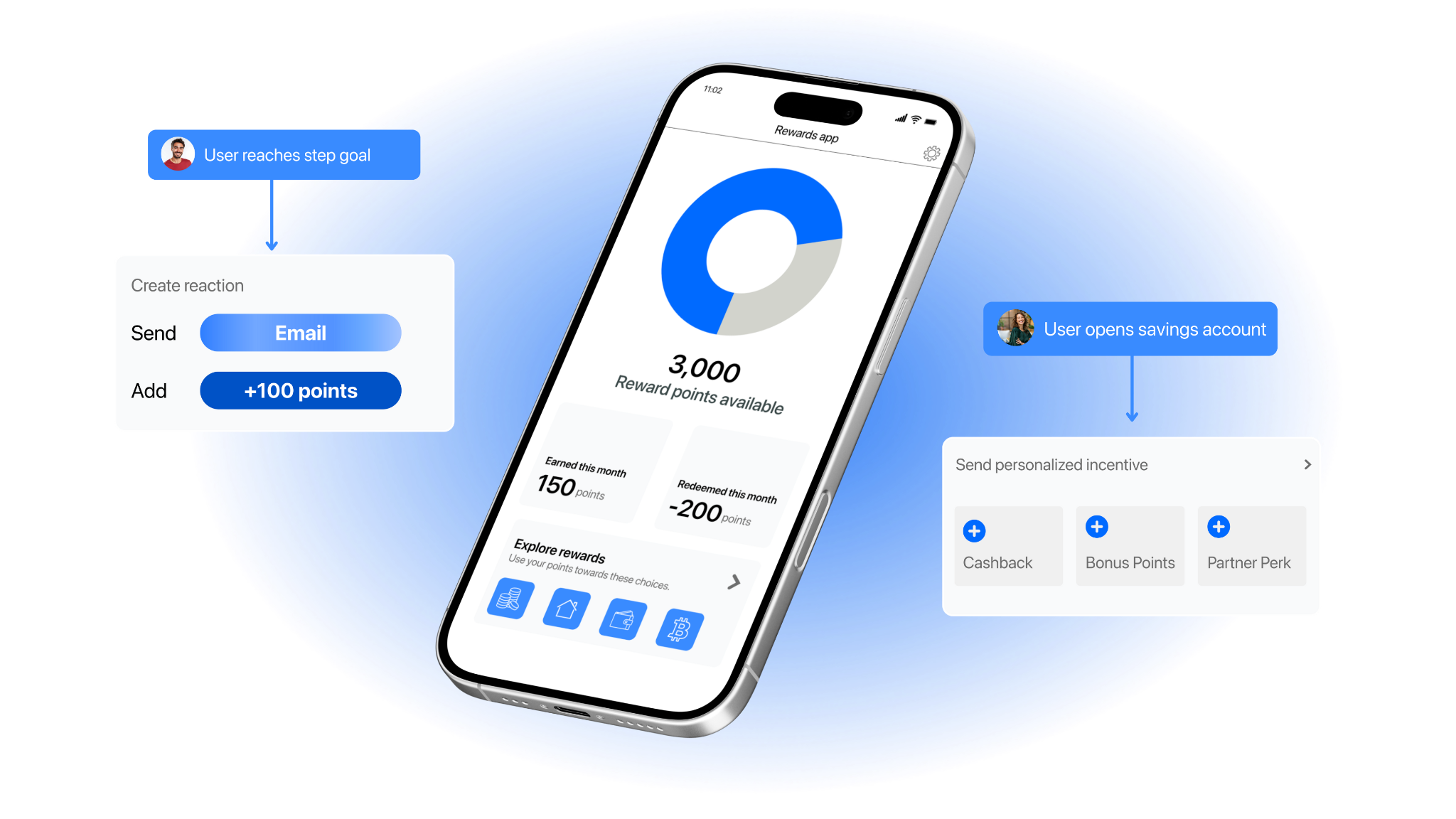
Product-led loyalty is the practice of embedding loyalty mechanics (points, tiers, rewards, referrals, gamification) directly inside the product experience, rather than running them as a separate marketing program.
It treats engagement and retention as product surfaces owned by product managers, not as campaigns owned by marketing. The reward isn't a coupon emailed later; it's the next interaction in the app.
The distinction matters. Traditional loyalty programs are adjacent to the product, a parallel system the user has to opt into and remember. Product-led loyalty is part of the product, something the user encounters in the natural flow of using it.
Why is loyalty becoming part of the product?
Three forces are pushing loyalty out of marketing and into product.
User expectations have changed. People who grew up with Duolingo streaks and Strava kudos see loyalty programs as how good products work. A separate rewards portal feels like a relic.
The economics are too good to leave to marketing alone. Bain's foundational research found that a 5% increase in customer retention can correlate with at least a 25% increase in profit. When the upside is that large, loyalty becomes too important to confine to a CRM tool that engineering touches once a year.
Loyalty mechanics now move core product metrics. Points, tiers, and rewards are driving activation, retention, feature adoption, referral K-factor, and expansion revenue. Every one of those is a metric a PM is already accountable for.
The implication: if loyalty is moving the metrics on your dashboard, it belongs on your roadmap.
What does product-led loyalty look like in practice?
A few patterns recur across the products doing this well:
- Streaks and progress mechanics that make daily engagement feel like forward motion (Duolingo, Headspace, language and fitness apps generally).
- Tiered status that unlocks real product capability, not just badges (Strava's subscriber tiers, airline status applied to in-app perks).
- Earned rewards tied to product actions (completing a workflow, inviting a teammate, hitting a usage milestone) delivered inside the product rather than via email.
- Referral loops built into the natural sharing moments of the product, with rewards that show up in the recipient's account, not a coupon code.
- Behavioral nudges that reward habits the product is trying to build (saving, learning, completing, sharing) rather than just transactions.
The common thread: every reward is anchored to a product action, and every reward shows up where the user already is.
Why building loyalty in-house slows product teams down
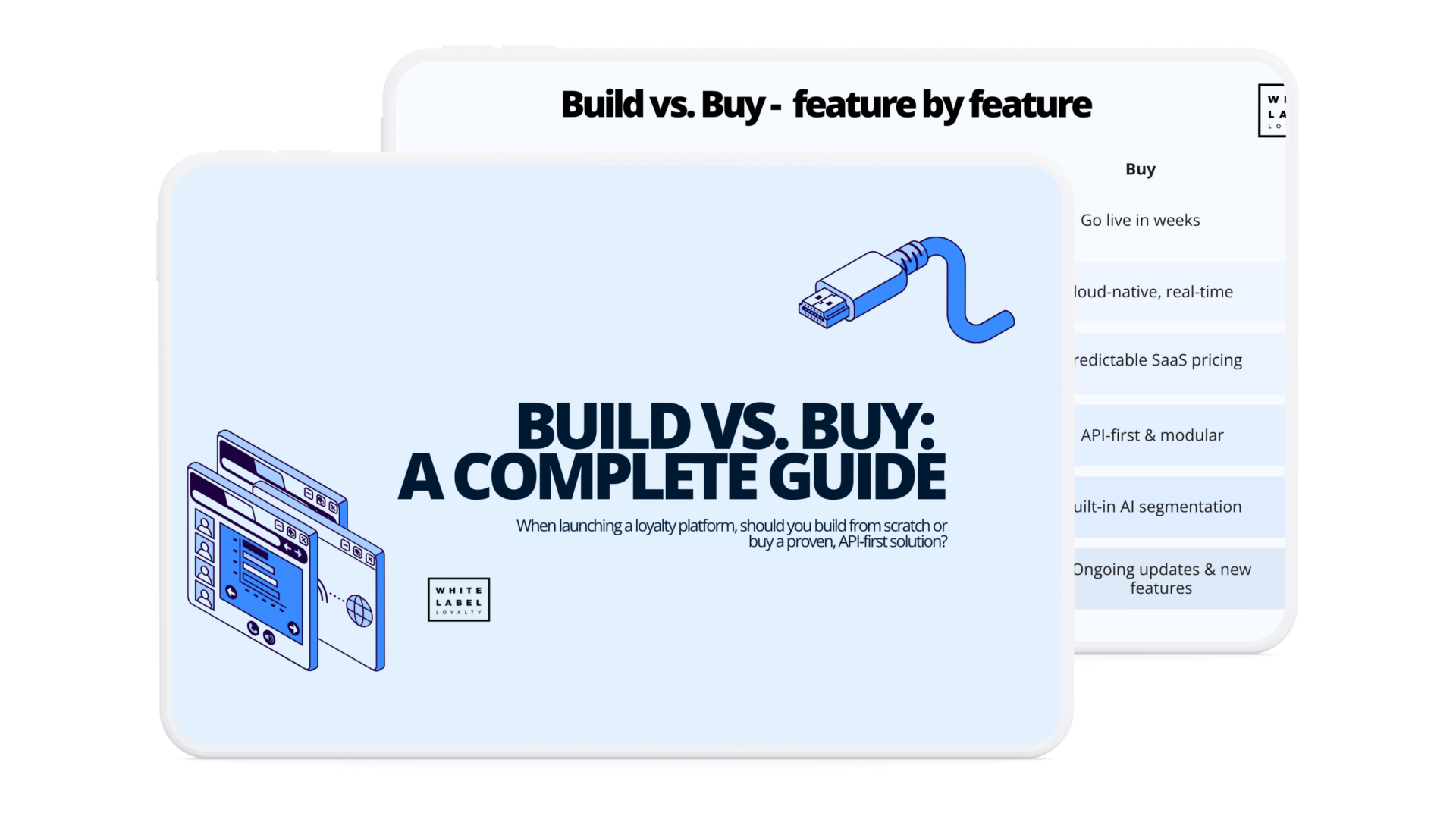
If product-led loyalty is so valuable, why isn't every product team already shipping it? Because building it from scratch is a much bigger lift than it looks.
A real loyalty system needs:
- A points engine with earning rules, expiration logic, and balance management
- A reward catalog with fulfillment, inventory, and delivery
- Tier definitions, qualification rules, and tier transitions
- Fraud detection and abuse prevention
- An admin interface so non-engineers can change rules without a deploy
- Reporting and analytics tied to user behavior
- Audience segmentation for targeting rewards to the right users
- Integrations with your CRM, CDP, billing, and analytics stack
None of that is differentiating. None of it is what your product is actually for. But all of it has to work, and it all has to keep working as the product grows.
Most teams that try to build it in-house ship a stripped-down v1, then spend the next several quarters firefighting edge cases instead of iterating on the mechanics that actually drive engagement.
That's the real cost of building loyalty in-house: not the initial build, but the permanent maintenance tax that prevents you from iterating fast enough to learn what works.
How do you add loyalty to your product without a multi-quarter build?
The answer most successful product teams have landed on is the same one they reached for analytics, payments, and authentication: use infrastructure instead of building it.
Here's the practical sequence:
- Start with the events you already track. Signups, key actions, referrals, upgrades, transactions, whatever your product already emits. These are the raw material for loyalty mechanics. You don't need a new instrumentation pass; you need to make existing events rewardable.
- Define rewards in configuration, not code. The whole point of treating loyalty as a product surface is being able to iterate on it. If changing a points rule requires an engineer and a deploy, you've recreated the problem you were trying to solve. Use a system where PMs and growth teams can change rules, rewards, and segments without touching code.
- Plug into your existing data stack. Your CRM, CDP, and warehouse already know who your users are, what they've done, and what they've bought. A loyalty system that requires a parallel data store is a maintenance burden waiting to happen. Pick infrastructure that reads from what you already have.
- Ship one mechanic first. Don't try to launch a full program at once. Pick one mechanic (a referral reward, a streak, a tier unlock) that maps to a metric you're already trying to move. Ship it, measure it, and only then add the next one.
- Measure which actions loyalty actually moves. The reason loyalty belongs in product is that you can finally close the loop: did rewarding action X actually increase retention? Did the referral mechanic move K-factor? If your loyalty system can't answer those questions, you're flying blind on what to build next.
- Treat loyalty as iterative, not launched. The best programs are tuned continuously based on what users respond to. Plan for that from day one.
This is the path the Biscuit team took when they added rewards to their pet care app: they used a flexible loyalty API to plug rewards logic directly into their product, which let them ship and iterate without standing up a parallel system.

How do you measure whether product-led loyalty is working?
The metrics are the same ones you're already accountable for as a PM. Loyalty just becomes another lever you can pull on each one:
- Activation: Are rewarded users completing key first-time actions at a higher rate?
- Retention: Are users in the program returning more often than the control group?
- Referral K-factor: Is the referral mechanic generating net-new users at a rate that justifies the reward cost?
- Expansion revenue: Are tier unlocks or rewards driving upgrades, add-ons, or higher usage?
- Engagement depth: Are rewarded users using more features, deeper, more often?
If you can attribute movement on those metrics back to specific loyalty mechanics, you've built something that earns its place on the roadmap. If you can't, you've built a marketing program in product clothing.
Conclusion
If you're a PM looking at loyalty for the first time, the trap is treating it as a program to launch. Don't. Treat it as a mechanic to test.
Pick one user action that already correlates with retention, reward it, measure whether the reward changes behavior. If it does, add another mechanic. If it doesn't, change the reward and try again.
The teams that ship product-led loyalty well aren't the ones with the most ambitious launch plan, they're the ones who can iterate fastest once it's live.
That iteration speed is the whole reason loyalty belongs in product, and the whole reason most teams are now reaching for infrastructure instead of building it themselves.
Ready to add product-led loyalty to your product without the roadmap tax? See how the loyalty API works for product teams.
Frequently Asked Questions (FAQs)
Recommended Posts
If you enjoyed this article, check out these relevant posts below.
Share this Article

Sara Rabolini
Senior Content Marketing Executive
Sara is our Senior Content Marketing Executive. She shares engaging and informative content, helping businesses stay up-to-date with the latest trends and best practices in loyalty.