No-Code Loyalty Campaigns: A Guide for Marketers
Marketing teams are under constant pressure to launch campaigns faster and prove impact, but when it comes to loyalty, they’re often stuck waiting on developers. Whether it’s setting up reward logic or making simple changes to a live campaign, even small updates can get pushed into engineering backlogs.
In many cases, teams that rely heavily on developers see campaigns delayed by weeks, missing key opportunities to engage customers when it matters most.
This bottleneck slows down time-to-market and turns what should be a dynamic growth channel into a static, hard-to-manage program.
That’s why more brands are turning to no-code loyalty platforms: solutions designed to give marketing teams full control over their campaigns without relying on technical resources.
Platforms like White Label Loyalty are built for growth, enabling marketers to launch data-driven loyalty campaigns and optimize performance in real time, all from a single, intuitive interface.
In this guide, you’ll learn how to launch loyalty campaigns without developers using a proven, step-by-step framework. We’ll also explore real-world campaign examples and break down what to look for in a loyalty marketing platform.
TL;DR: Why you need a no-code loyalty platform
- Marketing teams often rely on developers to launch loyalty campaigns, slowing down execution and limiting experimentation.
- No-code loyalty platforms remove this bottleneck by giving marketers full control over campaigns.
- With the right tools, teams can define triggers, configure rewards, and launch campaigns independently.
- Real-world examples (like Dubai Holding and ARDEX) show how both B2C and B2B brands can scale loyalty without engineering support.
- The key is choosing a platform that combines flexibility, real-time data, and seamless integrations.
Why marketers are still blocked by developers
Despite loyalty being a core driver of retention and customer lifetime value, many marketing teams still don’t fully own it. The reason? Traditional loyalty systems were never designed with marketers in mind.
Historically, loyalty programs have been hard-coded and heavily dependent on engineering teams. Every element (from reward structures to campaign rules and triggers) often needs to be built, tested, and deployed by developers. Even simple changes, like adjusting a points multiplier or launching a limited-time offer, can require technical input.
This creates lots of familiar challenges:
- Long lead times that slow down campaign launches
- Missed seasonal opportunities, where campaigns can’t go live in time
- Limited experimentation, because testing new ideas requires dev resources
- Static programs that quickly become outdated and less engaging
As a result, loyalty becomes less of a growth channel and more of a maintenance task: something that runs in the background rather than actively driving engagement.
But this model is quickly changing. Modern loyalty marketing software is shifting control away from engineering and into the hands of marketers, helping teams to launch data-driven loyalty campaigns that increase retention and engagement without relying on developers or discounts.
What no-code loyalty platforms actually do
The term “no-code loyalty platform” gets used a lot, but in practice, it doesn’t mean removing technology altogether, just removing dependency. Marketing teams can design, launch, and continuously optimize loyalty campaigns themselves, without needing developers for every change.
In loyalty marketing, “no-code” is about giving marketers direct control over the mechanics that drive engagement (from defining customer behaviors to configuring rewards) through an intuitive interface rather than code.
At their core, modern no-code loyalty platforms provide a few key capabilities:
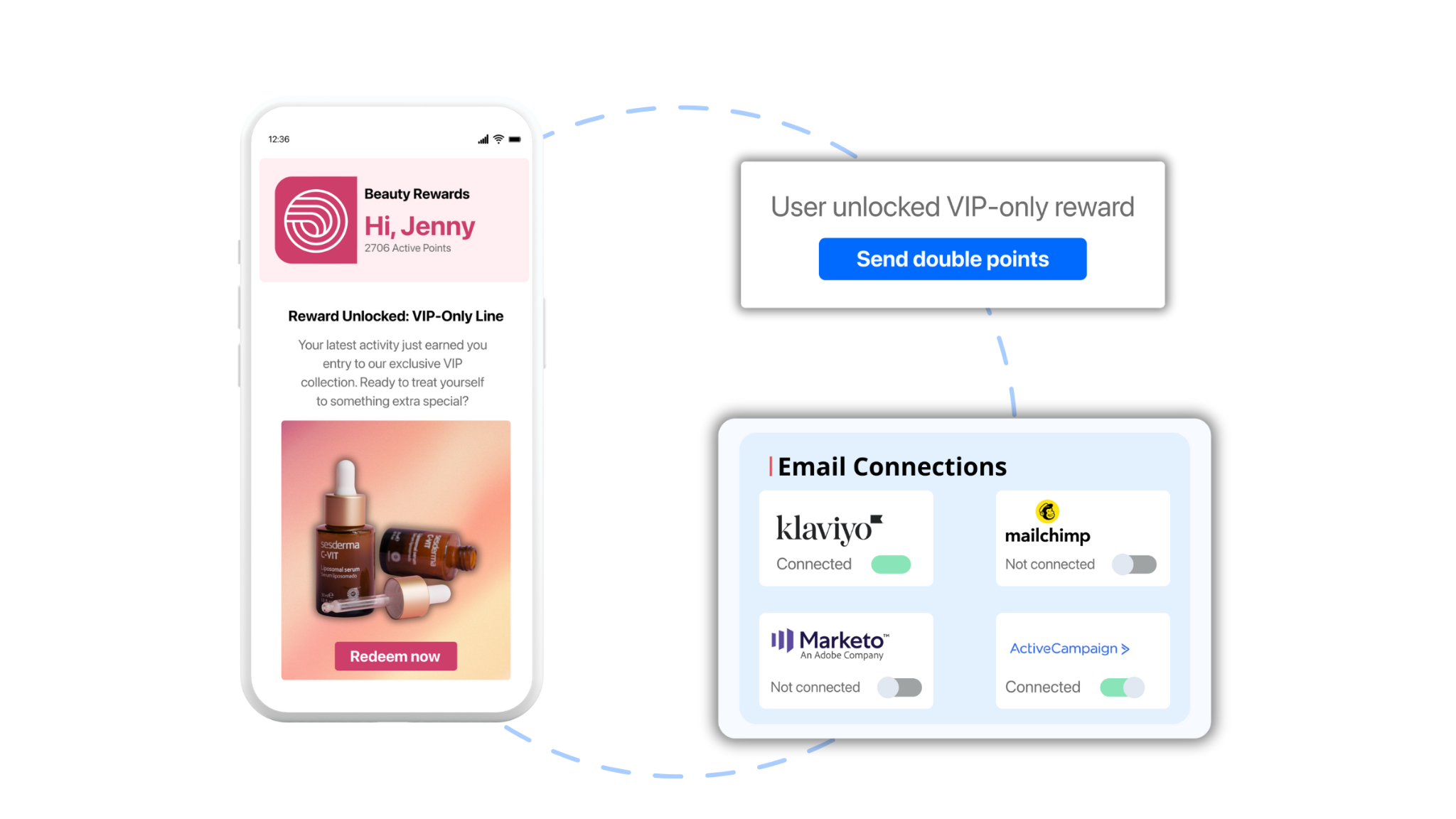
- Full control over campaigns: Marketers can set up rules and rewards without writing a single line of code. Whether it’s launching a double points promotion or creating a referral incentive, everything can be configured and adjusted in real time.
- Clear data and analytics: Every customer action and reward outcome is visible in a centralized, real-time dashboard. This makes it easy to track performance, attribute repeat purchases or referrals, and understand exactly what’s driving results.
- Personalization at scale: Using behavioral data, marketers can deliver targeted offers and rewards at the right moment, creating more relevant and engaging loyalty experiences without manual effort.
- Seamless integrations: No-code doesn’t mean working in isolation. The best platforms integrate directly with your existing stack (including tools like HubSpot, Salesforce, Klaviyo, and Shopify) along with thousands of other tools, so loyalty campaigns can connect with the rest of your marketing ecosystem.
Ultimately, the goal is simple: remove friction, increase speed, and give marketing teams the autonomy to experiment and scale what works, with no coding or manual complexity required.
No-code vs Developer-led loyalty programs
When it comes to loyalty programs, businesses generally have two approaches: traditional developer-led setups or modern no-code platforms. Understanding the difference helps marketing teams choose the right solution for growth.
Feature | Developer-led loyalty | No-code loyalty platform |
| Setup | Requires engineering resources for every change | Marketers can configure campaigns visually, no coding needed |
| Speed to Launch | Weeks or months for updates | Hours or days for campaigns |
| Flexibility | Limited; hard-coded rules are difficult to change | Fully flexible rules, triggers, and rewards that can be adjusted anytime |
| Testing & Iteration | Slow, dependent on dev cycles | Rapid A/B tests and real-time optimization |
| Data & Insights | Often siloed and difficult to access | Centralized dashboards with real-time analytics |
| Scalability | Scaling requires more development effort | Scale campaigns across channels and customer segments effortlessly |
Key takeaway: No-code platforms remove bottlenecks, giving marketing teams full control, while developer-led programs often slow down execution and innovation.
Step-by-step framework: launch campaigns without developers
One of the biggest advantages of a no-code loyalty platform is the ability to move from idea to live campaign quickly, without waiting on engineering. Below is a practical, repeatable framework marketing teams can use to launch and scale loyalty campaigns without developers.
5-step framework to launch loyalty campaigns without developers
Step | What to do | Example |
| 1. Define behaviors | Identify the actions you want to reward | Repeat purchases, referrals, app logins |
| 2. Set triggers & rules | Choose event-based triggers and conditions | “Purchase over €50” or “3 logins in 7 days” |
| 3. Configure rewards | Assign incentives that drive action | Points, cashback, tier upgrades |
| 4. Launch & iterate | Go live quickly and test variations | A/B test double points vs cashback |
| 5. Analyze & optimize | Measure impact and refine campaigns | Track revenue, engagement, retention |
1. Define the customer behaviors you want to reward
Start with the outcome. What actions actually drive retention, engagement, or revenue for your business? Common examples include:
- Purchases (first-time or repeat)
- Referrals and invites
- Product reviews or ratings
- App logins or repeat visits
- Social engagement
By focusing on high-impact behaviors, you ensure your customer loyalty program and loyalty strategy are aligned with real business goals.
2. Choose triggers and rules
Next, translate those behaviors into event-based triggers, the actions that will activate your campaign. For example, a purchase completed, a referral sent, a user logging in 3 times in a week, etc.
Then layer in rules to control how and when rewards are issued:
- Threshold-based (e.g. spend €50, earn reward)
- Time-based (e.g. double points this weekend)
- Segment-based (e.g. new vs returning customers)
This is where modern loyalty platforms really stand out, allowing marketers to configure complex logic in their own loyalty program without code.
3. Configure rewards
Once your logic is in place, define the incentives that will motivate action and customer engagement. These might include:
- Loyalty points or cashback
- Discounts or perks
- Exclusive access or experiences
- Tier upgrades or status-based rewards
The key is flexibility. With the right platform, you can build real-time, personalized loyalty journeys that automatically respond to customer feedback, with no manual intervention required.
4. Launch, test, and iterate
Instead of long development cycles, campaigns can be launched quickly and refined over time. Marketing teams can:
- Run fast experiments
- Test different reward structures or conditions
- Adjust campaigns based on performance
With real-time dashboards, you can see what’s working and optimize on the fly, without waiting weeks for results.
5. Analyze and optimize performance
The final step is turning customer data into action. A strong loyalty marketing software will allow you to:
- Attribute revenue directly to specific campaigns
- Track engagement, spend, and redemption
- Identify high-performing customer segments
- Focus retention spend where it delivers the most impact
By following this framework, marketing teams can take full ownership of their loyalty strategy, launching, testing, and scaling campaigns independently, without developer bottlenecks.
Real-world examples: what marketers can launch without developers
The shift to no-code loyalty platforms is already transforming how both B2C and B2B brands launch and scale campaigns. From large-scale consumer apps to complex manufacturing ecosystems, marketing teams are taking control of loyalty and driving measurable results without relying on developers.
Here are two examples that show what’s possible.
Transforming customer loyalty at scale: Tickit by Dubai Holding (B2C)
When Dubai Holding set out to build Tickit, their goal was ambitious: create a seamless, digital-first loyalty experience that could work across thousands of outlets and brands.
Before launching the program, the experience was fragmented:
- Customers had to scan receipts or present apps at checkout
- Earning points was limited to specific brands
- Redemption was manual and cumbersome
Using White Label Loyalty, the marketing team was able to completely redesign the experience, without adding friction or complexity. With card-linking technology, users can now automatically earn and redeem points by simply paying with their Visa or Mastercard and access rewards across 3,000+ outlets and 300+ brands.
The results speak for themselves:
- Became the 2nd largest loyalty program in the UAE in under a year
- Rapid early growth, with strong user adoption from launch
- Consistent engagement driven by a frictionless experience
This is a clear example of how marketers can launch high-impact, omnichannel loyalty campaigns, turning everyday transactions into engagement opportunities, all without relying on developer-heavy processes.

Reshaping loyalty in manufacturing: ARDEX / BAL (B2B)
Loyalty isn’t just for consumer brands. In fact, some of the biggest opportunities lie in traditionally underserved sectors like manufacturing.
For ARDEX Group, the challenge was very different:
- Limited visibility into end-customer behavior
- Difficulty building loyalty in a price-driven market
- Complex distribution networks with indirect relationships
To address this, ARDEX launched a digital loyalty program (GivBax Rewards) designed to engage customers directly, something rarely seen in their industry.
With White Label Loyalty, their marketing team was able to reward purchases across any distributor using receipt scanning, offer cashback incentives to stand out from competitors, and collect valuable first-party data on customer behavior.
The impact was immediate:
- 73% engagement rate within six months
- 17% of the total addressable market acquired in that time
- 10%+ increase in total spend per user
- Nearly 9% of total sales driven through the program
This shows how even in complex B2B environments, marketers can launch data-driven loyalty campaigns that drive real business outcomes, without needing custom-built systems or ongoing developer support.

These examples highlight how, with the right platform, loyalty becomes a marketing-led growth channel that can be launched, tested, and scaled quickly across industries.
What to look for in a no-code loyalty platform
Not all no-code loyalty platforms are created equal. While many claim to give marketers more control, the reality is that some still rely heavily on technical setup or lack the flexibility needed to scale.
If your goal is to truly launch and manage loyalty campaigns without developers, there are a few essential features to look for:
- Full control & no coding required: The platform should allow marketing teams to independently create and launch campaigns. This includes configuring rules and rewards without engineering support, so you can move quickly and adapt in real time.
- Clear, real-time analytics dashboards: Visibility is critical. You should be able to track every customer interaction and outcome in one place, with real-time insights into what’s driving engagement, retention, and revenue.
- Personalization at scale: Modern loyalty isn’t one-size-fits-all. Look for platforms that use behavioral data to power personalized loyalty journeys, delivering the right reward or message at the right moment automatically.
- Seamless integration with your marketing stack: Your loyalty platform should connect easily with the tools you already use so campaigns don’t operate in isolation.
- Real-time performance tracking and optimization: The ability to launch quickly is only half the equation. You also need to test and optimize campaigns continuously, adjusting rules and targeting based on live performance data.
Ultimately, the right platform should remove complexity, not add to it. It should give marketing teams everything they need to build, automate, and scale campaigns from a single place.
Conclusion
Loyalty has traditionally been seen as a complex, developer-led initiative, but that model no longer fits how modern marketing teams operate.
Today, speed, flexibility, and experimentation are critical. Waiting weeks to launch a campaign or make a simple adjustment is a missed opportunity to engage customers and drive growth.
With no-code loyalty platforms, marketers can take full ownership of their strategy. From defining customer behaviors to launching personalized campaigns and measuring real impact, everything can be managed from a single, intuitive interface.
If you’re looking to build data-driven loyalty campaigns without developers, now is the time to rethink how your program is set up and who really controls it.
Explore how a no-code loyalty platform can help your marketing team launch campaigns faster.
Frequently Asked Questions (FAQs)
Recommended Posts
If you enjoyed this article, check out these relevant posts below.
Share this Article

Sara Rabolini
Senior Content Marketing Executive
Sara is our Senior Content Marketing Executive. She shares engaging and informative content, helping businesses stay up-to-date with the latest trends and best practices in loyalty.
Post Tags