Points-Based vs Event-Driven Loyalty Programs: What's the Difference?
Most loyalty programs still work the same way they did in 1981, when American Airlines launched the first frequent flyer scheme: spend money, earn points, redeem for something. It's simple, familiar, and for a growing number of brands, it’s also no longer enough.
The way customers relate to brands has changed fundamentally. They expect to be recognised not just when they open their wallets, but when they write a review, refer a friend, complete their profile, or show up to an event. A points-for-purchases model simply can't capture that relationship.
That's where event-driven loyalty programs come in. This guide explains both models clearly, compares them head-to-head, and helps you decide which (or which combination) is right for your business.
What is a points-based loyalty program?
A points-based loyalty program is a system where customers earn a fixed number of points for each purchase (or pound/dollar spent), then redeem those points for discounts, products, or other rewards. The mechanics are transactional: spend money → earn points → redeem points.
Points-based programs are the most common loyalty format in the world. Supermarket loyalty cards, airline miles, hotel rewards, almost all of them are built on some variation of this model.
Classic example: A coffee chain offers 1 point per £1 spent. Members who accumulate 100 points get a free coffee. Nothing else, no recognition for writing a review, downloading the app, or visiting 10 days in a row, earns rewards.
Pros and cons of a points-based loyalty program
Pros
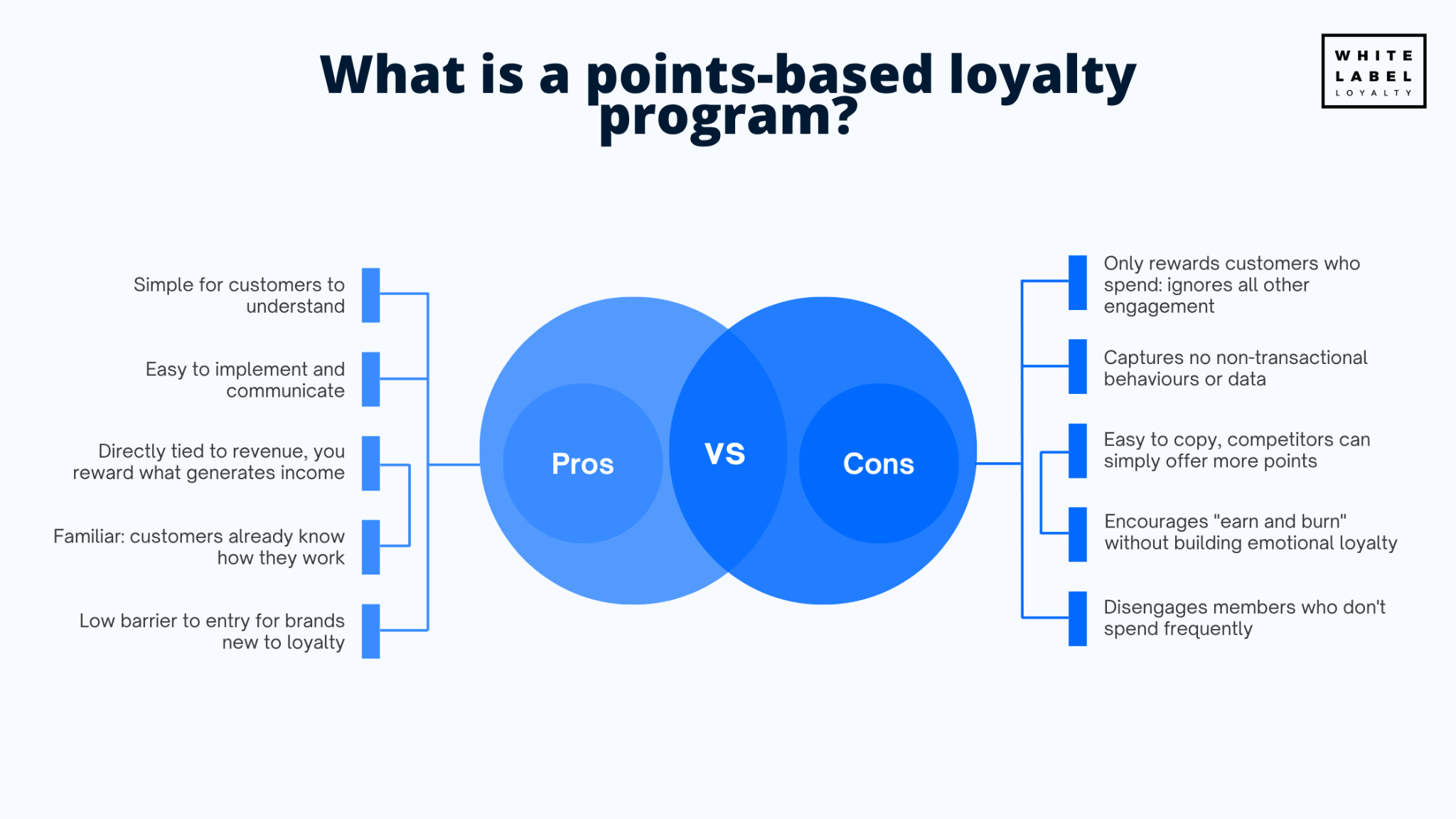
Simple for customers to understand
Easy to implement and communicate
Directly tied to revenue, you reward what generates income
Familiar: customers already know how they work
Low barrier to entry for brands new to loyalty
Cons
Only rewards customers who spend: ignores all other engagement
Captures no non-transactional behaviours or data
Easy to copy, competitors can simply offer more points
Encourages "earn and burn" without building emotional loyalty
Disengages members who don't spend frequently
The fundamental limitation of a pure points-for-purchases model is that it confuses retention mechanics with loyalty. A customer who earns points is not necessarily loyal, they may simply be locked in. When a competitor offers a better deal, they leave.
What is an event-driven loyalty program?
An event-driven loyalty program (also called an event-based loyalty program) is a system that rewards customers for any defined behaviour, and not just purchases.
The program is powered by a loyalty engine that listens for specific customer actions ("events"), then automatically triggers a configured response: awarding points, sending a personalised offer, unlocking a tier, issuing a badge, and so on.
The core idea is simple: instead of treating loyalty as a cash-back mechanism, you treat it as a two-way relationship. You recognise customers whenever they do something meaningful, whether that's making a purchase, writing a review, referring a friend, checking in at a venue, sharing something on social media, or completing their profile.
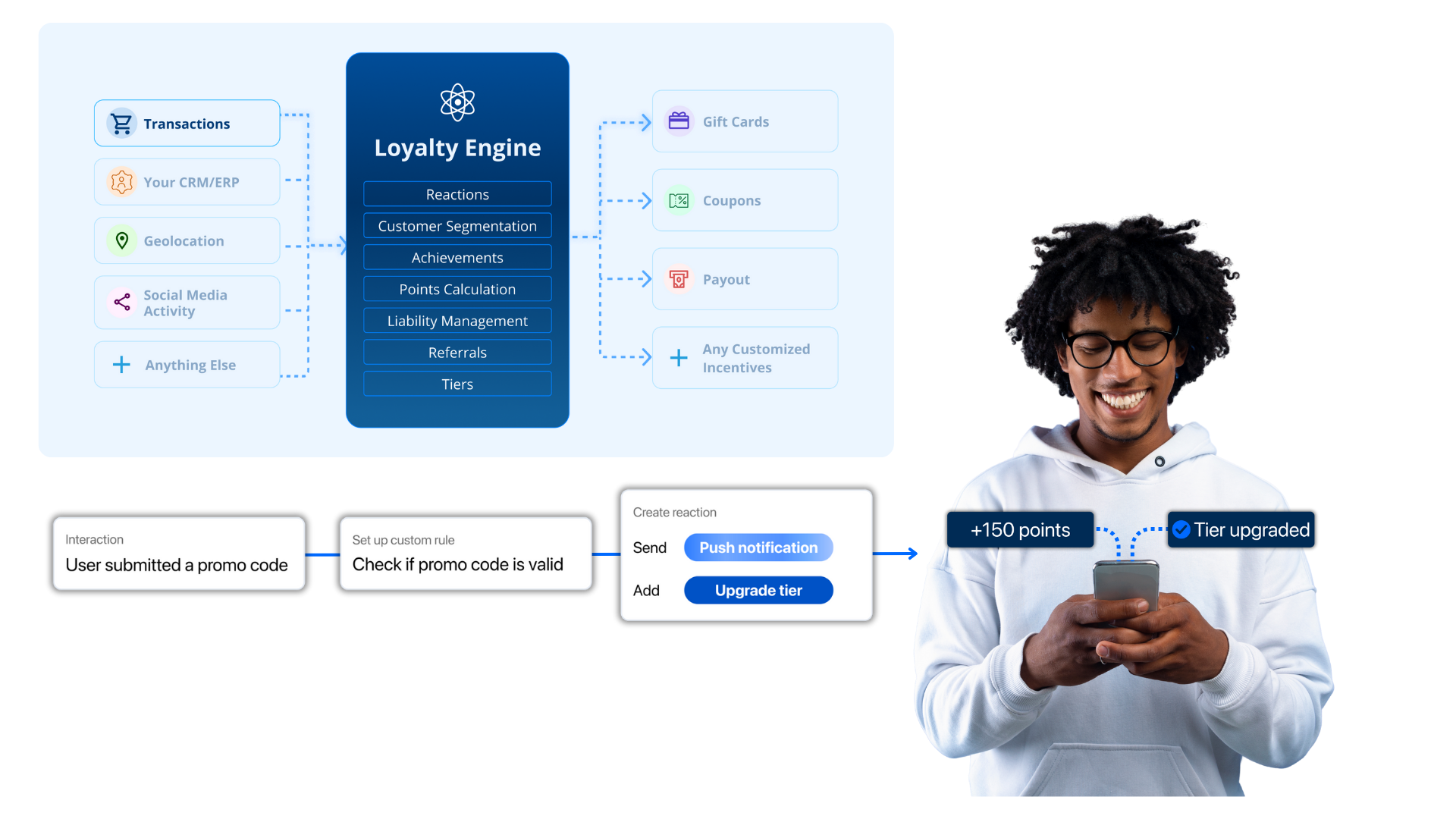
Event-driven example: A retailer's loyalty engine fires a "product_reviewed" event when a customer submits a review. The reactor automatically awards 50 points and sends a personalised message. When the same customer refers a friend who makes a first purchase, a "referral_converted" event triggers a £10 reward voucher. Both actions are tracked, building a richer customer profile that improves future personalisation.
The technical backbone of this model is a loyalty engine: a rules engine that maps events to reactions. At White Label Loyalty we have an API-first engine that lets you define any event type, set rules for how to respond, and trigger rewards or communications in real time.
Strengths
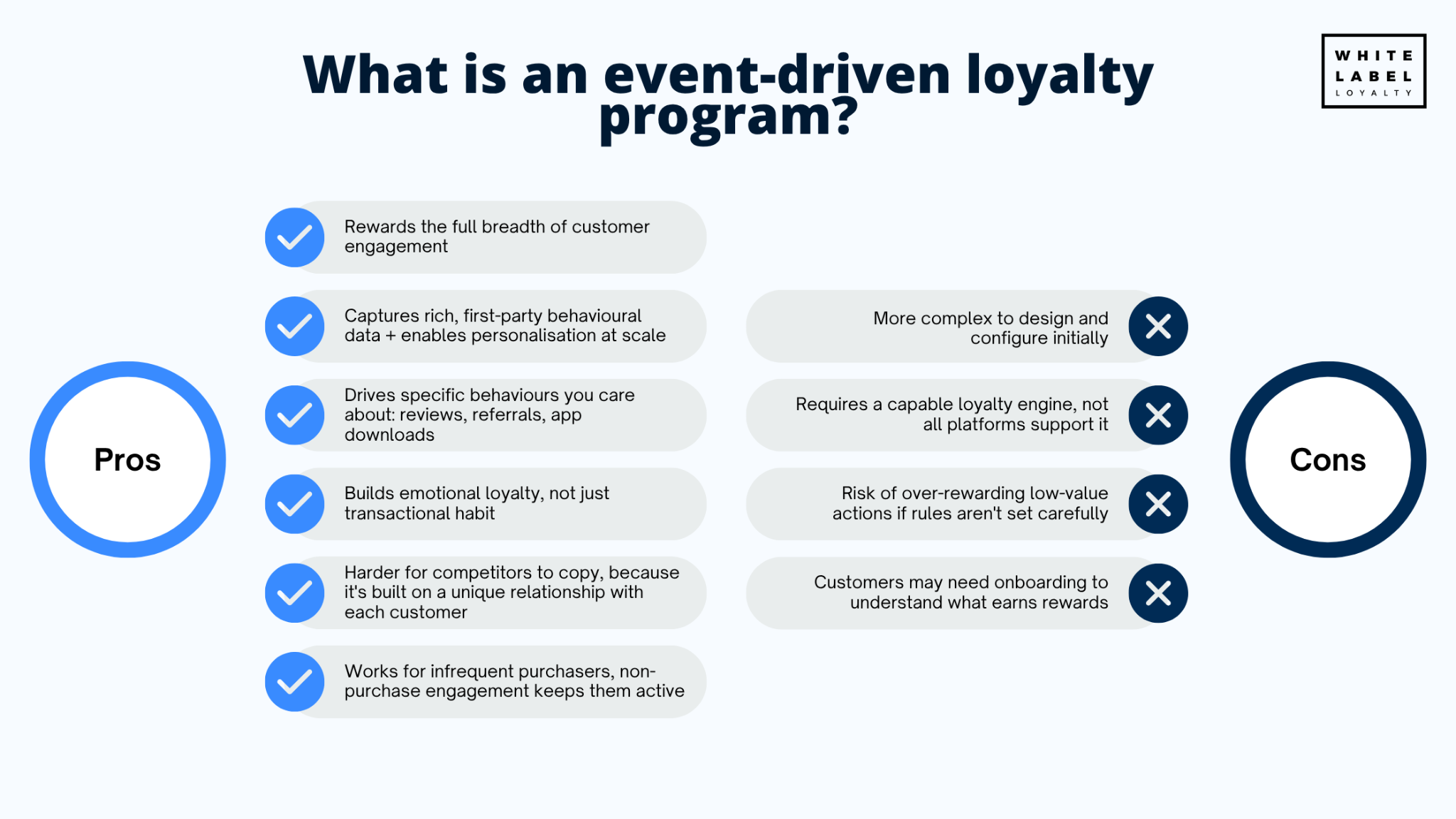
- Rewards the full breadth of customer engagement
- Captures rich, first-party behavioural data
- Enables personalisation at scale
- Builds emotional loyalty, not just transactional habit
- Harder for competitors to copy, because it's built on a unique relationship with each customer
- Drives specific behaviours you care about: reviews, referrals, app downloads
- Works for infrequent purchasers, non-purchase engagement keeps them active
Limitations
- More complex to design and configure initially
- Requires a capable loyalty engine, not all platforms support it
- Risk of over-rewarding low-value actions if rules aren't set carefully
- Customers may need onboarding to understand what earns rewards
Points-based vs event-driven: head-to-head comparison
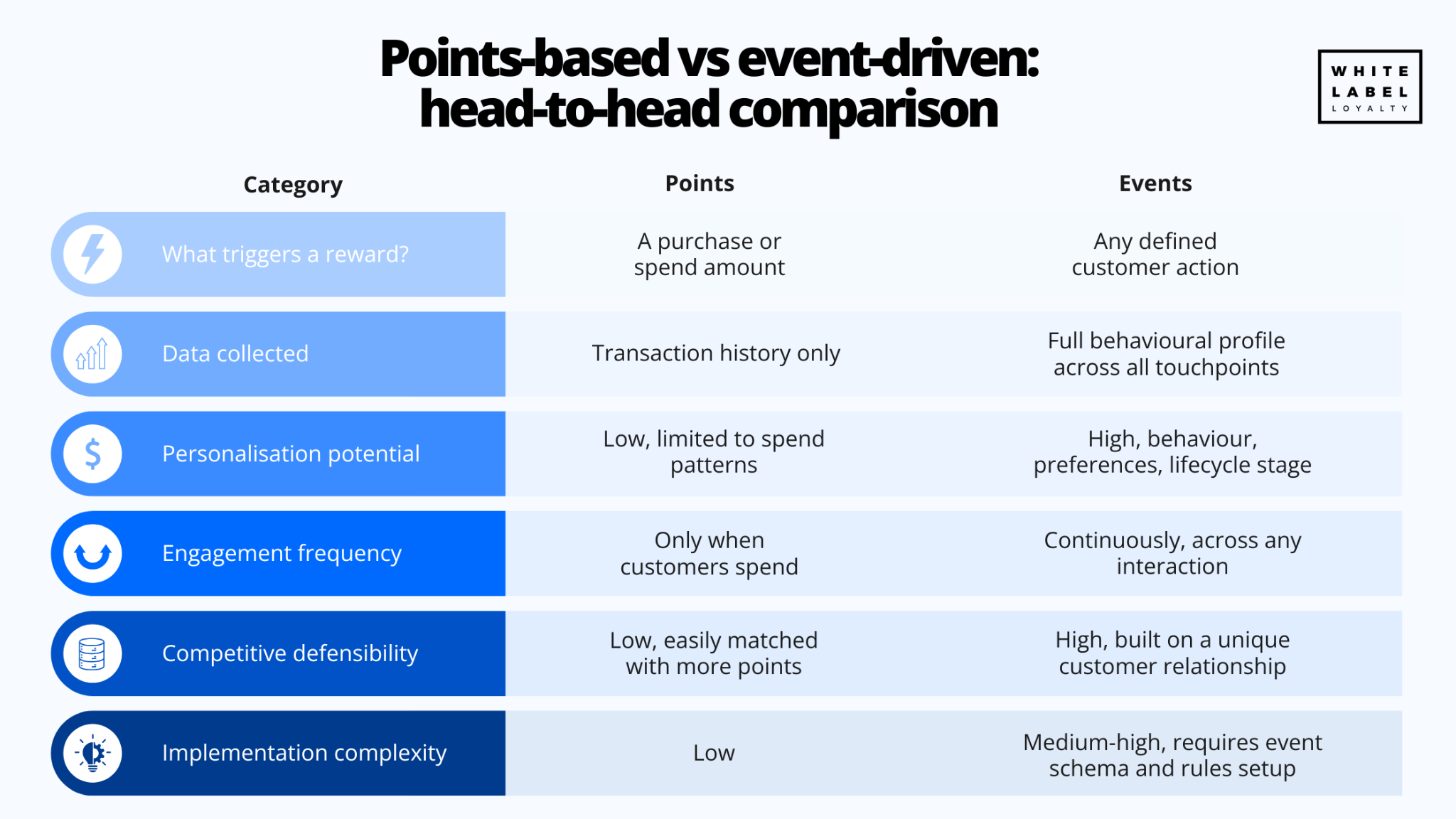
Dimension | Points-based | Event-driven |
| What triggers a reward? | A purchase or spend amount | Any defined customer action |
| Data collected | Transaction history only | Full behavioural profile across all touchpoints |
| Personalisation potential | Low, limited to spend patterns | High, behaviour, preferences, lifecycle stage |
| Engagement frequency | Only when customers spend | Continuously, across any interaction |
| Emotional connection | Transactional, customers feel rewarded, not recognised | Relational, customers feel seen and valued |
| Competitive defensibility | Low, easily matched with more points | High, built on a unique customer relationship |
| Works for infrequent buyers? | Poorly, they disengage quickly | Yes, non-purchase engagement keeps them active |
| Implementation complexity | Low | Medium-high, requires event schema and rules setup |
| Best for | High-frequency, transaction-heavy categories (grocery, QSR, fuel) | Most industries; especially B2C brands seeking retention and data |
When points-based programs still make sense
We'd be doing you a disservice if we dismissed points-based programs entirely. They remain valuable in specific contexts.
High-frequency, commodity categories. If your customers buy from you multiple times a week, grocery, petrol, quick-service restaurants, a simple points mechanic is frictionless and effective. Customers don't need elaborate event logic when the purchase itself is already the primary engagement.
Regulated industries. Financial services and healthcare businesses often face strict limits on what non-transactional behaviours they can incentivise. A points-per-purchase model may be the appropriate fit.
Early-stage programs. If you're launching loyalty for the first time, starting with a simple points-for-purchases program lets you build the habit before adding complexity. You can layer event-driven mechanics on top once members are engaged.
When event-driven programs are the right choice
Event-driven loyalty programs are the stronger choice in most modern contexts, particularly when:
- You want first-party data. As third-party cookies disappear, the behavioural data you collect through a loyalty program is becoming your most valuable marketing asset. Event-driven programs capture a depth of insight that a simple points tally never could: what customers do between purchases, what content they engage with, what motivates them to refer others.
- Your customers don't buy frequently. A B2B platform, a luxury goods brand, or a travel company may have customers who only transact a few times a year. An event-driven program keeps those customers engaged, through content, community, milestones, and recognition, in the months between purchases.
- You want to drive specific behaviours. Need more reviews? More referrals? More app downloads? You can design an event-driven program to reward exactly those actions, turning your loyalty program into a precision behaviour-change tool.
- You sell across multiple channels. Event-driven systems handle omnichannel complexity naturally. Whether a customer buys in-store, clicks an email, scans a QR code at an event, or engages on your app, each touchpoint can fire a loyalty event, creating a unified picture of the customer relationship.
The smarter approach: combining both
The most effective modern loyalty programs don't choose between points and events, they use event-driven infrastructure with points as one of many reward currencies.
In practice: a customer earns 10 points per pound spent (classic points mechanic), and earns 50 points for submitting a review, and gets a personalised double-points event triggered on their birthday, and unlocks a VIP tier badge when they refer three friends.
Points give customers a familiar, tangible currency. Event-driven logic gives your program the flexibility, personalisation, and data richness to build genuine loyalty, not just habit. The key insight is that points are a reward type, not a program architecture. Event-driven is the architecture; points live comfortably within it.
How White Label Loyalty supports both models
White Label Loyalty was built from the ground up as an event-driven platform. Our Loyalty Engine models every customer interaction as an event stream, which means you can reward any action, not just purchases, and configure your own rules for what happens when each event fires.
At the same time, points remain a core reward currency within the platform. You can configure earn rates per transaction, set up multipliers for specific product categories, and let members redeem points for vouchers, gift cards, experiential rewards, or charitable donations.
The result: your loyalty program can be as simple or as sophisticated as your business needs, starting with a straightforward earn-and-burn mechanic if needed, and expanding to full behavioural loyalty as you mature.
Brands including PepsiCo, Burger King, and Ford have used our platform to move beyond transactional loyalty into programs that reward the full customer relationship. Get in touch with our loyalty experts now!
Frequently Asked Questions (FAQs)
Recommended Posts
If you enjoyed this article, check out these relevant posts below.
Share this Article

Sara Rabolini
Senior Content Marketing Executive
Sara is our Senior Content Marketing Executive. She shares engaging and informative content, helping businesses stay up-to-date with the latest trends and best practices in loyalty.