B2B Channel Loyalty Programs: Close the Marketing Lag
Most B2B manufacturers believe they already have what they need to market to their customers. New research from White Label Loyalty suggests otherwise.
In a March 2026 survey of Ecommerce Directors, Commercial Directors, and Marketing Directors at mid-market and enterprise B2B manufacturers across the UK, Europe, and the US, 72% said they own first-party customer data.
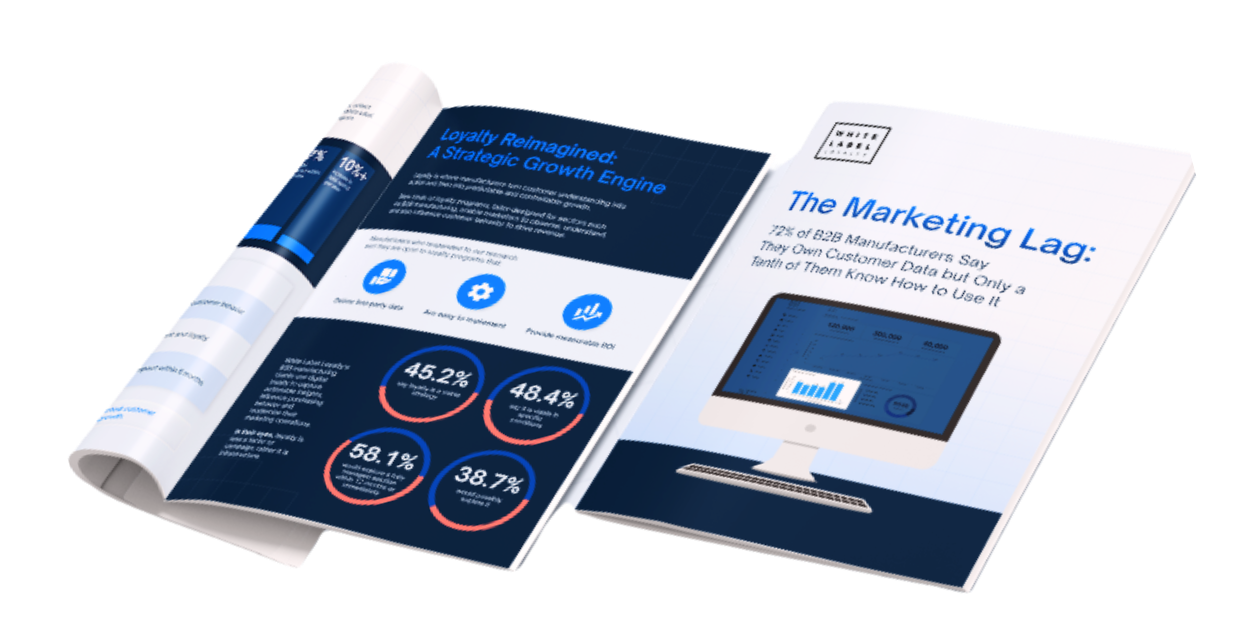
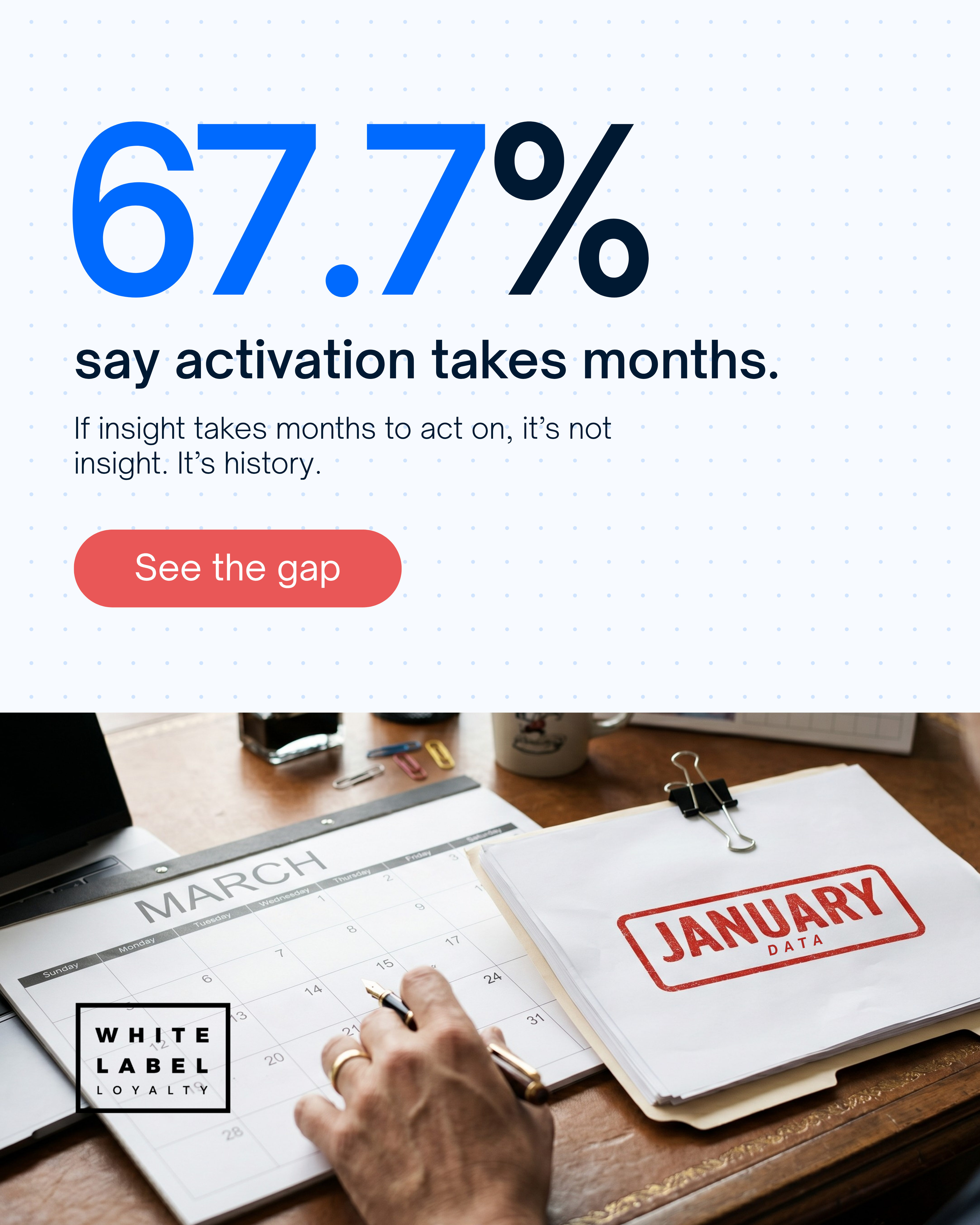
But when asked how well they actually use it, the picture looked very different: only 9.7% said they can activate that data in real time, 67.7% said activation takes months or they struggle to do it at all, and just 6% said they understand end-customer behaviour "extremely well."
White Label Loyalty calls this the B2B Manufacturing Marketing Lag: the gap between believing you own customer data and being able to act on it when it matters.
For most B2B manufacturers, this lag hands the advantage to competitors who are moving faster, owning the customer relationship more directly, and making better decisions because of it. Channel partner loyalty programs are one of the most powerful tools for closing that gap.
Curious what that gap is costing your business specifically? Calculate your Loyalty ROI to see the potential revenue impact before reading on.
What is a B2B channel partner loyalty program?
A channel partner loyalty program is a structured incentive framework that rewards the businesses and individuals in your indirect sales network for behaviours that drive your growth: purchases, product advocacy, certifications, referrals, training completion, and more.
Unlike direct B2B loyalty (where you reward a client for buying more from you), channel loyalty operates one step removed. You're shaping how a partner engages with your brand, how much they know about your products, and how motivated they are to recommend you over a competitor.
Common partner types covered by these programs include:
- Distributors and wholesalers: rewarded for volume, new SKU adoption, and data sharing
- Resellers and VARs (Value-Added Resellers): rewarded for sales performance, certifications, and deal registration
- Installers and contractors: rewarded for verified product use, brand advocacy, and training
- Agents and brokers: rewarded for lead quality, conversions, and client retention
The real problem: you don't know your channel as well as you think
The Marketing Lag research makes the disconnect concrete. When manufacturers were asked how well they understand end-customer buying behaviour, only 6% said "extremely well." The majority (61.3%) said "fairly well" at best.
That's a meaningful gap for any brand trying to compete on more than price.
The problem isn't the absence of data. It's the absence of actionable data: insight that arrives fast enough to influence a decision, personalise a message, or catch a customer before they switch to a cheaper alternative.
Traditional trade marketing doesn't solve this. According to the same research, 78% of manufacturers say trade promotions either drive short-term spikes in behaviour or fail to drive behaviour change at all. Discount a product, see a temporary lift, watch it disappear the moment the promotion ends. The cycle repeats without building anything durable.
The manufacturers in WLL's research who are moving beyond this model share a common characteristic: they've stopped treating loyalty as a campaign and started treating it as infrastructure.
Why channel partner loyalty is different from standard B2B loyalty
The same loyalty logic applies (reward behaviours that create value) but the execution is more complex. A few key differences:
- You often don't own the customer relationship. Your distribution partner does. That means you have limited visibility into what's being bought, when, and by whom. A loyalty program is partly a data strategy: getting that visibility back before a competitor does.
- The buyer is also a seller. A distributor or reseller isn't just consuming your product — they're deciding whether to actively promote it. Loyalty mechanics need to reward advocacy, not just purchasing.
- Rewards need to fit business contexts. Individual B2C rewards (a gift card, a free coffee) often don't fit here. Channel partners may need account-level incentives, co-marketing funds, tiered rebates, exclusive training access, or early product availability.
- Multiple stakeholders within one account. The account manager at a distribution company, the sales rep on the ground, and the technical installer all have different motivations. Effective programs can address them separately.
What channel partner loyalty programs reward
The most effective programs reward a mix of financial and non-financial behaviours:
- Purchase and sales activity Points or rebates for verified purchases, hitting volume thresholds, growing sales of target SKUs, or registering deals through your system.
- Training and certification Partners who understand your product sell more of it and churn less. Rewarding completed training modules, certifications, or product demos drives long-term performance — not just short-term purchases.
- Referrals and advocacy Rewarding partners for referring new clients or sharing positive experiences in their network turns your channel into a growth engine, not just a distribution network.
- Data sharing In many industries, getting sell-through data from distributors is a major challenge. Incentivising data sharing (purchase records, customer information, secondary sales data) gives you the visibility to run smarter marketing. This directly addresses the data activation gap the Marketing Lag research identifies.
- Events and engagement Attending trade days, product launches, or brand events is a loyalty signal worth recognising. Scanning a code at an event to earn bonus points is a simple mechanic that deepens the relationship.
The technology behind channel partner loyalty
Running a channel partner loyalty program manually (tracking rebates in spreadsheets, sending gift cards manually, reconciling invoices from dozens of distributors) is both operationally expensive and impossible to scale. More critically, it's slow. And as the Marketing Lag research shows, speed of data activation is where most manufacturers are already falling behind.
Modern loyalty platforms automate the heavy lifting and, critically, close the activation lag:
- Receipt and invoice scanning lets partners upload proof of purchase from any distributor or retailer. Computer vision reads the invoice, identifies your SKUs, and triggers the reward automatically: no manual verification, no delay.
- Event-based reward logic means any action can be made rewardable: a product scan, a certification completion, a referral, a survey response. You define what matters, the platform handles the rest in real time.
- ERP and CRM integration syncs sales and partner activity automatically, giving you a single, up-to-date view of each account without manual data entry.
- Multi-tier program management lets you run different rules for different partner types: distributors, resellers, and installers can each have their own earning and redemption mechanics from one platform.
- Real-time analytics show which partners are engaging, which mechanics are driving results, and where you're at risk of losing a key relationship, before it's too late to act.
The Marketing Lag research found that only 9.7% of manufacturers can currently activate customer data in real time. A well-integrated loyalty platform is, for many manufacturers, the fastest route to joining that minority.
Case Study: how ARDEX closed the gap
ARDEX Group UK, a manufacturer in the flooring and tiling sector, faced a challenge familiar to many manufacturers: they sold through a complex distribution network but had almost no direct visibility into who was buying their products, how often, or why.
They also faced a competitive pricing problem. ARDEX makes premium products. They couldn't (and didn't want to) win on price. They needed a different kind of leverage.
Working with White Label Loyalty, ARDEX built GivBax Rewards: a digital loyalty program that rewarded installers and contractors for purchasing ARDEX and BAL products from any distributor, anywhere in the UK. Using receipt scanning technology, customers could upload any invoice, physical or digital, and be rewarded instantly, without needing to change where or how they bought.
The results:
- 73% engagement rate among members
- 17% of total addressable market acquired within 6 months
- 8.8% of ARDEX Group UK's total sales now flow through the loyalty program
- 10%+ increase in average spend per user transaction
Before GivBax, ARDEX had fragmented data, limited direct engagement with end customers, and no structural answer to lower-priced competition. After: direct customer relationships, real-time purchase visibility, and a measurable commercial impact within six months.
As one contractor told ARDEX directly: the cashback rewards made the financial difference between their premium pricing and cheaper alternatives small enough that switching simply wasn't worth it.
This is what closing the Marketing Lag looks like in practice. Want to estimate the equivalent impact for your business? Run the numbers with our Loyalty ROI calculator.

Are you lagging? Four questions to ask
The Marketing Lag research offers a useful self-assessment framework. Honest answers reveal quickly whether a channel loyalty program belongs on your roadmap.
- Accuracy of insights: Are you making channel decisions based on direct first-party data, or relying on distributors who currently own your transaction data?
- Customer ownership: If your distribution channel shifted tomorrow, could you immediately reach your end customers directly? Or would you lose contact with them entirely?
- Speed of execution: Can you activate customer data into a campaign within five days? Or does moving from insight to action take months?
- Budget efficiency: Do your trade promotions create sustained behaviour change or short-term spikes that disappear when the discount ends?
If these questions surface more uncertainty than confidence, you're likely among the 87% of manufacturers the research identifies as over-relying on trade marketing, and ceding ground to competitors who aren't.
What manufacturers actually want from a loyalty program
The research also asked manufacturers what would make a loyalty program worth pursuing. Three requirements dominated: it should deliver first-party data, be easy to implement, and provide measurable ROI.
Those aren't unreasonable criteria. And the uptake appetite is real: 58.1% said they would explore a fully managed loyalty solution within 12 months or immediately. A further 38.7% said they would possibly explore it.
That's nearly the entire market signalling readiness: what's holding most back isn't scepticism about whether loyalty works. It's uncertainty about where to start and whether the operational lift is worth it.
The answer, increasingly, is that it doesn't have to be a heavy lift. Platforms built specifically for B2B manufacturers (with receipt scanning, ERP integration, and real-time analytics) are designed to get programs live fast and prove ROI early.
Ready to Build a Channel Partner Loyalty Program?
White Label Loyalty's platform is purpose-built for B2B channel complexity, from multi-tier partner structures to receipt scanning, ERP integration, and real-time analytics. We've helped manufacturers, FMCG brands, and B2B suppliers across the UK, Europe, and the US build programs that close the data gap and deliver measurable commercial results.
Want to see what it could be worth for your business? Calculate your Loyalty ROI →
Data in this post is sourced from The Marketing Lag: White Label Loyalty's 2026 survey of Ecommerce, Commercial, and Marketing Directors at mid-market and enterprise B2B manufacturers in the UK, Europe, and the US.
Frequently Asked Questions (FAQs)
Recommended Posts
If you enjoyed this article, check out these relevant posts below.
Share this Article

Sara Rabolini
Senior Content Marketing Executive
Sara is our Senior Content Marketing Executive. She shares engaging and informative content, helping businesses stay up-to-date with the latest trends and best practices in loyalty.