AI Customer Behavior Analysis: Turn Data Into Retention
Businesses today aren’t short on data: they track purchases, browsing behavior, app usage, reward redemptions, referrals, email engagement, and churn signals.
Dashboards are full, and reports are automated, but data alone doesn’t drive growth.
AI customer behavior analysis bridges the gap between raw data and intelligent action, transforming behavioral signals into predictive insights and retention strategies that increase revenue.
In this guide, we’ll explore:
- What customer behavior analysis with AI actually means
- How AI customer segmentation works
- How AI improves customer retention
- And how to turn insights into automated loyalty and engagement strategies

What is AI customer behavior analysis?
AI customer behavior analysis is the use of machine learning models to analyze customer interactions across channels and predict future actions such as churn, repeat purchases, upsells, or referrals. It turns historical behavioral data into forward-looking retention and revenue strategies.
Unlike traditional analytics, which is retrospective (“what happened?”), AI-driven analysis is predictive and prescriptive:
- What is likely to happen next?
- Which customers are at risk of churn?
- Who is most likely to upgrade, refer, or increase spend?
- What incentive will influence this specific customer?
AI models analyze purchase frequency and basket size, engagement trends over time, reward interaction patterns, browsing behavior, channel preferences, tier progression, customer satisfaction, and response to promotions.
Instead of static reporting, AI uncovers hidden behavioral correlations and surfaces opportunities before revenue is lost.
How AI identifies patterns humans miss
Traditional dashboards rely on predefined filters and rules. AI models like the Lifecycle Intelligence module, however:
- Detect micro-segments within broader cohorts
- Identify early churn signals before customers fully disengage
- Recognize non-linear behavior patterns
- Correlate activity across channels automatically
- Continuously learn and update predictions
This shift from reporting to prediction is what makes AI customer behavior analysis transformative and not just informative.
How AI customer behavior analysis works
At its core, AI customer behavior analysis relies on supervised machine learning models trained on historical transactional and engagement data. These models learn patterns associated with churn, repeat purchases, and revenue growth.
Key inputs typically include:
- Recency, frequency, and monetary value (RFM signals)
- Behavioral engagement trends
- Loyalty tier progression
- Promotion responsiveness
- Time-based activity decay patterns
The models continuously retrain as new data comes in, ensuring predictions evolve alongside customer behavior and customer satisfaction.
AI customer segmentation: journey stage intelligence
Segmentation has always been central to marketing, but static cohorts or rule-based RFM models can’t capture the nuances of modern customer behavior.
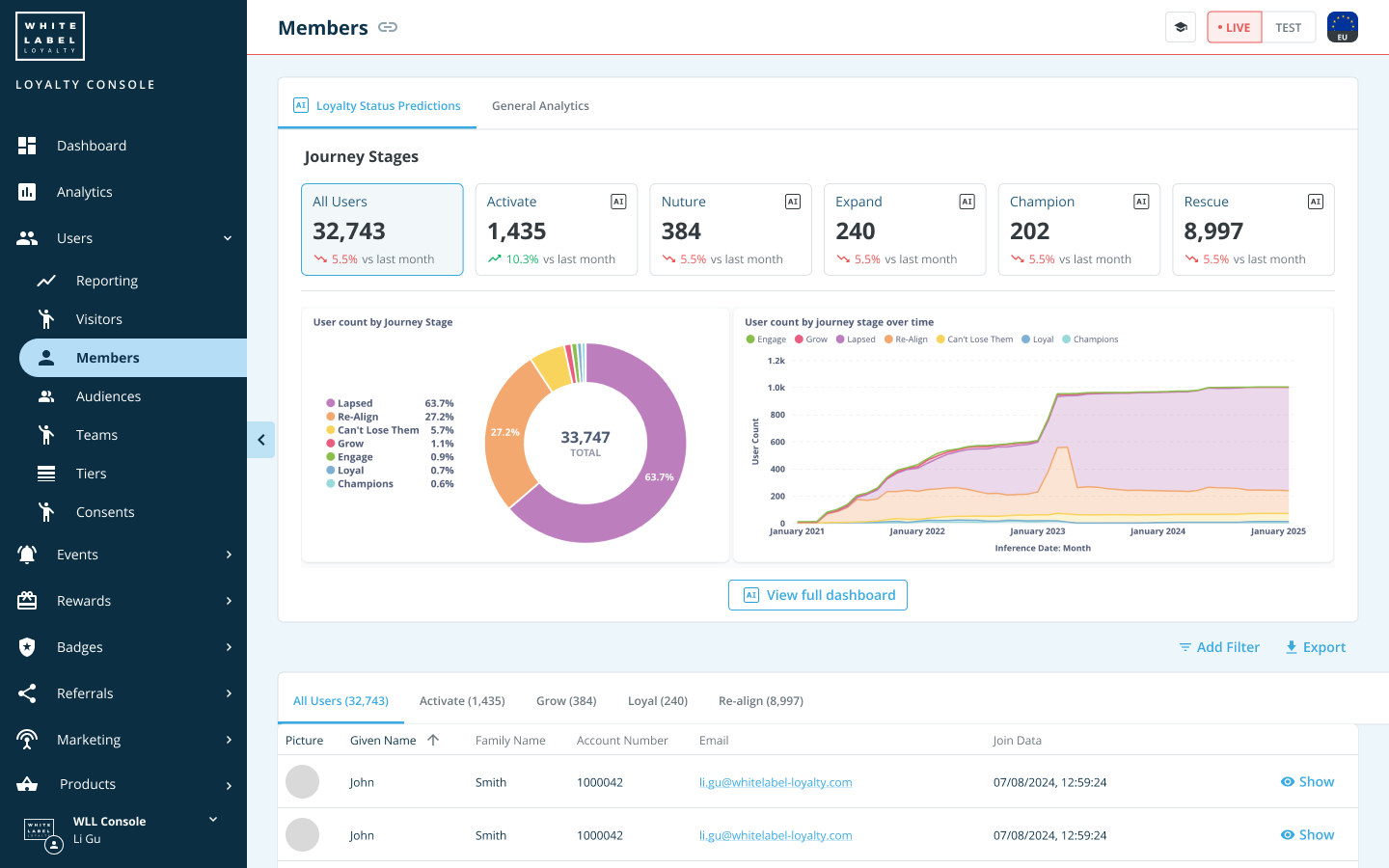
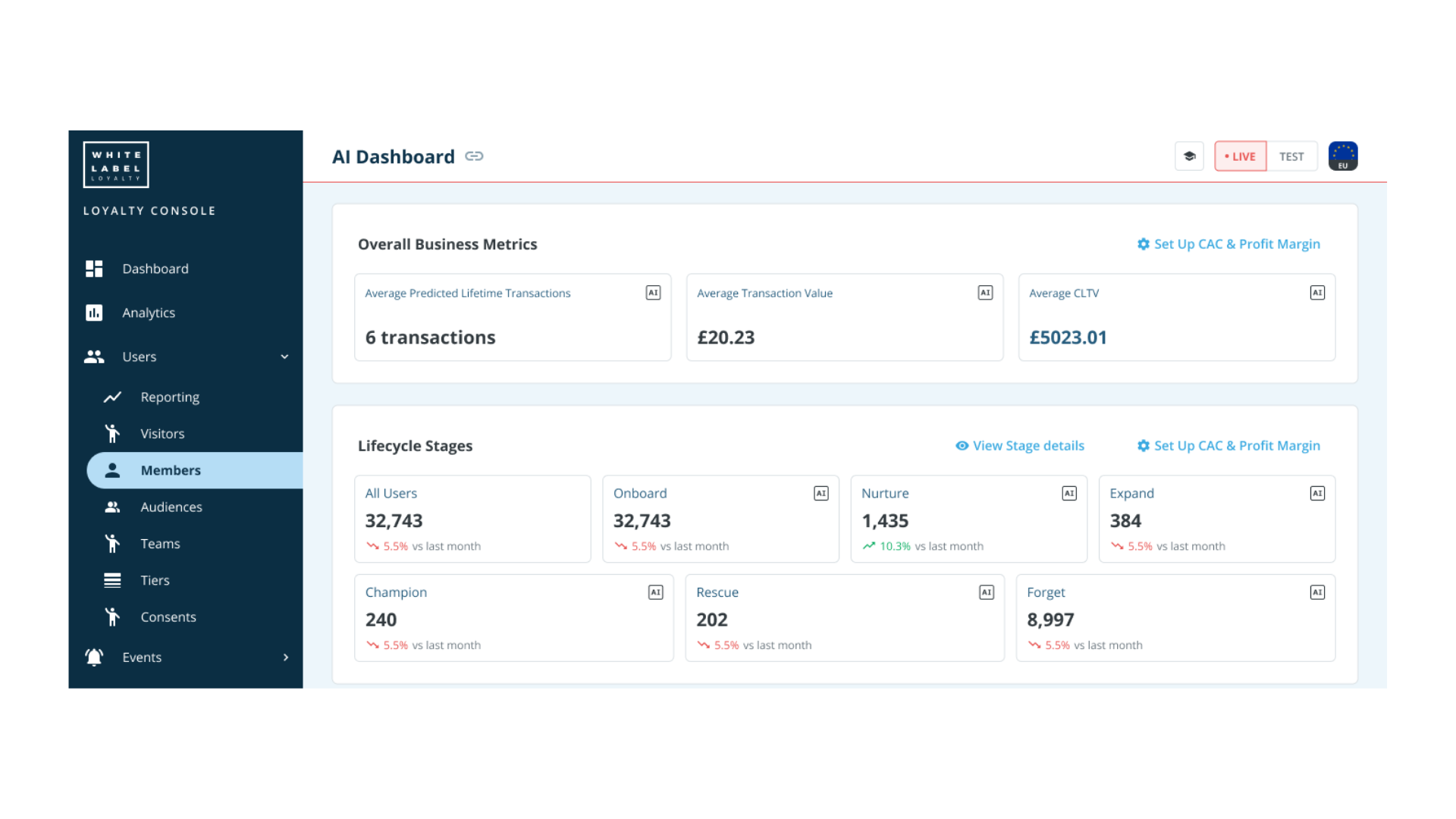
This is where White Label Loyalty’s Lifecycle Intelligence module shines. It automatically classifies each customer into one of six journey stages based on predicted lifetime value and churn probability:
Stage | Focus | Action |
| Activate | New users | Fast incentive to convert first purchase |
| Engage | Low-value, potentially lapsing | Limited incentives to avoid wasted spend |
| Grow | Active, profitable | Upsell and cross-sell campaigns |
| Champion | High-value, loyal | Low-cost engagement, referral campaigns |
| Rescue | High-value, at risk | High-value offers to recover revenue |
| Lapsed | Very low re-engagement probability | Likely write-off |
This approach turns complex behavioral data into actionable segments, even for brands without dedicated loyalty teams. By combining churn probability and CLTV, brands focus their retention budget on customers who deliver the best ROI, rather than scattering spend across low-value or loyal-but-non-profitable segments.
Example: A $10 incentive could retain a customer predicted to spend $200, creating a clear, profitable return on investment.
AI for customer retention: predict, prevent, personalize
We all know retention is cheaper than acquisition. But that only matters if you can actually spot the customers who are about to leave and do something about it in time.
That’s where AI for retention becomes powerful. Instead of reacting after revenue drops, the right tech helps brands see what’s coming next and act before it’s too late.
Here’s how.
1. Churn prediction
Customers rarely disappear overnight: they start visiting less often, spending a little less, and stop engaging with rewards or emails.
AI models pick up on these subtle shifts in behavior long before they show up in a monthly report. By analyzing transaction frequency, engagement patterns, and reward interactions, AI identifies customers with a rising churn probability.
That early warning gives brands something invaluable: time. Time to reach out, to incentivize, and to retain revenue and customer loyalty that we all would have considered lost.
2. Personalized incentives
Not every customer needs the same incentive, and treating all customer relationships the same can waste budget.
AI customer segmentation allows brands to tailor incentives based on where someone is in their journey, and this approach protects margin while increasing impact.
You’re not over-incentivizing loyal customers and you’re not under-investing in high-value customers who are drifting away.
That’s what smart, AI-driven retention looks like.
3. CLTV optimization
Customer Lifetime Value (CLTV) changes the retention conversation. Instead of asking, “How do we retain everyone?” you ask, “Where will retention drive the highest return?”
By predicting future CLTV, AI helps brands prioritize spend on customers with strong growth potential. Marketing efforts and budgets become more strategic, and incentives become more calculated.
The outcome of predicting customer behavior? Higher retention, better profitability, and smarter allocation of resources.
Why AI customer behavior analysis matters now
Several major industry shifts are reshaping how brands grow, and they all point toward the same conclusion: predictive, data-driven retention is now foundational to sustainable revenue.
Rising customer acquisition costs
Customer acquisition costs (CAC) continue to climb across industries. Paid media is more competitive, ad platforms are saturated, and performance volatility is higher than ever.
When acquisition becomes more expensive, retention becomes more valuable. Analyzing customer behavior allows brands to protect existing revenue, increase repeat purchases, and grow customer lifetime value and customer engagement, all without increasing acquisition spend.
Privacy changes limiting third-party tracking
With tighter data regulations and the decline of third-party cookies, brands can no longer rely on broad tracking and external data sources to understand customers.
This shift makes first-party behavioral data analysis (transactions, engagement, loyalty interactions) significantly more important.
AI models built on this data can generate predictive insights without depending on third-party signals, creating a more resilient and privacy-compliant growth strategy.
Increased competition for retention
Markets are saturated. In most industries, customers have multiple alternatives offering similar pricing and products. The competitive edge increasingly comes from experience, personalization, and relevance.
AI-driven customer segmentation enables brands to deliver timely, personalized incentives and engagement strategies that feel proactive rather than reactive. In a crowded market (which could be anything from e-Commerce to financial services industry), relevance drives retention.
Growing importance of first-party data
Brands that can transform their own behavioral data into predictive intelligence will outperform those relying solely on historical reporting.
AI customer behavior analysis turns raw first-party data into actionable insights into customer experience that you can actually use: who is likely to churn, who is ready to upgrade, and where retention investment will drive the highest ROI.
Common mistakes when using AI for customer retention
AI-powered tech for retention can be incredibly powerful, but only if it’s used properly. Even advanced teams sometimes miss the mark. Here are the most common mistakes:
1. Using AI as a reporting tool, not a decision engine: If AI only tells you what happened, you’re still reacting. It should guide real-time decisions: who to target, how to intervene, and where to invest the retention budget.
2. Ignoring valuable customer data: Transactional data alone isn’t enough. First-party and zero-party data strengthen AI customer behavior analysis and improve churn prediction accuracy.
3. Over-segmenting without action: AI customer segmentation can create endless micro-groups. But if there’s no clear campaign tied to a segment, it adds complexity without impact.
4. Disconnecting AI from loyalty execution: Predictive scores need to link directly to incentives, rewards, and loyalty mechanics. Insight without activation doesn’t drive retention.
5. Waiting too long to intervene: Churn builds gradually. The earlier you act, the lower the cost to retain the customer.
The right AI tools solve these challenges by turning predictive segmentation into clear, stage-specific actions, so AI insights translate directly into measurable retention and revenue.
AI customer segmentation vs traditional RFM Models
Traditional RFM segmentation groups customers based on past recency, frequency, and monetary value. While useful, it’s static and backward-looking.
AI customer segmentation goes further: it predicts future behavior, identifies non-linear behavioral patterns, updates dynamically as new data arrives, and incorporates engagement and loyalty signals beyond transactions
Where RFM tells you who was valuable, predictive analytics tells you who will be valuable and who needs intervention today.
The future of customer retention is predictive
The brands that win today and beyond won’t be the ones collecting the most data. They’ll be the ones using AI customer behavior analysis to predict what customers need before they ask and acting on it in real time.
Retention is now a predictive discipline powered by machine learning, first-party data, and intelligent segmentation.
In a market where acquisition costs are rising and privacy constraints are tightening, predictive retention is foundational to sustainable revenue growth.
Frequently Asked Questions (FAQs)
Recommended Posts
If you enjoyed this article, check out these relevant posts below.
Share this Article

Sara Rabolini
Content Marketing Executive
Sara is our Content Marketing Executive. She shares engaging and informative content, helping businesses stay up-to-date with the latest trends and best practices in loyalty...