Zero-Party Data Loyalty Programs: Guide for Marketers
The disappearance of third-party cookies has rewritten the rules of customer data, and loyalty programs are becoming the new engine of personalised marketing. As brands shift toward privacy-first strategies, zero-party data has emerged as one of the most valuable (and under-utilised) assets available.
But despite the growing emphasis on customer-provided data, most companies still aren’t ready for this shift. In a recent Forrester-derived study, 42% of organizations admitted they don’t know how to effectively use the zero-party data they collect.
This reveals a major gap: brands may be gathering high-value data, but they’re struggling to activate it in meaningful ways. This is where modern loyalty technology becomes essential: zero-party data is only powerful when it fuels relevance, personalisation, and better customer experiences.
Loyalty programs provide the structure, incentives, and interactions needed to turn raw customer insights into real business outcomes.
TL;DR: Zero-party data in loyalty programs
- Customer-declared data that is permission-based and privacy-safe.
- Highly accurate for facts (postcode, store, business size) and directional for self-identity (role, brand usage).
- Most powerful when layered with first-party data for a complete customer view.
- Loyalty programs provide incentives and engagement to collect and refresh data.
- Activating zero-party data drives personalisation, smarter segmentation, and higher ROI.
What is zero-party data
Zero-party data is information that a customer intentionally and proactively shares with a brand. Unlike first-party data, which is collected by observing customer behavior, zero-party data is explicit and volunteered directly by the user. It typically comes from:
- Preference centers
- Surveys and questionnaires
- Onboarding flows
- Interactive content like quizzes, product finders, or gamified experiences
- Personal profile inputs, such as motivations or purchase intentions
This type of data often includes a customer’s preferences, future purchase plans, lifestyle details, and personal context: insights that companies normally try to infer through analytics or tracking.
Because zero-party data comes straight from the customer, it is highly accurate, permission-based, and privacy-compliant, making it incredibly valuable in a world without third-party cookies. It enables brands to create deeply personalized, relevant customer experiences without guessing or relying on behavioral assumptions.
In short: zero-party data tells you exactly what the customer wants, rather than forcing you to guess.
Zero-party data vs first-party data vs third-party data
While zero-party data is often grouped under the umbrella of first-party data, the two are not the same, and the distinction matters more than ever in a privacy-first landscape.
Zero-party data is explicitly and intentionally shared by the customer. First-party data is observed behaviour, and third-party data is purchased or inferred from external sources.
Data type | How it’s collected | Examples | Privacy risk |
| Zero-party data | Proactively shared by the customer | Preferences, intentions, motivations | Very low |
| First-party data | Observed user behaviour | Purchases, app usage, clicks | Low |
| Third-party data | Bought or inferred from external sources | Demographics, interest profiles | High |
Zero-party data is the only category where consent, accuracy, and intent fully align. For loyalty programs, this makes it the most reliable foundation for personalisation, segmentation, and long-term customer trust.
Why zero-party data matters in loyalty programs
Zero-party data fits naturally within loyalty ecosystems because customers are already motivated to share information, when the value exchange is transparent.
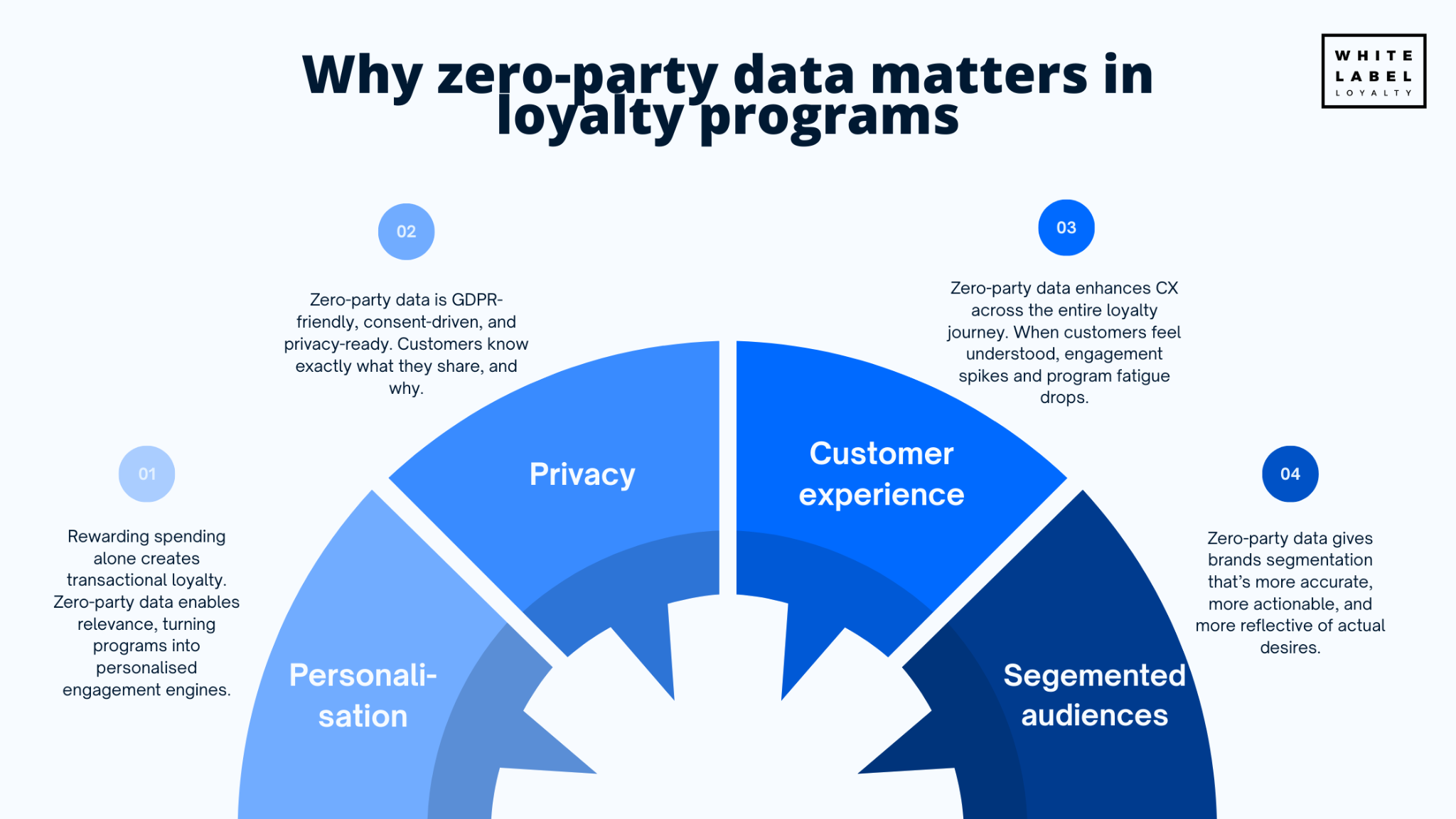
1. Next-level personalisation in customer loyalty
Rewarding spending alone creates transactional loyalty. Zero-party data enables relevance, turning programs into personalised engagement engines.
With WLL’s event-based loyalty engine, brands can trigger tailored experiences such as:
- personalised rewards
- targeted product recommendations
- custom challenges
- dynamic offers based on stated preferences
This creates emotional loyalty, not just transactional retention.
2. Strengthens trust and privacy compliance
Zero-party data is GDPR-friendly, consent-driven, and privacy-ready. Customers know exactly what they share, and why. This also future-proofs brands against cookie deprecation, ad targeting restrictions, and declining effectiveness of third-party data.
3. Improves the customer experience at every stage
Zero-party data enhances CX across the entire loyalty journey. When customers feel understood, engagement spikes and program fatigue drops.
Loyalty stage | Zero-party data impact |
| Onboarding | Creates smart flows based on personal interests |
| Engagement | Powers contextual rewards and challenges |
| Conversion | Shows only high-intent offers |
| Retention | Builds emotional loyalty through relevance |
| Advocacy | Helps identify superfans and high-value segments |
4. Hyper-accurate audience segments based on consumer data
Zero-party data gives brands segmentation that’s more accurate, more actionable, and more reflective of actual desires. With WLL’s segmentation tools, brands can create micro-audiences such as:
- “High spenders who prefer eco-friendly products”
- “Users who want experiences, not discounts”
- “Parents interested in family bundles”
This granularity drives ROI across loyalty, CRM, and paid media. Zero-party data provides clarity on what customers say they want, while first-party data reveals what they actually do.
When these signals align, confidence in targeting increases; when they diverge, brands gain insight into unmet needs, adjacent interests, or evolving customer intent.
The reality of zero-party data: accuracy, context, and decay
Zero-party data is one of the most valuable inputs a loyalty program can collect, but it works best when treated with nuance.
In practice, brands see a clear difference between objective truths and self-perception. Data points such as postcode, preferred store, or business size tend to be highly accurate because they are factual and easy for customers to verify.
These attributes are especially effective for regional targeting, store-level campaigns, and operational segmentation.
More subjective inputs, such as profession, type of business, or brand usage, still provide critical context, but they reflect how customers define themselves, not always how they behave in reality.
For example, a B2B loyalty program may ask members to self-identify their trade or area of expertise. While this data is directionally correct, purchase behaviour often reveals crossover needs that don’t fit neatly into a single category.
From our experience with B2B brands, we know a customer who identifies as a floor layer may still purchase tiling products occasionally, indicating a broader commercial profile than their declared role suggests.
This is where loyalty programs create real value. Zero-party data captures intent and preference, while first-party data validates and enriches it through behaviour. When combined, brands gain a more complete, realistic view of the customer, enabling smarter segmentation without forcing users into rigid labels.
Want more actionable insights? Download our 10 Insights from 10 Years of Loyalty guide and learn how top brands use customer data to drive engagement, personalisation, and ROI.
Zero-party data loyalty use cases by industry
Zero-party data becomes exponentially more powerful when applied within industry-specific loyalty strategies. Below are some of the most common and effective use cases.
Retail & eCommerce loyalty programs
Retail and eCommerce brands can collect zero-party data such as product and brand preferences, size, style, or fit information, sustainability or ethical values, and purchase timing intent.
This enables highly personalised rewards, smarter recommendations, and relevant incentives without relying on behavioural guesswork.
FMCG & QSR loyalty programs
In fast-moving consumer goods and quick-service restaurants, zero-party data often includes taste preferences, dietary requirements, occasion-based intent (breakfast, family meals, on-the-go).
Loyalty programs can then deliver menu personalisation, localised offers, and frequency-based rewards that feel timely and relevant.
Hospitality & travel loyalty programs
Hospitality brands use zero-party data to understand travel motivations (leisure vs business), room or service preferences, and experience vs price sensitivity.
This allows loyalty programs to move beyond points and deliver personalised upgrades, curated experiences, and tailored tier benefits.
B2B & SaaS loyalty programs
Some loyalty programs use zero-party data such as postcode and preferred stockist to power highly localised campaigns. This allows brands to promote store-specific offers, regional promotions, or in-person events that feel immediately relevant to the customer.
Because this data is explicitly provided, it offers a privacy-safe alternative to passive location tracking, while still enabling meaningful geographic personalisation. When layered with engagement or purchase data, regional campaigns can be optimised further based on real customer response.
How to collect zero-party data inside a loyalty program
The most effective way to collect zero-party data is to build a clear value exchange: customers share information, and in return they get better experiences, more relevant rewards, and more control.
Here’s how leading loyalty programs typically achieve this:
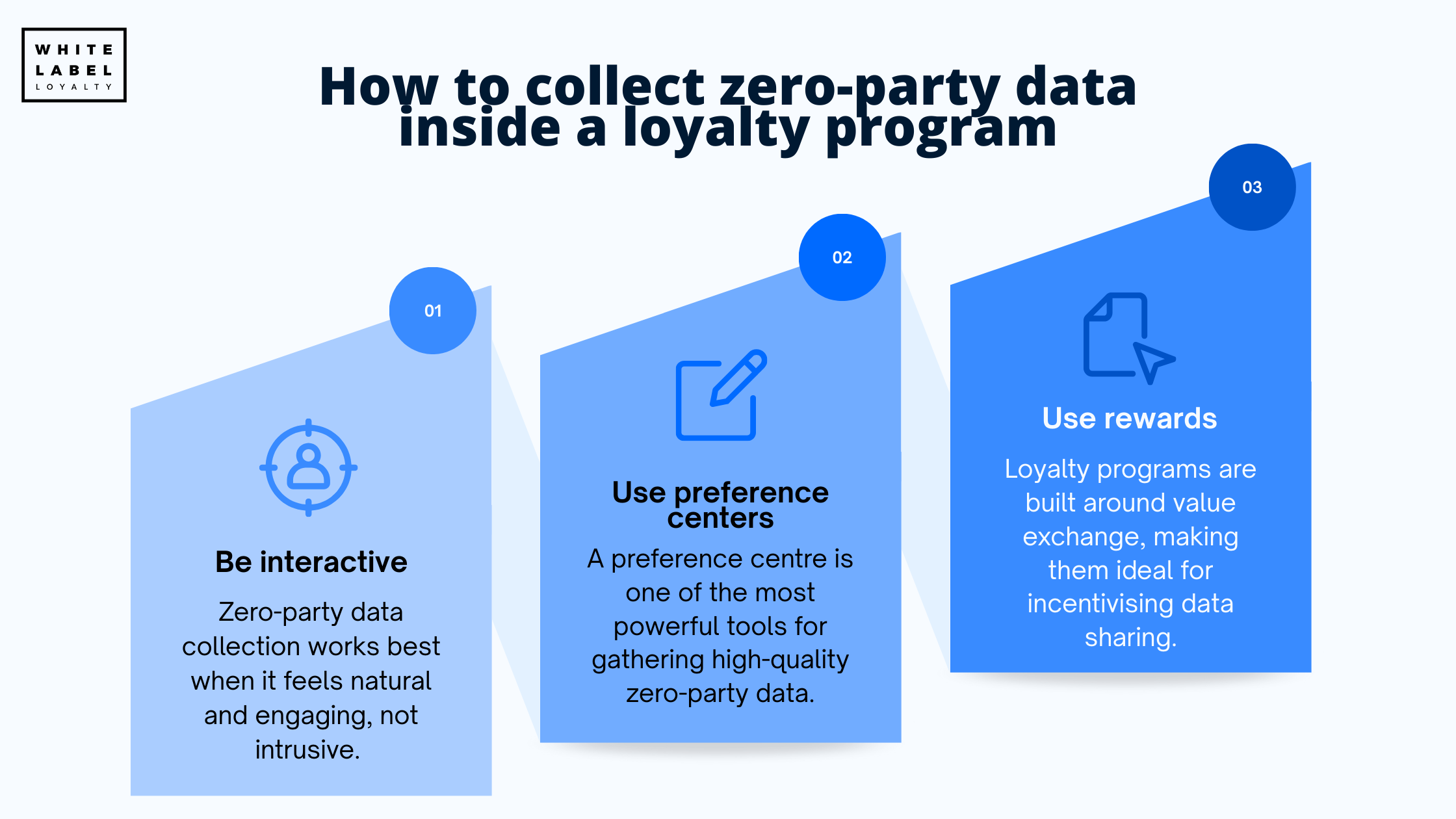
1. Use interactive mechanics as data strategy
Zero-party data collection works best when it feels natural and engaging, not intrusive. Modern loyalty programs increasingly use interactive elements such as: gamified challenges, polls and quizzes, digital treasure hunts, and "choose your reward” experiences.
These formats give customers instant value (points, rewards, or personalised insights), which makes people far more willing to participate.
Why it works: customers enjoy the interaction and feel in control of what they share.
2. Preference centres customers can control
A preference centre is one of the most powerful tools for gathering high-quality zero-party data.
Inside a loyalty program, this can include preferred product categories, favourite stores or locations, dietary or lifestyle choices, communication preferences, and notification frequency.
Because customers proactively choose what they share and can update it at any time, the data remains accurate and trustworthy: something behavioural data alone can’t provide.
Why it works: transparency builds trust, and self-managed data stays fresh.
3. Reward customers for sharing their data
Zero-party data is a currency, and loyalty programs are built around value exchange, making them ideal for incentivising data sharing.
Brands can offer:
- Bonus points for completing surveys or quizzes
- Exclusive access to products, drops, or events
- Personalised offers based on preferences
- Early access or VIP perks for more complete profiles
When customers understand the benefit, they’re more willing to share high-quality information that improves their own experience.
For example, a convenience retailer may invite members to select favourite product categories, such as baby, pet, or grocery, in exchange for bonus points. On its own, this zero-party data signals intent. When combined with purchase behaviour, it becomes far more powerful.
Brands can then identify high-potential opportunities, such as customers who declare interest in baby products but have never purchased a leading brand, and trigger targeted incentives like a personalised discount or bonus points offer. This approach increases relevance without relying on assumptions or intrusive tracking.
Frequently Asked Questions (FAQs)
Conclusion
As third-party cookies disappear and privacy expectations rise, asking customers directly and rewarding them for sharing is now a competitive advantage.
However, the real power of zero-party data doesn’t come from collecting more of it. It comes from collecting the right data, keeping it fresh, and combining it with behavioural insight to reflect how customers actually engage over time.
Loyalty programs provide the ideal framework for this approach. They create a clear value exchange, encourage ongoing interaction, and turn customer-provided insights into personalised experiences that feel relevant, respectful, and rewarding.
Get in touch with one of our loyalty experts now!
Recommended Posts
If you enjoyed this article, check out these relevant posts below.
Share this Article

Sara Rabolini
Content Marketing Executive
Sara is our Content Marketing Executive. She shares engaging and informative content, helping businesses stay up-to-date with the latest trends and best practices in loyalty...