How to Identify Loyal Customers: Key Signs to Look For
Every business wants loyal customers: they’re the ones who return time after time, spend more, and bring their friends with them. But identifying true loyalty goes beyond tracking repeat purchases: it’s about understanding behavior, emotion, and advocacy.
This guide is for marketers and customer experience professionals who want to identify and nurture loyal customers for long-term growth, because understanding customer loyalty is essential for building sustainable success and maximising customer lifetime value.
In this article, we’ll explain the key signs that show a customer is genuinely loyal, how to measure customer loyalty, and how modern loyalty platforms make it easier to identify and nurture your best customers.
TL;DR: Key signs of a loyal customer
A loyal customer is someone who consistently chooses your brand over competitors, increases their value over time, engages across multiple channels, and often recommends your brand to others.
Identifying loyal customers means analysing behavioural patterns, spending trends, engagement signals, and advocacy indicators rather than relying on purchase frequency alone.
Loyal customers with a high brand loyalty show:
- Repeat purchases and increasing spend
- Low price sensitivity
- High engagement with emails, apps, and loyalty programs
- Emotional attachment to your brand
- Advocacy behaviors like referrals, reviews, sharing a positive word, and recommendations
- Consistent interaction across multiple channels
Businesses can identify loyal customers using loyalty metrics like Repeat Purchase Rate, Customer Lifetime Value (CLV), Customer Retention Rate, referrals, customer effort score, Net Promoter Score (NPS), and engagement analytics.
If all of these terms feel a bit overwhelming, check out our blog post about key metrics for a clear, jargon-free explanation.
Why identifying loyal customers matters
Loyal existing customers are the foundation of sustainable growth. Studies show that the top 20% of customers can generate up to 70% of a company’s revenue. They’re also 5–10x cheaper to retain than acquiring new ones, but only if you know who they are.
By identifying loyal customers early, you can:
- Reward and retain your most valuable segments.
- Understand what drives brand loyalty across your audience.
- Predict churn before it happens.
- Build stronger, more emotional relationships with your customers.
And with a loyalty platform that unifies your customer data, these insights become measurable and actionable.
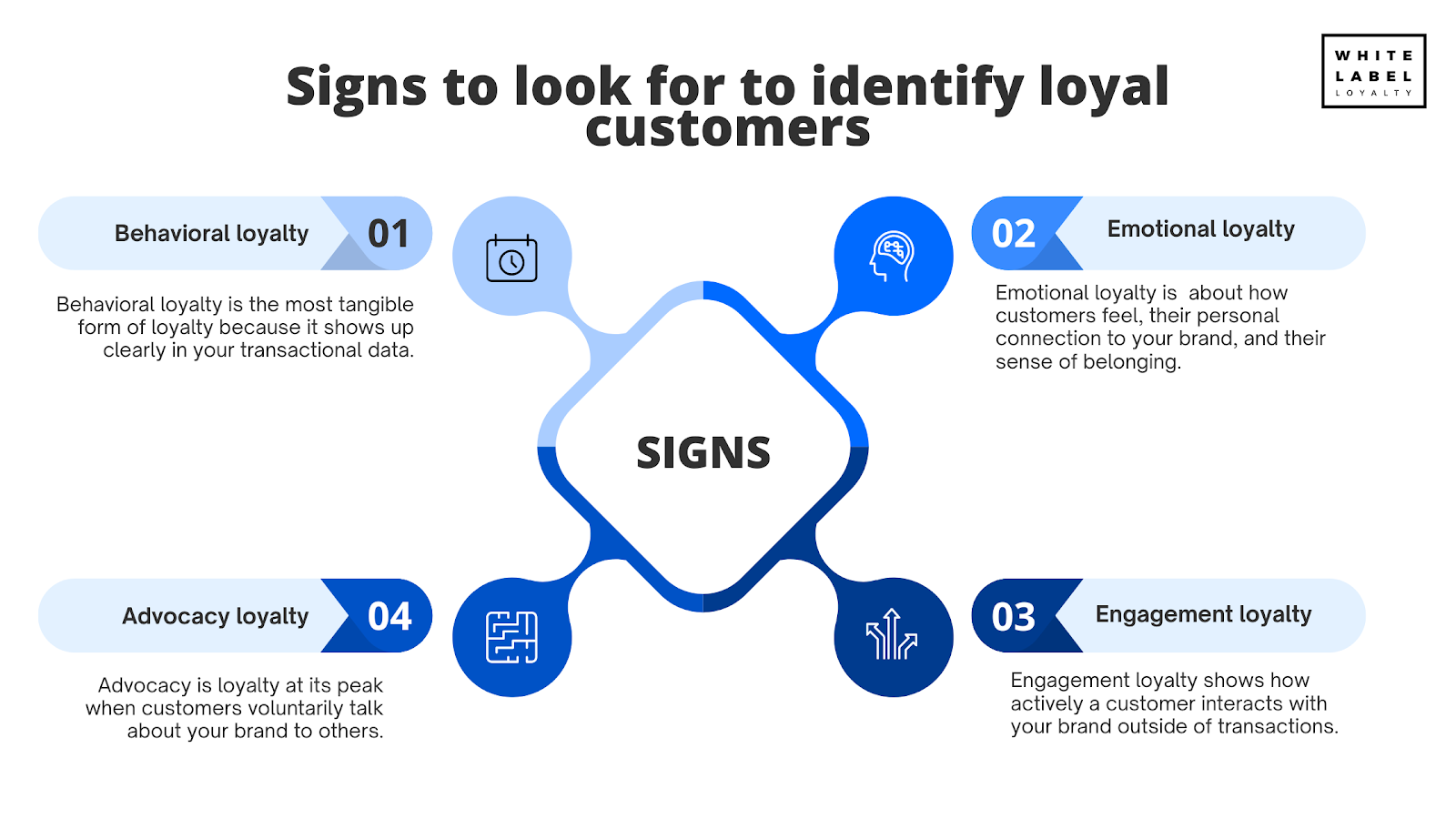
Four signs to look out for to identify loyal customers
Some customers come back regularly but feel no real attachment, while others may buy less often yet actively advocate for your brand. To identify true loyalty, you need to look at a combination of signals: how customers behave, engage, and speak about your brand over time.
These four signs help you spot customers who aren’t just returning, but genuinely committed to your brand.
1. Customer behavior
Behavioral loyalty is the most tangible form of loyalty because it shows up clearly in your transactional data. It’s the pattern of what customers do: how often they buy, what they buy, and how their habits evolve over time.
When customers repeatedly choose your brand over others, even in routine situations, you’re seeing the early foundation of genuine loyalty.
Signs of behavioral loyalty
Customers demonstrating behavioral loyalty often show:
- Repeat purchases at consistent intervals: a reliable cadence that indicates habit and satisfaction.
- A rising AOV (Average Order Value) as trust grows and customers feel comfortable buying more.
- Cross-buying across categories: a strong signal that they see value in your wider offering, not just a single product.
- Long customer lifespan and strong retention, showing they’re sticking with you for reasons beyond promotions.
Key metrics to track
To quantify these behaviors, focus on metrics like how many customers come back after the first purchase (Repeat Purchase Rate), Customer Lifetime Value, the Average Order Value, and retention vs. churn rate.
A unified loyalty platform automates the tracking of these metrics and highlights which customer segments drive the most value, and which ones may need timely re-engagement.
2. Emotional loyalty
Emotional loyalty is less visible, but far more impactful. It’s about how customers feel, their personal connection to your brand, their belief in your values, and their sense of belonging. When emotional loyalty is strong, customers stay not because they need to, but because they want to.
Signs of emotional loyalty and customer satisfaction
Emotional loyalty often shows up through:
- Alignment with your brand values, culture, or mission.
- Positive sentiment and satisfaction that goes beyond simple product performance.
- Deep interest in your brand story, vision, or behind-the-scenes content.
- Proactive feedback, not complaints: customers genuinely trying to help you improve.
- Resilience to competitor discounts, staying with your brand even when alternatives are cheaper.
Advanced loyalty analytics (sentiment analysis, engagement scoring, and voice-of-customer insights) help you understand these emotional triggers at scale.
3. Advocacy loyalty
Advocacy is loyalty at its peak when customers voluntarily talk about your brand to others. Advocates amplify your reach and credibility in ways no ad budget can replicate. Their motivation isn’t transactional; it’s rooted in genuine satisfaction and trust.
Signs of advocacy loyalty
Advocacy tends to look like:
- A high NPS (Net Promoter Score): customers confidently recommending you.
- Consistent referrals that drive new customers.
- Testimonials, UGC, and positive reviews, often unsolicited.
- Social mentions or even defending your brand online from criticism.
A modern loyalty platform can reward these advocacy behaviors automatically (awarding points for referrals, social shares, customer interactions, or reviews), turning promoters into partners.
4. Engagement loyalty
Engagement loyalty shows how actively a customer interacts with your brand outside of transactions. It captures interest, curiosity, and intent, all of which are essential for long-term loyalty.
Signs of engagement loyalty
Engaged enthusiastic customers often:
- Log in frequently to your app or website.
- Take part in gamified challenges, tier progressions, or points-earning activities.
- Open, click, or reply to your campaigns, especially personalised ones.
- Try new products early, showing trust in your innovation.
- Consume content, browse FAQs, or participate in communities, behaviors that indicate a deeper relationship.
These engagement signals give you early visibility into who is building loyalty and who may be drifting toward churn.
How to measure loyalty effectively
Tracking loyalty across all these dimensions is complex if your data is scattered. A modern loyalty platform solves this by centralising customer information and automating insights.
With a unified system, you can:
- Build rich customer profiles that combine behavioral, emotional, and engagement data.
- Automate loyalty analytics rather than manually pulling reports.
- Reward behaviors instantly, closing the loop between insight and action.
- Predict churn using machine learning models.
- Deliver personalised experiences based on loyalty stage or lifecycle.
- Sync data with CRM and marketing automation tools.
- Identify high-value, emerging, and at-risk segments in real time.
Without this consolidation, loyalty signals remain siloed and nearly impossible to act on. With it, your loyalty strategy becomes proactive, precise, and scalable.
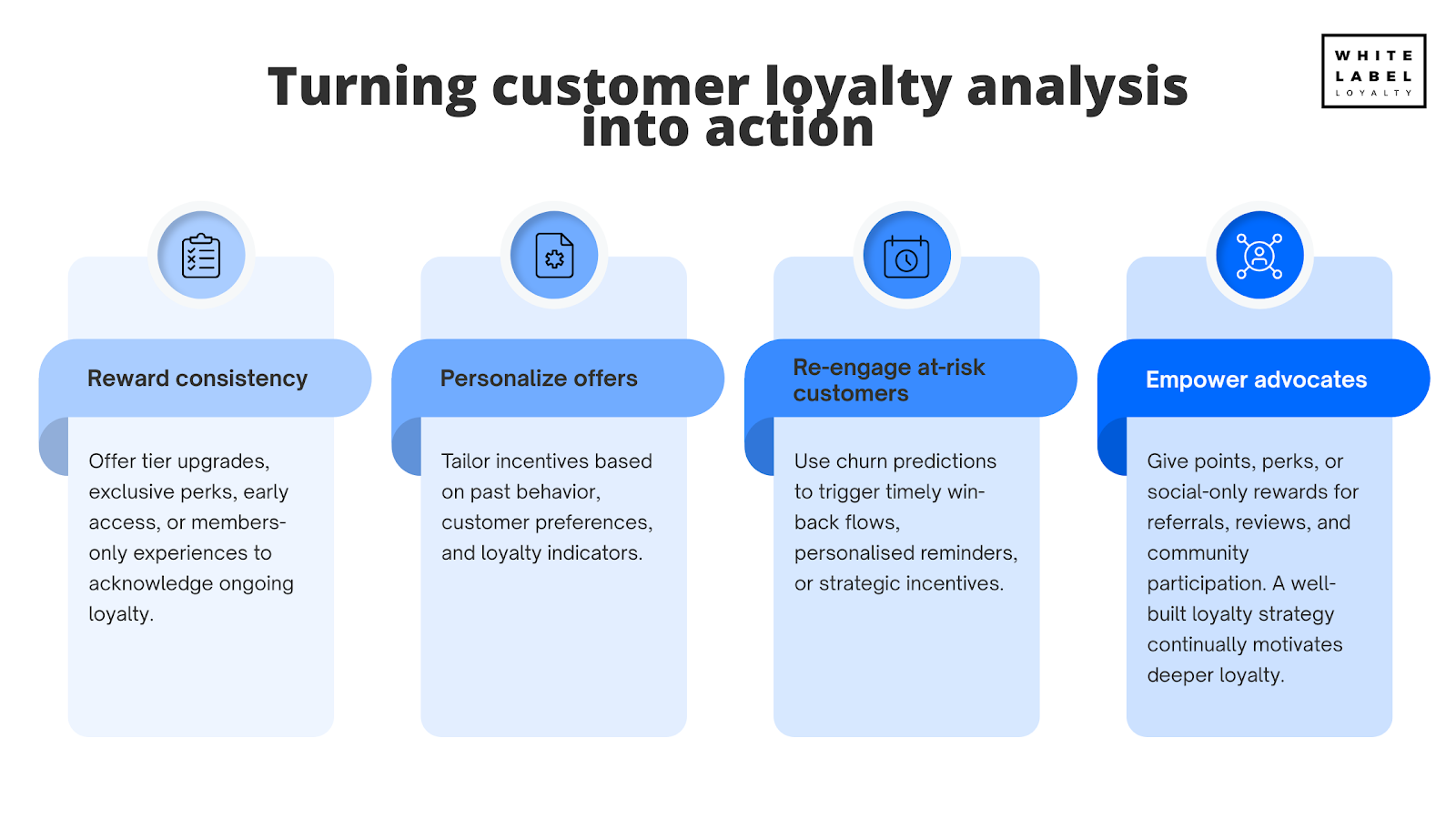
Turning customer loyalty analysis into action
Once you understand who your loyal customers are and you gather all the customer loyalty analytics you need, you can shape experiences that deepen their connection and maximize value. Here’s what effective brands do:
- Reward consistency: offer tier upgrades, exclusive perks, early access, or members-only experiences to acknowledge ongoing loyalty.
- Personalize offers: tailor incentives based on past behavior, customer preferences, and loyalty indicators.
- Re-engage at-risk customers: use churn predictions to trigger timely win-back flows, personalised reminders, or strategic incentives.
- Empower advocates: give points, perks, or social-only rewards for referrals, reviews, and community participation. A well-built loyalty strategy continually motivates deeper loyalty.
Turning visitors into loyal members
A customer can’t become loyal if they never enter your loyalty ecosystem, and the signup moment is the most important step. Increasing customer loyalty program enrollment requires a mix of psychology, convenience, and well-placed incentives.
Simplify the signup process
Remove friction wherever possible using short forms, fewer steps overall, and single sign-on options. Anything that makes joining effortless increases conversion and makes for satisfied customers.
Offer immediate value and clear benefits
Customers sign up when the reward is instant and obvious. Examples include welcome points, first-purchase discounts, and unlocking exclusive content or perks. The key to improve this customer experience is to show value right away, not “someday.”
Promote your program across multiple touchpoints
Visibility drives adoption. Highlight your program on on-site banners, pop-ups, email signatures, social media, checkout pages, and in-store signage. Where customers see it matters as much as how often they see it.
Use gamification and social proof
Psychology significantly boosts participation, so use progress bars, tiers and badges, “10,000 members already joined!”, leaderboards and challenges to make signups feel rewarding and credible. Encouraging customers to share their experiences and customer feedback on social media is another great way to increase customer engagement.
Frequently Asked Questions (FAQs)
Conclusion
When you start looking beyond transactions and into behaviours, attitudes, and tiny signals (the repeat visits, the forgiving moments, the willingness to engage), you begin to see who’s truly in your corner.
And once you know who those people are, it becomes much easier to serve them better, reward them meaningfully, and build a relationship that actually lasts.
If your business wants more loyalty, this is where it starts: by recognising it when you see it.
Recommended Posts
If you enjoyed this article, check out these relevant posts below.
Share this Article

Sara Rabolini
Content Marketing Executive
Sara is our Content Marketing Executive. She shares engaging and informative content, helping businesses stay up-to-date with the latest trends and best practices in loyalty...